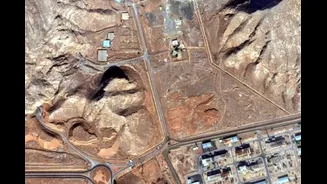









Satellite images show that Iran has been actively strengthening and concealing several sensitive military and nuclear facilities, experts say, following two separate airstrikes—one by Israel in October
2024 and another joint strike by the United States and Israel in June last year.
The developments come amid ongoing tensions with Washington, which is seeking a nuclear deal with Tehran while warning of possible military action if negotiations fail.
Satellite images reveal how Iran is preparing for a possible collapse of negotiations with the United States.
Amid reports of potential American military action, satellite imagery shows Iran restoring military and nuclear sites damaged in previous conflicts, including Parchin,… pic.twitter.com/OpwZAdnFzM
— Israel News Pulse (@israelnewspulse) February 18, 2026
According to a report by Reuters, the images show that Iran has built a concrete shield over a new facility at a sensitive military site and covered it with soil, effectively hiding it from view.
The country has also buried tunnel entrances at a nuclear site hit during the US-Israel strike in June last year, reinforced tunnel entrances near Natanz, and repaired missile bases damaged in the conflicts.
ALSO READ: US, Israel Could Launch Major Military Operation Against Iran ‘Very Soon’: Report
Parchin Military Complex
Located about 30 km southeast of Tehran, the Parchin complex is one of Iran’s most sensitive military sites. Israel reportedly struck it in October 2024. Satellite imagery taken since the attack shows extensive reconstruction, including a new structure now fully concealed by a concrete and soil “sarcophagus,” experts say.
Stalling the negotiations has its benefits:
Over the last two to three weeks, Iran has been busy burying the new Taleghan 2 facility at the Parchin military complex with soil. Once the concrete sarcophagus around the facility was hardened, Iran did not hesitate to move soil over… pic.twitter.com/AowjWFFd92— David Albright (@DAVIDHALBRIGHT1) February 17, 2026
David Albright, founder of the Institute for Science and International Security (ISIS), said on X that the burial of the facility provides “significant protection from aerial strikes.”
William Goodhind, a forensic imagery analyst, noted that the roof has been covered with soil to “obscure the concrete colour”.
Isfahan Nuclear Complex
The Isfahan enrichment site, also targeted in the June 2025 joint US-Israel strike, has seen all tunnel entrances completely backfilled with soil. ISIS said this would help reduce the risk of airstrikes and complicate ground operations to seize highly enriched uranium.
Natanz Tunnel Entrances
Satellite images show ongoing reinforcement of tunnel entrances under a mountain near Natanz, involving heavy machinery. ISIS said the work appears aimed at strengthening the site against possible strikes.
Shiraz South Missile Base
About 10 km south of Shiraz, this base is one of Iran’s 25 primary sites capable of launching medium-range ballistic missiles.
Satellite images show reconstruction and clearance efforts at the main logistics and likely command compound, though the site has not yet returned to full operational capacity.
“The key takeaway is that the compound has yet to return to its full operational capacity from prior to the airstrikes,” Goodhind added.
Qom Missile Base
Some 40 km north of Qom, this base suffered moderate damage during the June strikes. Imagery shows a new roof installed over a damaged building, with repairs likely completed in late November 2025.
(With inputs from Reuters)