






If the International Space Station is in low Earth orbit, just a touch over 400km away from the beings on Earth, why do astronauts aboard the home away from home appear to float? In fact, a peek at the videos
of astronauts hopping on moon, and you must have noticed that they don’t just fly away or do backflips as they are seen gliding around on the ISS. So do they attain some special magical powers at a small distance away from Earth or does physics come into play for this seemingly otherworldly phenomenon? As much as we would have liked it to be the former, it’s the latter where the answer lies.
But first, let’s get through some interesting facts about the International Space Station.
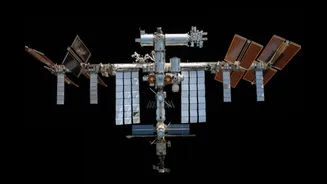
Distance From Earth: About 250 miles or 400km.
Speed: ISS zooms around Earth at 28,000 kmph.
One Lap: ISS takes 90 minutes to complete one lap or orbit of Earth. This means astronauts watch 16 sunrises and sunsets in a single day.
“No Gravity”: Astronauts experience zero-g or weightlessness. The human beings aboard the ISS grow a bit taller over time as their spines are not squished in the absence of gravity. They return to their usual height once they are back on Earth.
Why Does It Take Almost 4 Hours To Reach ISS? “The ISS moves at a speed of roughly 7.7 km/s or 17’000 mph. It’s not getting up there that’s hard, it’s catching up to that speed,” a Reddit user, answering this question on ELI5 Subreddit, wrote. Another used an analogy of a highway. “In other words, if you stand 10 feet from a highway, (successfully) catching up to a car requires more effort than just running 10 feet.”
Size: ISS is the biggest object made by humans in space and has been continuously inhabited since November 2000. In fact, the solar array wingspan (356 feet, 109 meters) is longer than the A380, the world’s largest passenger aircraft. Peggy Whitson has spent 665 days living and working in space.
“Astronauts Feel Weightless Because…”
Shubhanshu Shukla, India’s first astronaut to visit the International Space Station (ISS) on the Axiom-4 mission, experienced the life on ISS and answered the feeling of weightlessness that astronauts experience 400km away from Earth.
“Astronauts don’t feel weightless because gravity has disappeared—gravity up here is still about 90 per cent as strong as at Earth’s surface. We feel weightless because we and everything around us are constantly falling together. Floating in space is really just falling—forever,” Shukla wrote on X.
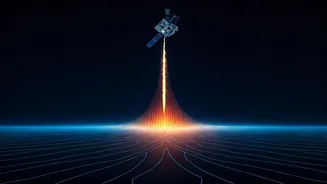
In layman’s terms, everything on the ISS is constantly falling towards Earth. But ISS’s incredible speed of 28,000 kmph makes it fall around the curve of Earth, making everything weightless relative to the station.
“Why Nothing Falls On ISS?”
“Nothing actually falls away in orbit. As you see in this video, if I let go of the lens, it doesn’t drop—it hovers. Why? Because both the lens and I are falling at the same speed around Earth. No relative falling = no ‘down,’” Shukla wrote. He also connected this to Isaac Newton’s famous thought experiment: toss a ball from a high mountain.
“Toss it gently—it arcs down nearby. Throw harder—it travels farther before dropping. Throw it so fast that as it falls, Earth’s surface curves away beneath it? The rate of drop matches the curvature of the Earth. Congratulations—you’ve just put that ball in orbit. It’s falling forever, but it never hits the ground,” the post stated.
Goodbye In 2030: NASA is planning to deorbit and decommission the ISS in 2030. The station will make a huge splash in the Pacific Ocean.
If you wish to do a deep dive on ISS, here’s NASA‘s detailed explanation of humanity’s astonishing achievement.