



The Union Home Ministry issued fresh guidelines on ‘Vande Mataram’ on Wednesday, once again bringing into the limelight the national song that has been the bone of contention between the ruling government
and the opposition Congress since late last year.
The new rules say the national song must be sung before the national anthem at all government events and schools, with everyone standing in attention while it is played. The most crucial aspect, however, is that the full six-stanza version of the song, including the four stanzas that had been historically excluded by the Congress from official use, must be played or sung.
Apart from this, when both the national song and Jana Gana Mana are performed at the same event, Vande Mataram must be played first. Schools across India are directed to include the national song in assemblies and promote respect for national symbols. The song is to be played at state functions, civilian award ceremonies, flag hoisting events, and during arrivals and departures of the President and Governors at formal events. The guidelines do not apply to movie theatre screenings—audiences are not required to stand if the song is played as part of a film or documentary, where standing could disrupt viewing.
The MHA’s latest directive assumes significance, given the contentious history of the song and what it has come to stand for. News18 takes a look at India’s national song, why it was truncated and what the latest row is all about:
History Of Vande Mataram
Originally written by Bankim Chandra Chattopadhyay in highly Sanskritised Bengali, Vande Mataram was composed in the 1870s and published in Anandamath (1882), a novel set during the Sannyasi Rebellion.
Soon, the song moved beyond literature and became a rallying cry in India’s freedom struggle. It was first sung at an Indian National Congress session in 1896 by Rabindranath Tagore. British authorities later viewed it as politically charged and, in some cases, restricted its public singing because it inspired nationalist sentiment.
Before Independence, some Muslim leaders raised concerns about certain later stanzas that personify the nation as Hindu goddesses such as Durga and Lakshmi. In 1937, the Indian National Congress decided that only the first two stanzas would be used for official purposes because they focus on the motherland’s natural beauty and are less religious in imagery.
On January 24, 1950, the Constituent Assembly of India gave Vande Mataram the status of national song, while Jana Gana Mana became the national anthem. The first two stanzas were officially recognised for ceremonial use.
Vande Mataram, which literally translates to “I bow to thee, Mother”—the mother here representing the motherland—consists of six stanzas and here’s what each of them signifies:
Stanza 1
“Vande Mataram” — I bow to thee, Mother.
The motherland is described as rich with flowing water, laden with fruits, cool with gentle winds, and green with crops. This means India is portrayed as fertile, nurturing, and life-giving.
Stanza 2
The land is described as smiling and sweet-speaking, bliss-giving and blessing-bearing, which means the motherland is not just physically beautiful but emotionally and spiritually comforting.
Stanza 3
The mother is described as powerful, protector of millions and destroyer of enemies. This means India is seen as strong and capable of defending her people.
Stanza 4
The nation is equated with Durga (goddess of strength), Lakshmi (goddess of prosperity), and Saraswati (goddess of wisdom), which means the country is symbolised through divine feminine power—blending spirituality with patriotism.
Stanza 5
The mother is described as a source of knowledge, source of faith, and source of devotion. Hence, the land shapes the identity, culture, and spiritual life of its people.
Stanza 6
A final affirmation of devotion is when the speaker pledges loyalty and reverence to the motherland, ending the song as a patriotic vow of dedication.
What Was The Core Objection?
The full song (six stanzas) personifies India as a goddess, often invoking Hindu deities such as Durga, Lakshmi, and Saraswati. For instance, lines like “Thou art Durga, Lady and Queen” associate the motherland with divine Hindu figures.
During the time, Muslim leaders and communities felt this could make singing the full song religiously uncomfortable or exclusive, especially in a diverse country like India.
Critics argued that enforcing the full song at schools, government functions, or public events could alienate minorities, especially Muslims and Christians. Since nationalism was tied to colonial resistance, some feared that national symbols should not favour a single religion.
Another key reason was the context in which the song was used in the Anandamath novel, which, critics say, pits Hindus against Muslims and not the British colonial power.
Congress In A Fix, Tagore Suggests Middle Path
Rabindranath Tagore, who was a close contemporary of Bankim Chandra Chattopadhyay, admired Vande Mataram as a powerful patriotic song and acknowledged its role in inspiring Indians during the freedom struggle, recognising its emotional and cultural impact. In fact, much before it became a part of the movement, Tagore was the one who set the song to tune, sang it, and performed it at a Congress event in Kolkata in 1896.
However, despite appreciating its spirit, Tagore had reservations about enforcing the hymn as a compulsory national song. He was concerned that the religious imagery in the later stanzas (associating India with Hindu goddesses) might alienate minority communities. In his writings and letters, Tagore emphasised that nationalism should not conflict with humanity or spiritual universality. For him, patriotism should be inclusive and not tied to sectarian symbols.
In 1937, when the Congress faced a dilemma over the singing of Vande Mataram at the party session in Kolkata, senior leaders such as Jawahar Lal Nehru and Subhas Chandra Bose approached Tagore for his opinion.
According to an article in Outlook, Tagore wrote to Nehru, explaining that the spirit of tenderness and devotion conveyed in the first portion of Vande Mataram (the first two stanzas) and its focus on the beautiful and beneficent aspects of our motherland appealed to him so strongly that he had no difficulty in separating it from the remainder of the poem and from the novel itself.
He clarified that, apart from the exceptional quality of these opening stanzas, he would not have felt any particular sympathy or sentiment for the text, having been raised in the monotheistic Brahmo ideals. Addressing concerns from the Muslim community, he stated that he fully acknowledges that the entire poem, when read in its original context, “is liable to be interpreted in ways that might wound Moslem susceptibilities.” Nevertheless, he argued, the first two stanzas need not be seen as a constant reminder of the whole poem, or of the story (Anandamath) with which they happened to be associated.
Choosing a pluralistic approach, Tagore emphasised that the first two stanzas “acquired a separate individuality and an inspiring significance of its own in which I see nothing to offend any sect or community.” It was on this understanding that the Congress adopted the compromise formula, officially recognising only the first two stanzas as the national song.
Debate Returns To Parliament
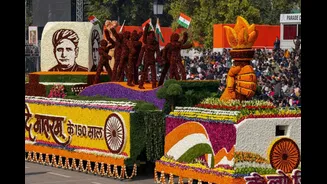
As the country marked the 150th anniversary of Vande Mataram, both the ruling Bharatiya Janata Party (BJP) government and the opposition Congress traded barbs in Parliament and on public forums.
In November last year, Prime Minister Narendra Modi alleged that the dropping of “crucial verses of Vande Mataram” meant the severing of a part of its soul which “also sowed the seeds of division of the country.” Calling the issue relevant, the prime minister reasoned that “the same divisive thinking remains a challenge for the country even today. The Congress must answer for the “injustice done” to the “great mantra of nation building,” he had said.
Raising the issue during the special discussion held in Parliament on December 8 to celebrate the song’s 150th anniversary, PM Modi called out Nehru for “bowing to the Muslim League”, alleging that the Grand Old Party compromised on Vande Mataram, “the mantra of India’s freedom struggle”.
The Congress, on its part, has strongly pushed back against the claims, arguing that the BJP is politicising the song for contemporary gain, particularly citing the imminent assembly elections, especially in West Bengal, as a motive.
The party argued that the 1937 decision to use only the first two stanzas was intended to maintain inclusive secularism in a religiously plural society, not to demean the song. Congress leaders also shared historical explanations that the choice was made on the advice of figures like Tagore to avoid offending minority communities.
Leaders like Priyanka Gandhi Vadra accused the government of inventing controversy and diverting attention from real issues, accusing it of selectively quoting history and unnecessarily targeting leaders like Nehru.