





After nearly two decades of stop-start negotiations, India and the European Union have finally concluded talks on an ambitious free trade agreement (FTA), widely billed as the “mother of all deals.”
The
pact, expected to be formally announced during the India-EU summit in New Delhi, could reshape economic ties between two of the world’s largest markets.
Here are 10 major takeaways from the negotiations and what they mean for both sides.
YEARS IN MAKING
Talks on the India-EU FTA first began in 2007 but were suspended in 2013 over disagreements on tariffs, market access and regulatory standards. Negotiations were revived in 2022 and accelerated last year as global trade tensions intensified and both sides sought to diversify economic partnerships.
ENORMOUS ECONOMIC SCALE
Together, India and the 27-nation EU bloc account for roughly a quarter of global GDP and represent a combined market of nearly two billion consumers. Bilateral trade in goods stood at about $136.5 billion in FY2025, while services trade exceeded $80 billion, underlining the vast scope of the agreement.
TARIFF CUTS AT THE CORE
A central element of the talks has been tariff reduction. India is expected to significantly lower import duties on European cars and wine, while the EU will ease access for Indian products such as textiles, garments, jewellery, chemicals, pharmaceuticals and electronics.
The sharpest spotlight has been on automobiles, where India’s duties can exceed 100 per cent.
BIG IMPLICATIONS FOR AUTO SECTOR
Under the deal, tariffs on EU-made cars could fall to around 40 per cent, potentially opening the door for manufacturers like Volkswagen, BMW, Mercedes-Benz and Renault to expand in India’s fast-growing car market.
For New Delhi, the challenge has been balancing liberalisation with protecting domestic champions such as Tata Motors and Mahindra, as well as Japanese market leader Suzuki.
SOME SECTORS KEPT OUT
Despite the broad scope of the pact, negotiators have carved out exceptions. Certain farm and dairy products have been excluded, reflecting India’s concern about protecting millions of small farmers.
Sensitive industrial segments have also been handled cautiously to avoid sudden shocks to domestic producers.
NON-TARIFF BARRIERS REMAIN A CONCERN
India has repeatedly raised objections to what it sees as EU non-tariff barriers, particularly carbon-related levies on imports of steel, aluminium and cement.
New Delhi is also wary of Brussels scaling back preferential tariff treatment for Indian goods under the EU’s Generalised System of Preferences, which has affected exports worth nearly $2 billion. Officials say the FTA should help offset some of these pressures.
STRATEGIC TIMING
The deal comes as countries worldwide hedge against uncertainty in trade ties with the United States. Washington’s sharp tariff hikes on Indian goods and threats of new duties on European exports have pushed both New Delhi and Brussels to deepen alternative economic partnerships.
The agreement also follows recent EU pacts with Mercosur and several Asian economies, and India’s own deals with Britain, New Zealand and Oman.
LEGAL SCRUBBING BEFORE IMPLEMENTATION
Although negotiations have concluded, the agreement will not take effect immediately. The text will undergo a “legal scrubbing” process lasting five to six months, followed by formal signing and ratification, including approval by the European Parliament. Officials expect the pact to be operational within about a year.
LINKED TO WIDER COOPERATION
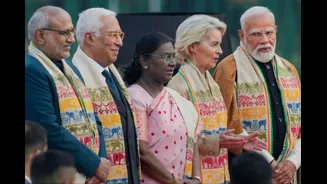
The FTA is being unveiled alongside a broader diplomatic push. At the India-EU summit, leaders are expected to adopt a comprehensive strategic agenda covering prosperity, technology, connectivity and global issues.
The two sides will also sign a Security and Defence Partnership focused on maritime cooperation, cybersecurity and counter-terrorism, signalling that the relationship now goes well beyond commerce alone.
BIG OPPORTUNITIES
Economists say Indian exporters of textiles, garments and leather could gain significantly from better access to Europe’s vast consumer market, helping them compete with rivals such as Bangladesh and Vietnam.
At the same time, European firms see India as one of the world’s most promising growth markets. Yet the pact will likely face political scrutiny on both sides, particularly from industries worried about competition and environmental groups concerned about regulatory standards.