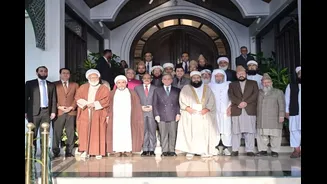










In a move that signals a hardening of Pakistan’s regional stance, Prime Minister Shehbaz Sharif hosted a high-level delegation of religious clerics at the Prime Minister’s Office (PMO) on Friday. The meeting,
which followed a similar outreach by the military’s media wing (ISPR), marks an overt attempt by the state to co-opt religious leaders into a renewed “information warfare” effort. Top intelligence sources suggest that the primary objective is to revitalise the Kashmir jihad narrative and establish a state-sanctioned religious justification for hostilities against India, framing the struggle as a “battle for truth”.
The delegation was led by Hafiz Tahir Mahmood Ashrafi, Chairman of the National Paigham-i-Aman Committee (NPAC), who was recently reappointed by Sharif as a special coordinator. Ashrafi and several members of the NPAC have long-standing, documented proximity to banned jihadist outfits, including Jaish-e-Mohammad and Lashkar-e-Taiba. By bringing these figures into the PMO, the government appears to be providing a platform for “legitimised jihad”, with plans to use mosque sermons and Friday prayers across the country to disseminate a coordinated anti-India message.
During the meeting, Prime Minister Sharif reiterated the military’s “principled position” on Kashmir and vowed to “drown terrorism in the Indian Ocean”. However, his rhetoric shifted significantly when discussing internal security. Sharif alleged a “nexus” between the Tehreek-e-Taliban Pakistan (TTP) and the Afghan Taliban, claiming both are funded and resourced by India and Afghanistan to destabilise Pakistan. Sources close to the PMO indicate that this narrative is a deliberate attempt to redirect public anger over Pakistan’s internal security failures toward external “enemies”, specifically targeting India’s diplomatic influence in the region.
This synchronised outreach by both the civilian government and the Inter-Services Public Relations (ISPR) underscores a deepening state-terror symbiosis. Rather than dismantling the infrastructure of extremism, Islamabad is once again leveraging religious scholars to establish a “Jihadi Narrative” for the Kashmir cause. Intelligence sources in New Delhi view this as a desperate tactical shift following Operation Sindoor, intended to consolidate domestic support through religious fervour while maintaining plausible deniability on the international stage. By assuring full cooperation to these “Mullahs”, the Pakistani state is effectively outsourcing its foreign policy to the very extremist elements it claims to be fighting.