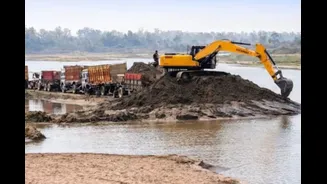




The Narmada, revered as the lifeline of Madhya Pradesh, along with more than 200 other rivers in the state, is now fighting for survival. Once known as the ‘birthplace of rivers’, Madhya Pradesh is watching
this identity erode rapidly due to illegal mining, unchecked sewage discharge and widespread encroachment.
The crisis has reached such alarming levels that the World Resources Institute (WRI) in the United States has listed the Narmada among six rivers worldwide whose future is under serious threat. This warning is not merely environmental in nature but serves as a stark alert for future generations.
Over 200 Rivers, Little Protection
India has nearly 450 rivers, of which more than 200 flow through Madhya Pradesh alone. Despite this, conservation efforts appear weak on the ground. Environmental experts warn that most rivers in the state are slowly dying, including the perennial Narmada, which is now suffering from pollution and illegal activities.
If corrective measures are not taken, rivers may soon exist only in maps and textbooks.
Senior environmentalist Dr Subhash Pandey states that rivers in Madhya Pradesh are gasping for survival. According to him, the Narmada is currently the only perennial river left in the state, but even it faces mounting threats. Sewage from drains and tributaries is flowing directly into the river, sharply degrading water quality.
Illegal Sand Mining And Ecological Damage
Dr Pandey emphasises that illegal sand mining has caused the most severe damage to the Narmada’s ecosystem. Sand beds are crucial breeding grounds for aquatic life. When mining destroys these beds, it wipes out fish, turtles, and other species that naturally help purify river water.
Without these organisms, rivers lose their ability to regenerate.
A Grim Prediction For The Future
Warning of dire consequences, Dr Pandey says that if current practices continue, the Narmada may not exist as a continuous river within the next 50 years. Instead, only scattered patches of water will remain, caused by falling water levels, encroachment, and pollution.
The WRI report echoes these concerns.
Sewage Treatment Plans Fall Short
Direct sewage discharge is identified as the second major cause of river pollution in Madhya Pradesh. The Congress party claims that while there was a plan to set up 28 sewage treatment plants to clean the Narmada, only one plant in Nemawar is partially operational.
Congress leader Bhupendra Gupta alleges that the government prioritises revenue from sand mining over river conservation.
Ponds Also In Decline
The situation of ponds across the state is equally troubling. Bhopal’s Upper Lake, a symbol of the city, has now fallen into Category C water quality.
Dr Pandey notes that none of Bhopal’s ponds are fit for drinking water anymore. Around 1.2 million people depend on this water, which is supplied only after heavy treatment.
Government Response
BJP spokesperson Ajay Singh Yadav asserts that the state government will not tolerate illegal mining. He says action is being taken against sand mafias and that the government remains committed to river conservation, with stricter monitoring planned in the future.
Experts stress that water, forests, and rivers form the true identity of Madhya Pradesh. Tribal culture, agriculture, industry, and ecological balance all depend on these natural resources. Without immediate and strong intervention, the worsening river crisis will directly impact the lives and livelihoods of people across the state.