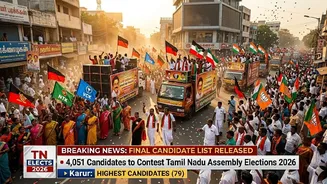






Dynastic politics is neither new nor incidental in Tamil Nadu. It is deeply embedded in the state’s political culture, shaped as much by ideology and organisation as by personality and legacy. As the 2026
Assembly elections approach, familiar political surnames are once again at the forefront.
One of the key reasons for this continuity lies in the structure of Dravidian politics itself.
Parties such as the DMK evolved not just as political platforms but as socio-cultural movements, where leadership often became centralised around individuals and, over time, their families.
The influence of cinema further reinforced this model. From M. Karunanidhi’s screenwriting legacy to the mass appeal of leaders like MGR and Jayalalithaa, politics in Tamil Nadu has long intersected with personality-driven mobilisation. This created a system where recognisable faces — and by extension, their families — became natural inheritors of political capital.
That trend is visible once again in the current election cycle.
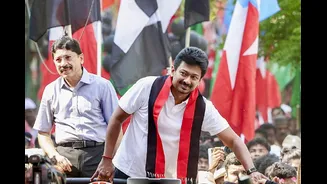
Chief Minister M. K. Stalin has filed his nomination from Kolathur, a constituency he currently represents. His son, Udhayanidhi Stalin, is contesting from Chepauk-Thiruvallikeni, continuing the family’s political footprint in Chennai.
In the AIADMK camp, O. Panneerselvam is in the fray from Bodinayakanur, a key constituency in southern Tamil Nadu where his influence remains significant.
The Pattali Makkal Katchi (PMK) also reflects this pattern. Sowmiya Anbumani, wife of Anbumani Ramadoss, has filed her nomination from Dharmapuri, marking another instance of family-linked candidature in the state.
These candidacies cut across party lines, indicating that dynastic politics in Tamil Nadu is not confined to a single formation but is a broader structural feature of its electoral landscape.
However, this model has increasingly come under political attack. Prime Minister Narendra Modi has repeatedly targeted dynastic politics in Tamil Nadu during his campaign speeches, arguing that it has limited opportunities for grassroots leaders and weakened governance. In a recent rally in the state, he criticised what he described as “family-run parties”, positioning the BJP as an alternative to entrenched political networks.
Similarly, AIADMK leader Edappadi K. Palaniswami has also raised the issue in his campaign outreach, claiming that dynastic politics has constrained internal democracy and hindered leadership emergence within parties. His remarks come even as sections within the AIADMK continue to be influenced by family-based political networks.