



A famous bull mosaic inside Milan’s historic Galleria Vittorio Emanuele II is once again undergoing restoration after years of tourists spinning on its most famous spot for good luck literally wore parts
of the artwork away.
The mosaic, located beneath the grand glass dome of the 19th-century shopping arcade, features a bull representing the city of Turin. But it is not the artwork itself that draws crowds every day — it is a centuries-old superstition attached to it.
What Is The Tradition?
Visitors place their heel on the bull’s testicles and spin around three times, usually clockwise, while balancing on one foot. According to local legend, the ritual brings good luck and guarantees that the visitor will one day return to Milan.
The custom has become one of Milan’s most famous tourist rituals, attracting thousands of visitors every day who queue up for their turn to perform the spin.
Why Is Italy Restoring It Again?
The tradition has become so popular that decades of spinning heels have physically damaged the mosaic.
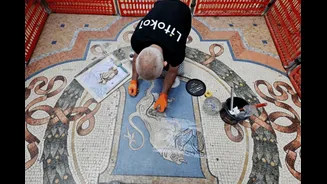
According to Milan city authorities, constant friction from tourists has worn down the pink mosaic tiles forming the bull’s testicles, creating a visible crater in the floor. The damage has become so severe that the city periodically has to restore the artwork.
The latest restoration is being carried out by specialist mosaic restorers using hand-cut stone pieces designed to match the original 19th-century artwork.
Where Did The Superstition Come From?
No one knows exactly how the ritual began.
One popular theory suggests it started as a joke among Milanese students in the late 19th century before evolving into a city-wide superstition. Another explanation links it to older traditions of touching animal symbols for fortune and prosperity.
Over time, word-of-mouth, travel guides and social media transformed the ritual into one of Italy’s most famous tourist customs.
Why Is The Bull There In The First Place?
The bull is part of a larger mosaic design celebrating the major cities of unified Italy.
The floor of the Galleria contains symbols representing Milan, Rome, Florence and Turin, reflecting the spirit of Italian unification during the 19th century. The bull specifically represents Turin, which was Italy’s first capital after unification.
Why Is It Called The ‘Lucky Spot’?
City officials themselves now refer to the worn section as the Galleria’s “lucky spot.”
Despite repeated restoration efforts, the tradition continues because many visitors see the ritual as a must-do Milan experience. Even during the current restoration, some tourists reportedly shifted to spinning on a nearby wolf mosaic representing Rome when they could not access the bull.
The Bigger Picture
The bull mosaic has become a rare example of a tourist attraction being damaged not by vandalism, but by affection.
For Milan, the restoration is not just about repairing artwork. It is about preserving a living tradition that blends history, superstition, tourism and local identity beneath one of Italy’s most iconic landmarks.