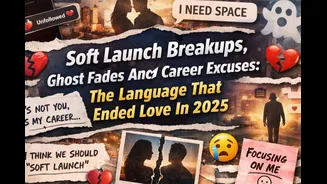










The end of a relationship was rarely announced this year; it was sensed. A message left on read for days, a partner who slowly stopped making plans and started ‘avoiding’ them, and an unfollow on social
media platforms rewrote the breakup rules of 2025. Breakups no longer demanded confrontations or final speeches; they crept in through ghost fades, soft launches and “I need to focus on my career.”
From everyday couples drifting apart to celebrities, this year exposed a shared reluctance to be the villain in someone else’s story. The way people broke up, and the phrases they chose, became a mirror of a culture obsessed with self-protection, emotional awareness, and non-confrontation. Understand the subtle art of modern breakups, decoding the lines, the intentions behind them, and the advice that shaped how love quietly ended.
The Rise Of The “Soft Launch” Breakup
When it comes to one of the most defining breakup trends of 2025, it is none other than soft launch. Borrowed from social media culture, where relationships are gradually introduced online, the soft launch breakup worked in reverse.
There was no announcement or declaration, instead the couples stopped appearing together. Photos were not deleted immediately from Instagram feeds; they simply stopped being added. Stories went solo and captions shifted from “we” to “I.”
The breakup line that often accompanied this phase was deceptively gentle: “I think we are slowly growing in different directions” or “Nothing’s wrong, I just feel like something’s changed.”
These phrases directly signalled withdrawal without finality. The couple allowed one person to step back without fully closing the door, leaving the other alone in ambiguity. In many cases, the breakup was not acknowledged officially until a time when a mutual unfollow confirmed the silence.
When Disappearing Felt Kinder Than Ending
Ghosting from relationships or jobs was not new in 2025, but it evolved. Instead of vanishing overnight, people started practising the ghost fade. Replies became shorter, response times stretched, plans were postponed without any valid reason, and the intention, many claimed, was kindness.
Some of the common breakup lines used during the year included:
- “I’m just really overwhelmed right now.”
- “I need some space to get my head straight.”
- “This isn’t about you. I just can’t show up the way I should.”
What these phrases often masked was avoidance. Rather than confronting incompatibility, many opted to let the connection quietly expire. The belief was that fading out would hurt less than a direct breakup. In reality, for the person on the receiving end who experienced the prolonged emotional confusion often questioned their worth rather than the relationship’s viability.
Therapy Language Took Over The Breakup
Committed couples broke up by using intelligent statements. People spoke fluently about boundaries, emotional clarity and self-alignment. Some of the popular lines included:
- “I’m choosing myself right now.”
- “You didn’t do anything wrong, but this no longer aligns with me.”
- “I don’t have the emotional willingness to deal with this.”
These statements entered everyday conversations and created an imbalance in the relationships. The person initiating the breakup appeared self-aware and more evolved, while the other was left with little to no room to respond without seeming immature. Therapy-speak often closed conversations rather than opening them, but it did leave one of the biggest scars.
Career First, Love Later
Another defining breakup narrative of 2025 centred on ambition. With burnout culture and hustle mentalities still dominant, many people chose the ‘Work-focused exit’ to break up with their partner.
The most repeated line of the year was: “I need to focus on my career right now.”
This phrase was framed not only in private relationships but also in celebrity splits, too. Sydney Sweeney’s engagement ending, Simone Ashley’s “single era,” and multiple high-profile breakups leaned on this explanation. While often genuine, the line also became a socially acceptable shield, hard to argue with, difficult to challenge.
Celebrity Breakups As Templates?
In 2025, celebrity breakups did not just make headlines, but they instructed too. Public statements became templates for how to end things “correctly.” Nicole Kidman and Keith Urban’s split emphasised respect, parenting unity, and not speaking badly of one another.
Naomi Osaka’s announcement centred on no bad blood and growth.
Amy Schumer’s divorce post mixed humour with clarity, rejecting speculation before it could spiral. Celebrities rarely disclosed raw emotion; instead, they offered polished narratives that balanced honesty with brand protection. For everyday people, this reinforced the idea that breakups should be calm, mutual, and dignified.
Mutual Unfollows, The New Trendsetter?
In 2025, unfollowing someone carried more weight than a breakup text. Mutual unfollows became the unofficial confirmation that things were truly over. Often, there were no words at all, just digital actions. When words were used, they were minimal: “I think it’s healthier if we don’t follow each other right now.”
One of the most revealing breakup lines of 2025 was: “I never wanted to ghost you, but I thought it was for your best interest.”
This sentence appeared not only in texts, but also in voice notes and DMs as well. This framing prioritised protection, silence and avoidance. The message was clear: discomfort with emotional responsibility outweighed the desire for clarity.
Many believed that explaining feelings in real time was more harmful than disappearing. Yet psychology suggests the opposite: ambiguity often deepens pain, while clear endings allow grief to begin.
Rebound Culture Meets Emotional Fatigue
Despite years of advice insisting that rebounds were unhealthy, 2025 still encouraged distraction as healing. Friends urged newly single people to “get back out there.” Social media celebrated quick turnarounds.
After soft-launch breakups and ghost fades, jumping into something new often felt premature. As several celebrity stories showed, on-again, off-again relationships and brief reconciliations, unresolved endings had a way of resurfacing.
The Backlash Against “No Contact”
“No Contact” remained the loudest breakup advice online, but 2025 saw growing scepticism. Some relationships ended due to timing, stress or external pressures rather than a lack of love. In such cases, thoughtful communication helped provide closure or, at a minimum, mutual understanding.
What 2025’s Breakups Revealed
At its core, breakup culture in 2025 reflected a paradox. People had more emotional vocabulary than ever, yet struggled to sit with discomfort. They wanted to be kind, but also to escape. What the year ultimately taught was not how to break up perfectly, but how imperfect our attempts at gentleness can be. The quiet endings, the fades, the unfollows, all pointed to a need for nuance.
As society continues to evolve, perhaps the next shift will be toward endings that are neither dramatic nor disappearing acts, but conversations that respect both individuals’ realities. Because love, even when it ends, deserves more than a quiet exit.