





The Maharashtra government has directed municipal corporations, municipal councils and nagar panchayats across the state to remove or demolish unauthorised structures located within the Right of Way (ROW)
of national highways. The deadline for the same is 60 days.
At the same time, the state has prohibited the construction or operation of new dhabas, eateries and other commercial establishments within the highway ROW. Existing licences and approvals in highway safety zones will also be reviewed.
The move follows a nationwide road-safety intervention by the Supreme Court in April 2026, triggered by a fatal highway accident in Rajasthan.
What Maharashtra Order On Highway Dhabas Says
The Maharashtra Urban Development Department has asked all urban local bodies to strictly implement the Supreme Court’s directions. The immediate focus is on unauthorised structures within the Right of Way of national highways. District Magistrates have been given 60 days to enforce the removal or demolition of new and existing unauthorised structures, following the applicable legal procedure.
Importantly, this does not mean that every dhaba or hotel situated near a national highway is automatically illegal or will be demolished. The critical question is where the establishment stands and whether it has the required permissions.
The government order specifically prohibits new dhabas, eateries and commercial structures within the highway’s ROW. It also says that no department, authority or local body should grant or renew a licence, NOC or trade approval for sites within highway safety zones without prior clearance from the National Highways Authority of India (NHAI) or the Public Works Department, as applicable.
Existing licences at such sites are to be reviewed within 30 days.
What Is The ‘Right Of Way’?
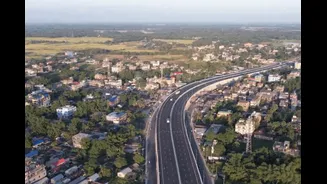
The term ROW can be confusing because it does not simply mean the strip of road on which vehicles drive. A highway’s Right of Way is the larger stretch of land acquired or reserved for the highway and associated infrastructure. It can include the carriageway, shoulders, drainage systems, embankments, service infrastructure and land required for the road’s present or future requirements.
That is why a restaurant or shop can appear to be sitting “beside” a highway to a motorist while technically falling within the highway’s ROW. Structures built or operating without the necessary authorisation inside this area can therefore obstruct highway operations, create access points and increase risks for vehicles entering or leaving the road.
The Maharashtra order is specifically aimed at such unauthorised occupation and construction.
The Trigger: Road Safety
The immediate background is a deadly accident in Rajasthan. In November 2025, at least 15 people were killed and two injured in a collision in Phalodi district. A tempo collided with a truck that had reportedly been parked beside the highway near an eatery. The tempo was attempting to overtake another vehicle when it hit the parked truck.
The accident eventually became part of a broader Supreme Court examination of safety conditions on national highways.
In its April 13, 2026 order in the suo motu proceedings concerning the Phalodi accident, the Supreme Court took a wider view of highway safety. The court was concerned not merely with the actions of individual drivers but with the infrastructure and enforcement failures that can turn highways into dangerous stretches.
The court subsequently issued directions dealing with unauthorised structures, parking and land-use restrictions along national highways.
What Are The 40-Metre And 75-Metre Rules?
One of the most significant parts of the Supreme Court’s directions concerns land use around national highways. The court directed states to prohibit land-use changes for residential purposes within 40 metres and for commercial purposes within 75 metres from the midpoint of a national highway.
This is important because it goes beyond simply removing existing encroachments. The objective is to prevent new development from gradually crowding highways and creating precisely the kind of roadside environment that can make high-speed roads hazardous.
Commercial establishments generate pedestrian movement, vehicle entries and exits, roadside parking, loading and unloading activity. If these activities occur too close to a highway without proper access and safety planning, they can create conflict points between slow-moving vehicles and fast-moving traffic.
Maharashtra has now begun translating those directions into an enforcement mechanism at the local level.
What Happens To Existing Hotels And Dhabas?
The order is not a blanket declaration that all hotels and dhabas near national highways must shut down. Instead, authorities have been asked to identify unauthorised structures within the ROW and remove them. Existing licences in highway safety zones are also to be reviewed.
The new system is designed to ensure that approvals involving highway safety zones are not granted or renewed without the required clearance from the relevant highway authority.
A District Highway Safety Task Force will be established in every district through which a national highway passes. The task force will include officials from the district administration, police, NHAI or the concerned land-owning agency, the Public Works Department and local bodies.
The District Collector will have a key role in coordinating the exercise, while the police leadership will also be responsible for enforcement. The stated responsibility for regular removal of encroachments has been assigned to the District Collector and the Commissioner of Police or Superintendent of Police.
What Changes For Motorists?
For ordinary travellers, the immediate impact may not be obvious. The aim is not to prevent people from stopping for food on highways. Instead, the emphasis is on ensuring that stops happen at locations that do not interfere with the highway’s functioning.
Over time, this could mean fewer informal eateries directly opening onto the highway and greater reliance on designated service areas, rest stops and authorised commercial zones.
For truckers, however, the transition could be more significant. The availability of safe and convenient parking will become increasingly important as enforcement against roadside parking and unauthorised establishments becomes stricter.
Maharashtra’s 60-day demolition deadline is therefore more than an anti-encroachment exercise. It is part of a larger attempt to change the relationship between India’s highways and the development that has grown around them.
For decades, roads often expanded after businesses and settlements had already developed along them. The new approach is the reverse: highways are increasingly being treated as high-speed transport corridors where access, parking, construction and commercial activity have to be planned around road safety.
The challenge will be enforcement without creating new problems. Removing an illegal structure may clear an obstruction. But making highways genuinely safer will require designated parking, properly designed access roads, emergency facilities, pedestrian management and adequate wayside amenities.