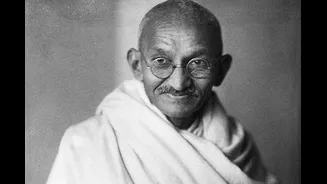







Gandhi Jayanti history and significance: Gandhi Jayanti will be celebrated on Friday, October 2, marking the 157th birth anniversary of Mahatma Gandhi, who was born on October 2, 1869, in Porbandar, Gujarat.
The day is observed across India in memory of Mahatma Gandhi and his emphasis on truth, non-violence, self-discipline and social service.
October 2 also has international significance. The United Nations observes the date as the International Day of Non-Violence, established by a UN General Assembly resolution adopted in 2007. The UN describes the day as an occasion to spread the message of non-violence through education and public awareness.
Who Was Mahatma Gandhi?
Mohandas Karamchand Gandhi, popularly known as Mahatma Gandhi or Bapu, was born on October 2, 1869, in Porbandar. He studied law in London and later spent more than two decades in South Africa, where his experiences with racial discrimination and political exclusion contributed to the development of his approach to organised non-violent resistance.
Read More: Bank Holidays In October 2026: Check Full List Of Bank Closures Across India
After returning to India, Mahatma Gandhi became an important figure in the country’s freedom movement. His political campaigns relied heavily on satyagraha, non-cooperation, civil disobedience and mass mobilisation.
Gandhi Jayanti: History
Mahatma Gandhi’s influence during India’s freedom struggle grew through campaigns that brought ordinary people into political action. Among the movements and campaigns associated with him were the Champaran movement, the Non-Cooperation Movement, the Salt March, the Civil Disobedience Movement and the Quit India Movement.
His approach was rooted in the idea that political and social change could be pursued through non-violent action.
Read More: October 2026 School Holiday Calendar: How Many Days Will Schools Be Closed Next Month?
The Salt March of 1930 became one of the most internationally recognised examples of this approach. Mahatma Gandhi and his followers marched from Sabarmati Ashram to Dandi, where he broke the British salt law by making salt.
The United Nations cites the Salt March as an example of the mass civil disobedience associated with Gandhi’s philosophy of non-violence.
Why Is Gandhi Jayanti Celebrated?
Gandhi Jayanti is observed to remember Mahatma Gandhi’s life and his contribution to India’s freedom movement, while also reflecting on principles associated with his public life.
Four ideas are particularly associated with the observance:
- Truth: Gandhi placed truth, or satya, at the centre of his philosophy. His approach to public life connected truth with personal conduct and social action.
- Non-Violence: Ahimsa, or non-violence, became one of the defining principles of Gandhi’s political and social campaigns. The United Nations says Gandhi’s philosophy helped inspire non-violent movements for civil rights and social change around the world.
- Simplicity: Gandhi became known for a deliberately simple lifestyle. His clothing, diet, living arrangements and emphasis on self-reliance became important elements of his public image and philosophy.
- Service: Gandhi repeatedly emphasised service to society and attention to disadvantaged communities. His legacy is therefore remembered not only in the context of India’s independence but also through discussions around social responsibility, equality and community welfare.
Gandhi Jayanti And The Freedom Movement
Mahatma Gandhi’s political career covered some of the most important phases of the independence movement.
- Champaran Satyagraha: The Champaran Satyagraha of 1917 was one of Gandhi’s early major movements in India. It focused on the problems faced by indigo farmers in Bihar and helped establish Gandhi as a prominent leader in Indian public life.
- Non-Cooperation Movement: Launched in 1920, the Non-Cooperation Movement encouraged Indians to withdraw cooperation from British institutions and systems. It represented a major attempt to turn anti-colonial sentiment into a mass movement.
- Dandi March: In 1930, Gandhi led the Dandi March, a 240-mile journey associated with opposition to the British salt monopoly. The campaign became an internationally recognised example of non-violent civil disobedience.
- Quit India Movement: In 1942, the Indian National Congress launched the Quit India Movement, demanding an end to British rule. Gandhi became one of the movement’s principal figures and was imprisoned by the British authorities.
India achieved independence on August 15, 1947.
Mahatma Gandhi’s Philosophy of Satyagraha
One of Mahatma Gandhi’s most important contributions to political thought was satyagraha.
The term is generally associated with resistance based on truth and non-violence. Rather than treating physical force as the primary instrument of political change, Mahatma Gandhi advocated methods including non-cooperation, civil disobedience and peaceful protest.
The United Nations describes non-violent action associated with Mahatma Gandhi in three broad categories: protest and persuasion, non-cooperation, and non-violent intervention.
His ideas subsequently influenced non-violent movements outside India, including campaigns for civil rights and social change.
How Is Gandhi Jayanti Celebrated?
Gandhi Jayanti is observed through official ceremonies, educational programmes, prayer meetings, cultural events and community activities.
A central tradition is the offering of tributes at Raj Ghat in New Delhi, the memorial associated with Gandhi. Political leaders and other dignitaries have traditionally paid homage there on Gandhi Jayanti.
Schools and educational institutions commonly organise activities such as:
- Essay and speech competitions
- Drawing and poster-making competitions
- Debates and quizzes about Mahatma Gandhi
- Prayer meetings
- Exhibitions on India’s freedom movement
- Readings and discussions about Gandhi’s writings
- Cleanliness and community-service activities
- Cultural programmes based on Gandhi’s life and ideas
Gandhi Jayanti And Cleanliness
Cleanliness has also become an important part of Gandhi Jayanti-related public campaigns in contemporary India.
Government initiatives in previous years have used October 2 as a focal point for cleanliness and community participation. For example, the Prime Minister’s Office has previously linked Gandhi Jayanti with Swachhata Hi Seva and community cleanliness activities.
This reflects Mahatma Gandhi’s longstanding emphasis on personal cleanliness, sanitation and civic responsibility, although today’s government campaigns are contemporary programmes rather than historical events from Gandhi’s lifetime.
Gandhi Jayanti as the International Day of Non-Violence
Gandhi Jayanti has significance well beyond India.
On June 15, 2007, the UN General Assembly adopted Resolution 61/271 establishing October 2 as the International Day of Non-Violence. The resolution was intended to disseminate the message of non-violence through education and public awareness.
The UN notes that Gandhi’s ideas have inspired non-violent movements for civil rights and social change in different parts of the world.
This gives October 2 a dual identity: it is Gandhi’s birth anniversary in India and an internationally recognised day dedicated to the principle of non-violence.
Gandhi Jayanti 2026: Important Facts
- Mahatma Gandhi was born on October 2, 1869.
- His birthplace was Porbandar in Gujarat.
- His full name was Mohandas Karamchand Gandhi.
- He trained as a lawyer in London.
- His years in South Africa significantly influenced his political philosophy and methods of resistance.
- Satyagraha and ahimsa became central concepts associated with his campaigns.
- The 1930 Salt March became a landmark episode of non-violent civil disobedience.
- Gandhi was assassinated on January 30, 1948, in New Delhi.
- Gandhi Jayanti is observed every year on October 2.
- October 2 is also the UN’s International Day of Non-Violence.
- 2026 marks the 157th birth anniversary of Gandhi.
Gandhi Jayanti 2026: Why the Day Remains Significant
Gandhi Jayanti is more than a commemoration of a historical figure. It provides an opportunity to revisit India’s freedom struggle and the ideas of non-violent resistance, truth, civic responsibility and social service associated with Gandhi.
The UN’s continued observance of October 2 as the International Day of Non-Violence also reflects the international reach of Gandhi’s ideas. The organisation says the day promotes a culture of peace, tolerance, understanding and non-violence.
As India celebrates Gandhi Jayanti, schools, institutions, communities and individuals can use the occasion to learn about the historical events of the freedom movement while reflecting on the continuing global discussion around non-violence and peaceful social change.
Gandhi Jayanti 2026: Frequently Asked Questions
When is Gandhi Jayanti 2026?
Gandhi Jayanti will be celebrated on Friday, October 2, 2026.
Which birth anniversary of Mahatma Gandhi will be celebrated in 2026?
Gandhi Jayanti 2026 marks Gandhi’s 157th birth anniversary.
Why is October 2 celebrated as Gandhi Jayanti?
October 2 is Mahatma Gandhi’s birth date. He was born on October 2, 1869, in Porbandar.
What is Gandhi Jayanti also known as internationally?
October 2 is observed by the United Nations as the International Day of Non-Violence.
What are the main ideas associated with Mahatma Gandhi?
Truth, non-violence, satyagraha, simplicity, self-reliance and service are among the ideas most closely associated with Gandhi’s public life and philosophy.
How is Gandhi Jayanti celebrated?
Observances commonly include tributes at Gandhi memorials, prayer meetings, educational programmes, cultural activities and community or cleanliness initiatives. Specific programmes vary by institution and location.