




In Part I of this edition of the Urban Quest series, Urban Quest | Bengaluru: The $1 Trillion Dream And The Crises Blocking The Path, I discussed how, by 2047—when Bharat celebrates 100 years of independence—Bengaluru’s
economy can reach the US$1 trillion mark.
In my piece Infra Vaani | Infra Woes Are Chipping Away at India’s Silicon Valley, Bengaluru Is Battling for Survival, I also examined why Bengaluru may soon find its ‘crown jewels’—the high-end tech industries that earned it the moniker ‘Silicon Valley of India’—slowly drifting away, first in a trickle and soon in droves.
Make no mistake: the writing on the wall about Bengaluru’s mounting woes has been visible for a long time. If business continues as usual, the city’s decline from its current pedestal as Bharat’s economic powerhouse is not just possible—it is imminent.
In Part II, I discuss the major crises blocking Bengaluru’s dream of becoming a US$1 trillion inclusive and equitable economy by 2047. Though the roadblocks to Bengaluru achieving its rightful place by 2047 are myriad, the city has no option but to remove them—one obstacle at a time.
Here are a few more serious roadblocks that should ideally have been addressed:
Firstly, Corruption
Former Prime Minister Indira Gandhi was haunted for years by her infamous 1983 statement, “corruption is a global phenomenon,” which many interpreted as an attempt to justify corruption in India. I posit that Bengaluru is not only the ‘Silicon Valley’ and ‘start-up capital’ of Bharat but also, unfortunately, one of the most corrupt state capitals in the country.
India’s rank in the 2024 Corruption Perceptions Index (CPI), released by Transparency International in early 2025, stands at 96 out of 180 countries. I would submit that, had Bengaluru been a separate country, its CPI ranking would have been hovering around 150.
Why do I say this?
There are examples in abundance of corruption eating away at Bengaluru like termites.
- The case of pothole-riddled roads: In 2022, a Karnataka High Court Bench led by Chief Justice Ritu Raj Awasthi—while hearing a seven-year-old PIL filed by activist Vijayan Menon (WP 42927/2015)—ordered the BBMP to survey and repair all potholes in Bengaluru’s Central Business District within 15 days and submit an action-taken report. Ironically, this sorry state of roads existed despite Rs 20,000 crore being spent between 2016 and 2020 on road repairs—an astonishing Rs 1.54 crore per km.
- Corruption in municipal works: Corruption across Bengaluru’s municipal works—managed by the BBMP and overseen by a state-appointed commissioner—has been monumental and long-standing. Allegations range from massive fund misappropriation to routine bribe demands for even basic services. Recent reports from the Lokayukta and the Karnataka State Contractors Association reveal a deeply systemic problem.
Key Allegations and Findings
- Fund Misappropriation: A major complaint to the Enforcement Directorate alleges misuse of Rs 46,300 crore allocated for road development between 2013 and 2024.
- “0% Work, 80% Bill” scams: A 2022 Lokayukta report detailed a scheme in which contractors billed for 80 per cent of the work while completing only 20–30 per cent—or none at all. Only two of the 116 scrutinised works were found to be properly completed, causing an estimated loss of Rs 118.25 crore in a single constituency.
- High kickbacks and bribes: The Contractors Association has repeatedly claimed that officials demand 40–50 per cent of the project cost as bribes for clearing bills and awarding contracts. They even wrote to the Prime Minister. Allegedly, the bribe component touched 80 per cent under the current government, forcing contractors to use substandard materials.
- Substandard work: The use of poor-quality materials—such as hollow bricks instead of concrete slabs for storm drains—has been widely reported and has created major safety hazards.
- Bureaucratic harassment: Citizens routinely face bribe demands for basic civic services such as obtaining an e-khata or transferring land titles. The High Court itself observed that corruption in the BBMP has reached “monstrous dimensions.”
- Procurement fraud: Concerns were raised over questionable tenders such as a Rs 613-crore project for renting road-sweeping machines—an amount critics argue would have been far lower had machines been purchased outright.
Key Takeaway
The extremely high level of corruption in Bengaluru—compounded by the absence of municipal elections for five years and the resulting accountability vacuum—has inflicted enormous hardship on citizens. It has contributed directly to the deterioration of the city’s already strained roads, worsened the water crisis by fuelling the water-tanker mafia, deepened the solid waste management mess, and eroded public trust in governance.
Make no mistake: before Bengaluru can become a US$1 trillion city, it must first become a substantially less corrupt one.
Secondly, Choked
Bengaluru, a city of 14 million people, currently produces between 4,500 and 6,000 metric tonnes of solid waste every day. A recent study places daily solid waste generation at 5,778 metric tonnes. But since a substantial proportion of waste goes undetected and uncollected, the real figure may be far higher. With Bengaluru’s population projected to reach 20.3 million by 2031 (according to the revised Master Plan 2031 of the Bengaluru Development Authority) and rapid lifestyle changes expected to increase per-capita waste generation by 2030, municipal solid waste output in the city is likely to exceed 10,000 metric tonnes a day.
This raises an important question: what is the composition of Bengaluru’s solid waste? How much of it is segregated and scientifically treated in conformity with the Solid Waste Management Rules, 2016—mandated by the Supreme Court of India—and how much is simply dumped in unhygienic landfills?
According to a 2020 study, Bengaluru generates 5,758 tonnes of municipal solid waste (MSW) daily, comprising 64 per cent wet waste, 28 per cent dry waste, 6 per cent inert waste and 3 per cent domestic hazardous waste. Waste generation in the BBMP area amounts to 564 grams per capita per day (BBMP SWM Manual 2017). As per BBMP (2017), the indicative composition of waste includes 30 per cent vegetable waste, followed by 23 per cent organic waste. Plastic accounts for 12 per cent, while electronic and biomedical waste constitute around 2 per cent.
- Poor Segregation and Treatment: A major problem in Bengaluru’s solid waste management is that less than 50 per cent of the waste generated is segregated, an even smaller portion is collected properly, and only a minuscule amount is scientifically treated, processed or recycled. The principle of a “circular economy” is yet to gain a foothold in the Silicon Valley of India.
- Landfills and Disposal: Unsurprisingly, a substantial portion of municipal waste—around 75 per cent—is dumped in the landfills at Mittaganahalli: Mandur, Bellahalli and Mavallipura. These sites are now overflowing with undisposed waste, and identifying alternative landfill locations has become nearly impossible.
- Impact: This over-reliance on landfills leads to groundwater contamination, greenhouse gas emissions, odour issues and severe health risks for citizens living near these sites.
Key Takeaway
Even at current population levels and per-capita waste generation, Bengaluru struggles with high waste volumes and low processing capacity, heavily relying on overflowing landfills despite efforts by the BBMP and others to improve the situation. It is alarming to imagine how dire the situation could become by 2031, when the city’s population crosses the 20-million mark. Clearly, it is time for the Silicon Valley of Bharat to get its municipal solid waste act together.
Three, Congestion
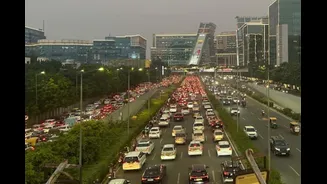
Bengaluru has the ignominy of consistently being one of the most congested cities globally. The congestion is so severe that whenever I travel from Pune to Bengaluru to spend time with my grandson, I complete the Pune–Bengaluru air leg of the journey in one hour, whereas the drive from Bengaluru airport to home takes 2 to 2.5 hours. It often takes an hour or more to cover a mere kilometre or two during peak traffic.
Unsurprisingly, according to the global TomTom Traffic Index, Bengaluru invariably ranks among the worst cities in the world for congestion. In 2022, it was ranked the second worst; in 2023, it performed marginally better at sixth; but in 2024, it returned to the top three as the third most congested city globally, just behind Barranquilla in Colombia and Kolkata in India.
In 2024, an average Bengalurean commuter lost approximately 117 hours (nearly five full days) in rush-hour traffic, according to the TomTom Global Traffic Index.
Key aspects include:
- Total time lost: TomTom estimates 117 hours lost annually to rush-hour traffic. Other reports suggest the figure could be as high as 130–150 hours.
- Average travel time: It took an average of 34 minutes and 10 seconds to cover just 10 kilometres in the city centre. In my experience, it often takes far longer.
- Average speed: Average speed across the year fell to 17.6 km/h. During morning rush hours, it dropped to 15.5 km/h, and in some stretches it frequently dips below 10 km/h.
- Congestion levels: Evening rush hours were particularly severe, with congestion levels reaching 68 per cent and travel times averaging nearly 42 minutes for 10 kilometres. Depending on time and location, it can be far worse.
- Worst day: 5 October 2024 was the most congested day of the year, with an average travel time exceeding 39 minutes to cover 10 kilometres.
Key takeaway
Bengaluru’s crippling congestion is driven by rapid urban expansion, soaring private vehicle ownership (far outpacing public transport growth also Bengaluru has now more cars than Delhi), and outdated road infrastructure. The resulting chaos costs the city’s economy billions in lost productivity. Congestion has become so dire that the probability has increased of several new-economy companies seriously considering relocation to more hospitable cities such as Hyderabad, Pune and the NCR. The sooner Bengaluru takes the congestion bull by the horns, the better. Kolkata, a declining city, may afford the tag of being among the most congested globally; Bengaluru, the economic powerhouse of Bharat, cannot.
Four, The Sewage Trouble
Bengaluru’s storm-sewage drains are largely open; even a couple of hours of rainfall is enough to flood hundreds of houses with four to six feet of sewage water. Open drains have also proved to be death traps for young children.
Here is the situation in brief:
Bengaluru’s sewage management is critically poor. Of the 1,940–2,225 MLD of wastewater generated daily, more than 50 per cent goes untreated or only partially treated, leading to rampant lake pollution and serious public-health risks.
Of the 34 operational STPs (with a combined capacity of 1,381 MLD), many underperform due to defects. Bengaluru also has about 2,700 decentralised apartment-level STPs, which together treat only about 615 MLD effectively, with recurring quality issues and no buyers for excess treated water.
Primary causes include incomplete underground drainage (UGD) coverage (only about 60–70 per cent), illegal household connections to stormwater drains, encroachments and narrowing of natural drains, rapid urbanisation outpacing infrastructure upgrades, and poor coordination among agencies (BWSSB, BBMP/GBA, KSPCB).
Key takeaway
BWSSB is adding 26 new STPs (470 MLD) and rehabilitating eight others at a cost of Rs 1,382 crore. It has also mandated that apartments with more than 20 units install and reuse STPs. Incentives for treated-water sales have been introduced, and piped-reuse networks are emerging. However, for a fast-growing economy whose population is set to double, the city requires long-term structural fixes, including 100 per cent UGD coverage, stricter effluent-treatment enforcement for industries, lake fencing, and ecosystem restoration to prevent sewage discharge.
Five, Acute Power Shortage
Bengalureans have made their peace with frequent power cuts lasting several hours, sometimes through the entire day. The erratic power supply hurts industry, reduces productivity, and at home often damages electrical appliances.
Here is the latest:
Bengaluru experienced frequent scheduled power cuts in late December 2025, typically lasting six to eight hours daily in affected areas. Outages impacted multiple zones such as Peenya, Whitefield, Kambipura and several industrial belts, disrupting homes, offices and factories on specific days.
These interruptions stem from breakdowns, routine substation maintenance (for example, at 66/11 kV stations), and emergency repairs undertaken by BESCOM and KPTCL to prevent larger failures, all amid Bengaluru’s rising demand driven by urban growth and winter peak loads.
Long-term solutions include enhancing grid capacity through new substations, solar integration and smart metering; promoting demand-side management via EV incentives and energy-efficiency measures; and accelerating renewable-energy projects such as Karnataka’s 10 GW solar target to reduce dependence on fossil fuels.
Six, Disrupted Urban Mobility
Like most Indian metropolises, Bengaluru has expanded haphazardly—radially and horizontally—becoming an urban sprawl with poorer populations relegated to the outer fringes. Many low-income groups are forced to walk or cycle, yet proper non-motorised transport (NMT) facilities are missing.
Bengaluru’s public transport system has a moderately robust bus network through BMTC—stronger than many other cities—but continues to face major coverage gaps.
BMTC operates around 6,300–6,500 buses (including approximately 1,800 electric buses and rising) with a daily ridership of about 45 lakh, the highest in the country. However, it still falls short of the Comprehensive Mobility Plan (CMP) target of 13,000 buses, and the existing fleet remains strained (running about 180 km per bus per day versus the ideal 230 km). Expansion to a 40 km radius, including areas such as Ramanagara, is planned with an additional 4,500 electric buses.
Namma Metro’s first line (Purple: Baiyappanahalli–MG Road) opened on 20 October 2011. Its current operational length is 96 km—making it the second longest in the country after Delhi—and it also has the second highest patronage.
However, both bus and metro systems are severely handicapped by poor first- and last-mile connectivity, with fragmented feeder services, high auto and taxi fares, unsafe pedestrian routes, and limited shared-bike or e-scooter options.
If Bengaluru is to become an inclusive and equitable US$1 trillion, 25-million-population city by 2047, it must emulate Shenzhen in China, which with a population of around 15 million has 16,000 electric buses and about 609.5 km of metro rail with 409 stations, supported by global best practices in first- and last-mile connectivity and compact transit-oriented development.
The time for Bengaluru to raise its ambition and move swiftly to address major roadblocks is now; otherwise, the US$1 trillion dream will remain a mirage and will die young.
The author is a multidisciplinary thought leader with Action Bias, India-based international impact consultant, and keen watcher of changing national and international scenarios. He works as president, advisory services of consulting company BARSYL. Views expressed in the above piece are personal and solely those of the author. They do not necessarily reflect News18’s views.