

Why Are The Indian Markets Falling? Indian equities extended their slump on Monday, with the Sensex and Nifty deepening a selloff that has erased nearly Rs 17 lakh crore in market value over six trading
sessions, leaving investors grappling with fresh uncertainty at home and abroad.
The BSE Sensex slumped over 700 points, to the day’s low of 82,864, while the NSE Nifty 50 slid over 150 points, slipping below the 25,500 mark. From a closing high of 85,762.01 on January 2, the Sensex has now shed more than 2,718 points, and the Nifty has declined around 3%, hitting a low of 25,529.05 over the same period.
The sharp declines follow the market’s worst weekly performance in over three months, with volatility and investor unease rising amid prolonged policy overhangs. The total market capitalisation of all BSE-listed companies has fallen by about Rs 18.5 lakh crore in six days to around Rs 462.68 lakh crore.
Key factors weighing on Indian equities
1. Trump tariffs and uncertain US-India trade outlook
An elusive India-US trade deal and ongoing uncertainty around U.S. tariff policy have dampened optimism ahead of the domestic earnings season. Analysts point to persistent policy ambiguity and geopolitical tensions — including tariff concerns, global flashpoints such as Venezuela and Iran, and market reaction to U.S. administration remarks — as major headwinds. This has also pushed the India volatility index (India VIX) higher.
2. Persistent FII selling
Relentless selling by foreign institutional investors has added to market pressure. FIIs continued to offload Indian equities, contributing to liquidity drain and amplifying losses amid fragile sentiment and adverse external cues.
3. Subdued global cues
Weak global signals compounded the cautious mood, with risk appetite dented after fresh concerns about the independence of the U.S. Federal Reserve and broader macrostress. U.S. equity futures slipped on investor unease, while European futures also trended lower in early Asian trading. Bond markets saw safe-haven flows, with benchmark U.S. Treasury yields edging down as rate cut expectations were priced in.
Overall, the sell-off reflects a confluence of domestic and global uncertainties — from stalled trade negotiations and tariff jitters to persistent foreign outflows and weak global market cues — weighing heavily on investor sentiment and driving one of the sharpest downturns in recent sessions.
4. Money flowing to safe-haven assets
Amid increased geopolitical risks, investors are rushing towards safe-haven assets, selling riskier equities in anticipation of further falls.
MCX gold February futures jumped by more than Rs 2,400, or 1.8%, to hit a record high of Rs 1,41,250 per 10 grams, while MCX silver March futures surged over 4% to scale its fresh peak of Rs 2,63,996 per kg on Monday morning. International gold prices breached the $4,600-per-troy-ounce mark for the first time on Monday.
5. Caution amid the Q3 earnings season
Indian companies have begun announcing their December-quarter results, keeping investors on edge, especially in heavyweight sectors such as banking and information technology.
Several marquee names are scheduled to report this week. TCS and HCL Tech will declare their Q3FY26 results on Monday, January 12, followed by Infosys on Wednesday, January 14. Reliance Industries is set to announce its numbers on Friday, January 16, while banking heavyweights HDFC Bank and ICICI Bank will report on Saturday, January 17.
While analysts are pencilling in healthy earnings growth for the quarter, any negative surprise could act as a significant drag on market sentiment, which is already under strain.
What Should Investors Do?
Jigar S Patel, Senior Manager – Technical Research Analyst, Anand Rathi Shares and Stock Brokers, said: “Sensex has decisively broken its critical support near 84,200 a couple of days ago, confirming short-term weakness and continuation of the corrective phase. The index is now gradually drifting towards its 200-day EMA placed around the 82,300 zone, which historically acts as a strong long-term demand area. From a technical perspective, the region between 82,000–82,400 is expected to provide strong support, where base formation is likely to occur. Momentum indicators are approaching oversold territory, hinting that selling pressure may start easing near these levels.”
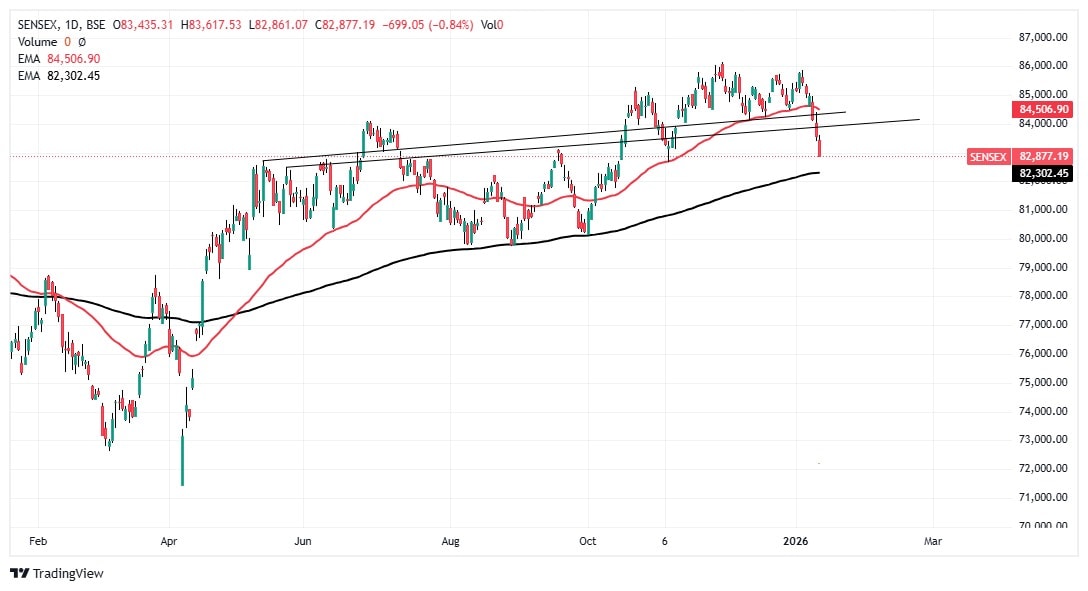
Investors should use this corrective phase to accumulate quality Sensex stocks in a staggered manner rather than panic selling. In the short term, a technical rebound towards 83,500 can be expected once stability is seen near the support zone, making this a favorable risk-reward buying opportunity, Patel added.
From a technical perspective, Aakash Shah, Technical Research Analyst at Choice Equity Broking Private Limited, advised traders to remain selective and disciplined.
Given the current backdrop, Shah said traders should adopt a range-bound approach, favour strong stocks on declines and wait for clear breakouts before building aggressive positions.