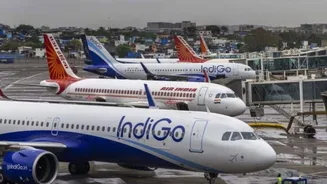








For many air passengers, the first week of December was highly chaotic as major airports across the country were facing massive flight delays and cancellations by IndiGo, the largest operating domestic
carrier. Families were left stranded overnight, some forced to purchase return tickets at exorbitant prices, others spending the night on terminal floors with no clarity or assistance. What initially appeared to be an isolated disruption soon unfolded into a week-long operational breakdown, marked by what passengers described as near-total administrative indifference.
For several days, the burden of the chaos fell squarely on travellers. Airlines, airport authorities and regulatory agencies appeared absent, leaving passengers to fend for themselves. According to data later released by the Directorate General of Civil Aviation (DGCA), IndiGo cancelled 2,507 flights during this period, while another 1,852 flights operated with severe delays. The crisis impacted more than 3 lakh passengers nationwide.
It was only after sustained outrage on social media that the Ministry of Civil Aviation intervened, directing the DGCA to take immediate action. While operations stabilised within days, the trauma of the disruption lingered. In response to public anger, authorities promised exemplary action to ensure accountability.
The DGCA imposed a penalty of Rs 22.20 crore on IndiGo and demanded a bank guarantee of Rs 50 crore. The regulator clarified that the guarantee would be returned in phases if the airline complied with stipulated corrective measures. Most senior airline officials, however, were let off with warnings for what the DGCA termed an “operational meltdown”.
The key question remains, that does a Rs 22.20 crore fine meaningfully penalise the country’s largest airline?
Impact of Rs 22.20 Crore Fine on IndiGo
IndiGo reported a total revenue of Rs 41,142 crore in the first two quarters of FY 2025-26 (April to September). Annualised, this translates to approximately Rs 82,284 crore, or an average daily revenue of around Rs 225 crore. In that context, the DGCA’s penalty amounts to just 0.1% of IndiGo’s daily earnings, roughly equivalent to 2.5 to 3 hours of revenue.
In other words, the fine barely dents the airline’s balance sheet.
The disruptions between December 3 and 5 triggered a detailed probe. Acting on instructions from the Ministry of Civil Aviation, the DGCA constituted a four-member inquiry committee to examine IndiGo’s network planning, crew rostering, software systems and operational decision-making.
What the Investigation Revealed
The committee’s findings concluded that over-optimisation, inadequate preparation, flawed software systems and managerial lapses collectively caused the crisis. IndiGo’s aggressive pursuit of operational efficiency, the report said, came at the cost of safety buffers and resilience.
A major failing identified was the airline’s poor implementation of revised Flight Duty Time Limit (FDTL) regulations. The impact of the Winter Schedule 2025, coupled with new duty norms, was not adequately assessed. This resulted in crew fatigue, disrupted rosters and cascading flight cancellations.
The inquiry also flagged excessive resource utilisation. Crew rosters were stretched to their limits, recovery times were minimised, and practices such as deadheading and tail-swapping were overused, severely weakening the airline’s ability to recover from disruptions.
Action Against Senior Officials
The DGCA issued warnings to IndiGo’s top leadership. The CEO was reprimanded for lack of crisis management and oversight, while the COO was warned for failing to assess the implications of the winter schedule and FDTL norms. The Senior Vice President (Operations Control Centre) was removed from operational responsibilities. Several other senior officials, including those overseeing flight operations and crew resource planning, were also warned, and the airline was directed to submit a compliance report after internal disciplinary action.
Penalty, Bank Guarantee and Passenger Relief
The Rs 22.20 crore penalty was imposed under the Aircraft Rules, 1937. It included a one-time system failure penalty of Rs 1.80 crore and a cumulative daily penalty of Rs 20.40 crore for 68 days of regulatory non-compliance.
Additionally, the DGCA ordered a Rs 50 crore bank guarantee under the newly instituted IndiGo Systematic Reform Assurance Scheme (ISRAS). The scheme mandates reforms across leadership accountability, manpower planning, digital systems and board-level oversight, with the guarantee to be released in stages upon verified compliance.
The regulator acknowledged that IndiGo restored normal operations swiftly and provided affected passengers with refunds, compensation under Civil Aviation Requirements, and a Rs 10,000 “Gesture of Care” voucher. At the same time, the DGCA underlined that passenger safety, regulatory compliance and crew welfare remain non-negotiable, and warned that similar negligence would not be tolerated in the future.