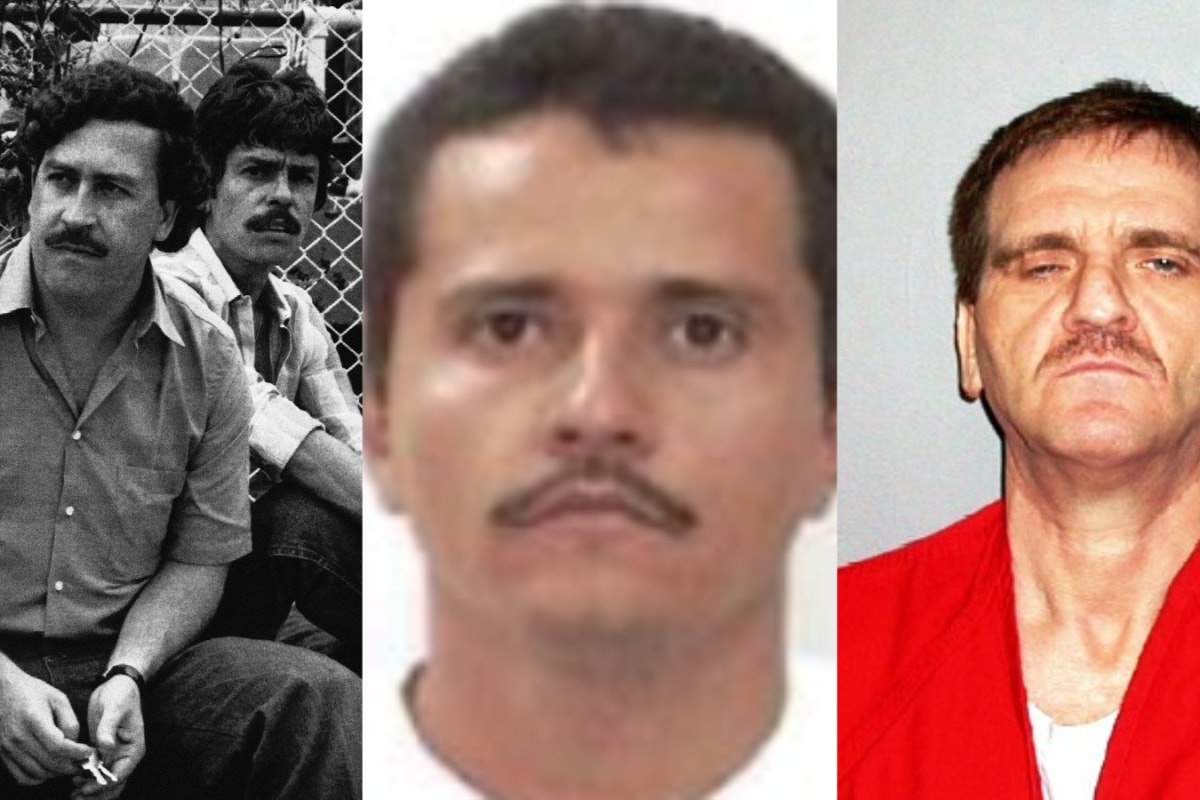








The killing of El Mencho — the elusive and ruthless head of Mexico’s Jalisco New Generation Cartel — has sent ripples through the underworld, marking a dramatic turn in the ongoing struggle against organised
crime in the Americas. His fall, confirmed after a fierce military operation, ignited violent reprisals across several states. It closes the chapter on one of the most feared figures in the continent’s recent history.
But as one titan of the narcotics trade falls, the long, tangled legacy of gang violence, mythic reputations and whispered urban legends surrounding cartel bosses from the Andes to the Gulf reminds us that the stories of North and South America’s most notorious crime lords, from Pablo Escobar toEl Mencho, are as complex and enduring as the shadow economies they helped shape.
El Mencho: The Invisible King
Nemesio Oseguera Cervantes, widely known as El Mencho, began his criminal trajectory in small regional trafficking circles during the 1990s before consolidating power within the Jalisco New Generation Cartel (CJNG). Under his command, the cartel evolved into one of Mexico’s most heavily armed and aggressively expansionist criminal groups, adopting paramilitary-style organisation, deploying armoured vehicle convoys, utilising high-caliber weaponry, and distributing carefully staged propaganda videos to project strength. CJNG distinguished itself through direct and highly public clashes with Mexican security forces — most notably in 2015, when its operatives brought down a military helicopter — a dramatic escalation that cemented El Mencho’s reputation as one of the most formidable and dangerous cartel leaders in the country.
Urban Legends
Stories surrounding El Mencho — often portray him as an “Invisible King.” Rumours suggest he had altered his appearance through plastic surgery, moved about disguised as an ordinary rancher or even a priest, and shifted constantly between remote mountain locations to avoid detection. In reality, while he successfully evaded capture for years, much of this aura likely stems from disciplined operational secrecy rather than anything supernatural.
Another widely circulated narrative is the “cartel army” legend tied to the CJNG. Propaganda videos showing long convoys of masked gunmen in armoured vehicles created the perception that he commanded a private force capable of rivaling state power, with some even claiming entire towns pledge allegiance to him. Although CJNG is well-armed, the imagery is also a calculated display meant to intimidate competitors and amplify fear.
In several regions of Mexico, narcocorridos — ballads that dramatise figures from the drug trade — have contributed to shaping his image. These songs often describe him as calculating, disciplined, and strategically brilliant, sometimes casting him as a rural strongman protecting his domain. Yet behind the mythology lies a record linked to severe violence, forced recruitment, and intimidation of civilians.
There are also tales framing him as the head of a “parallel government.” According to these accounts, he exercises sweeping influence over local police and municipal authorities while simultaneously offering loans or financial support in neglected communities. Such narratives blend elements of reality and exaggeration, as criminal organizations sometimes step into governance vacuums, which in turn strengthens their mythic status.
Pablo Escobar
Pablo Escobar was the head of the Medellín Cartel and, at the height of his power in the 1980s, dominated a significant share of the global cocaine trade. We are all familiar with Pablo Escobar — not because he was a hero, but because his violent empire forced the world to pay attention. For many outside Colombia, his name became widely recognised after the success of Narcos on Netflix, which dramatised his meteoric rise and bloody fall. The series may have brought cinematic scale to his story, but behind the gripping storytelling lay a grim reality: bombings that tore through cities, assassinations of judges and journalists, and a narcotics network that destabilised an entire nation. The danger with turning men like Escobar into screen legends is that spectacle can sometimes soften memory — and in doing so, blur the suffering that built their notoriety.
Urban Legends
His immense wealth and influence turned him into one of the most feared criminal figures in the world. Over time, however, fact blended with folklore. Stories claim he once burned millions of dollars in cash to keep his daughter warm while in hiding, that vast sums of his fortune remain buried across Colombia in secret vaults, and that the infamous “cocaine hippos” roaming near his former estate at Hacienda Nápoles serve as eerie remnants — even mythical guardians — of his lost empire. In parts of Medellín, he is still remembered by some as a Robin Hood–like benefactor who financed homes and football fields in impoverished neighborhoods.
The reality, however, is far more brutal. While he did fund housing and local projects that earned him loyalty in certain communities, Escobar simultaneously orchestrated bombings, assassinations, kidnappings, and terror campaigns that claimed thousands of lives. The legend emphasises generosity and daring; the historical record documents calculated violence and widespread suffering.
Fernandinho Beira-Mar
Fernandinho Beira-Mar, born Luiz Fernando da Costa, became one of Brazil’s most notorious drug traffickers and a prominent figure within the Comando Vermelho. Rising through Rio de Janeiro’s criminal networks in the 1990s, he was known for coordinating large-scale cocaine trafficking operations and forging international arms-for-drugs exchanges. His activities extended beyond Brazil’s borders, linking him to suppliers and insurgent groups in neighboring countries, which elevated his profile as a transnational crime figure. Eventually captured and imprisoned, he remained a high-value inmate within Brazil’s federal prison system.
Urban Legends
Around him, however, grew a powerful layer of urban legend. Rumours claimed he continued directing complex operations from behind bars through coded messages, effectively running a criminal empire from his cell. Other stories suggested he had bribed entire prison wings, creating “mini-favelas” within federal facilities where his authority remained unquestioned. In parts of Rio, tales even circulated that he possessed an almost supernatural instinct for anticipating police raids. While Brazil’s prison system has long struggled with gang influence and internal economies, much of the mythology surrounding him amplified real structural weaknesses into a near-mythic image of control and invincibility.
Héctor Luis Palma Salazar
Héctor “El Güero” Palma was a founding member of the Sinaloa Cartel and a close associate of Joaquín Guzmán during the cartel’s formative years in the late 1980s and early 1990s. Originally a police officer in Sinaloa, Palma moved into drug trafficking and rose quickly through the ranks, becoming a key logistics and distribution figure as the cartel expanded its cocaine routes into the United States. His career was marked by violent turf wars, particularly after the breakup of the Guadalajara cartel network. He was arrested in 1995 following a plane crash in Mexico and later extradited to the United States, where he served time before being returned to Mexico.
Urban Legends
The urban legends surrounding Palma are among the darkest in cartel folklore. According to widely repeated accounts, a Venezuelan associate betrayed him, had his wife murdered, and allegedly sent him her severed head — an act said to have triggered Palma’s ruthless revenge campaign. Stories claim he retaliated with extreme brutality against those responsible, cementing his reputation as a figure driven by personal vengeance.
While the betrayal and killings are part of documented criminal history, many of the grisly details have been amplified through narcocorridos, courtroom lore, and media retellings, blending fact with dramatic embellishment. As with many cartel figures, the myth magnifies the violence, but the underlying reality remains one of severe criminality and bloodshed.
Abimael Guzmán
Abimael Guzmán was the founder and ideological leader of the Maoist insurgent organization Shining Path (Sendero Luminoso), which waged a violent internal conflict against the Peruvian state beginning in the late 1970s. A former philosophy professor, Guzmán built a rigidly doctrinaire movement rooted in a radical interpretation of Maoism, calling for a peasant-led revolution. The insurgency that followed led to bombings, assassinations, massacres, and widespread terror, contributing to tens of thousands of deaths during Peru’s internal conflict. He was captured in Lima in 1992 by Peruvian intelligence forces, a turning point that significantly weakened the organisation.
Urban Legends
Around him, however, circulated powerful myths, particularly in remote rural and Andean regions. Some believed he was protected by supernatural forces, while others whispered that he could vanish into the mountains at will, evading capture through almost mystical means. There were also stories portraying him as possessing prophetic insight or a destiny tied to revolution.
These narratives amplified his aura of invincibility — an image that was dramatically punctured when authorities publicly displayed him in a striped prison uniform inside a metal cage following his arrest. The spectacle dismantled much of the mystique, replacing legend with the stark reality of a captured insurgent leader.