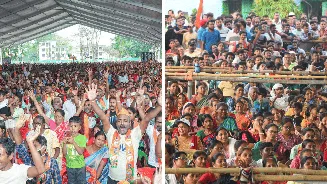






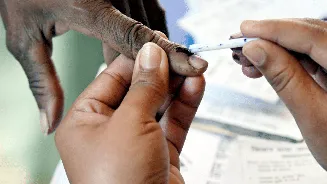
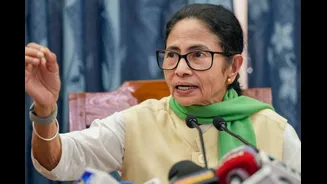
With West Bengal entering the heat of the 2026 assembly elections as the first round of voting was held on Thursday, the political battle is being fought not just in rallies and “Parivartan Rath Yatras”
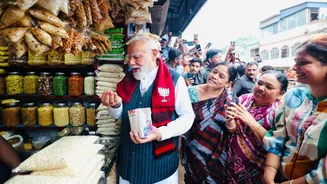
but also over the humble newspaper cones of the state’s most iconic street food. Jhalmuri, the spicy, pungent, and crunchy puffed rice snack, has emerged as the ultimate democratic leveller on the campaign trail. Whether it is a candidate sharing a “thonga” (paper bag) with locals in a village or a voter discussing seat distributions at a roadside stall, Jhalmuri remains the quintessential accompaniment to Bengal’s legendary political “adda”.
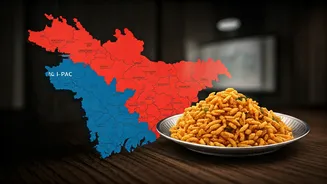
In the 2026 electoral landscape, the numbers surrounding this street-side staple are as staggering as the voter turnout. Across the 152 constituencies that went to the polls in the first phase today, an estimated 300,000 unorganised street vendors served as the unofficial hubs for political discourse, churning out roughly 1.2 million cones of Jhalmuri to hungry voters and party workers alike. With a record-breaking 90% voter turnout reported by the Election Commission, the scale of “Jhalmuri diplomacy” underscores its status as the most effective, low-cost medium for reaching Bengal’s 75 million-strong electorate.
Why has Jhalmuri become a symbol of the Bengal polls?
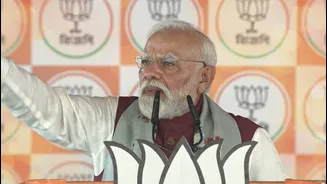
In this election cycle, Jhalmuri has transitioned from a mere snack to a strategic tool for political outreach. Candidates across party lines—from the ruling Trinamool Congress (TMC) to the surging Bharatiya Janata Party (BJP) led by Prime Minister Narendra Modi—frequently stop their convoys at local “Muri-wallas” to signal their connection with the common man. The snack’s composition itself is a metaphor for Bengal’s diverse and complex electorate: a mix of varied ingredients that must be perfectly balanced with “Sorsher Tel” (mustard oil) to create a cohesive result.
For a politician, eating Jhalmuri on camera is a masterclass in optics. It requires no fine dining etiquette and is accessible to the poorest voter. As the Election Commission monitors the high-stakes polls, the quiet rustle of puffed rice remains a constant in the backdrop of every “Chai pe Charcha” and “Chowpal” across the state.
What is the historic origin of this crunchy delicacy?
The history of Jhalmuri is deeply intertwined with the industrial and social evolution of undivided Bengal. While puffed rice (Muri) has been a staple in Bengali households for centuries, the specific “Jhal” (spicy) avatar we recognise today gained prominence during the Second World War. Kolkata, then a major hub for Allied troops, saw a massive influx of migrants from Bihar and Uttar Pradesh looking for work.
These migrants brought with them the concept of mixing spices and savoury elements, which merged with the local Bengali love for mustard oil and green chillies. Street vendors near the jetties of the Hooghly River and the busy railway stations of Howrah and Sealdah began tossing these ingredients in tin cans, creating a portable, affordable, and high-energy snack for the working class. Over the decades, it evolved from a “labourer’s lunch” to a cultural icon that even found its way to the streets of London through the famous “Jhalmuri Express.”
How can you recreate the authentic ‘Muri-walla’ taste at home?
Achieving the perfect Jhalmuri at home requires an understanding of the “Jhal” (heat) and the “Tok” (sourness) that define the street experience. The foundation is fresh, crisp puffed rice. In a large bowl, combine two cups of Muri with a generous tablespoon of raw mustard oil—this is non-negotiable for the authentic, pungent aroma. Add finely chopped red onions, cucumbers, and tomatoes to provide a fresh crunch.
For the savoury depth, mix in “Chanachur” (spicy gram flour noodles), roasted peanuts, and boiled potato cubes. The “secret” ingredient used by vendors is often a splash of “Acharer Tel” (oil from a mango pickle jar) and a sprinkle of black salt (Bit Nun). Finish with finely chopped green chillies, a squeeze of fresh lime, and a handful of fresh coriander. The key is to mix rapidly and consume immediately; even a minute’s delay can turn the crisp Muri soggy, losing the very “spirit” of the dish.
Is Jhalmuri a casualty of the ‘Modern vs Traditional’ debate?
As Bengal modernises, Jhalmuri faces a unique challenge from processed snacks and global fast food. However, in the 2026 socio-political climate, there is a visible “Return to Roots” movement. Young voters and urban “Bhadralok” are increasingly shunning air-conditioned cafes for the authenticity of the street corner. This resurgence is reflected in the election manifestos as well, where parties are promising better social security for unorganised street vendors.
The snack remains a testament to the Bengali resilient spirit. Much like the state’s politics, Jhalmuri is loud, spicy, and unapologetically bold. Whether it is the Election Commission’s flying squads or the local “Karyakartas” (workers), everyone eventually finds common ground at the Muri stall. In the end, as the ballot boxes are sealed, the only certainty in West Bengal is that the debate will continue over the next cone of Jhalmuri.