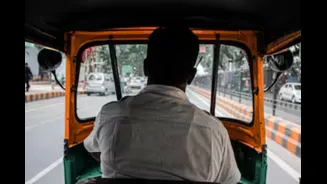







Autorickshaw passengers in Tamil Nadu will pay higher fares under a revised rate structure announced by the state government after more than 13 years without a change to the original minimum fare. The
minimum charge has risen from Rs 25 to Rs 50 for the first 1.8 km, while the rate for every additional kilometre has increased from Rs 12 to Rs 25.
The revised fares were notified by the Home (Transport-I) Department on Tuesday, October 27. The order also sets separate rates for journeys through ghat areas, travel during night hours and waiting time.
Under the new structure, the minimum fare for autorickshaws operating on ghat routes is Rs 60, followed by Rs 30 for each additional kilometre. Waiting will cost Re 1 per minute, while passengers travelling between 10 pm and 5 am will be charged 1.5 times the regular fare.
New Auto Fares In Tamil Nadu: Minimum, Per-Kilometre And Night Charges
The revised rates cover contract-carriage autorickshaws operating in Chennai Metropolitan Area and other regions of Tamil Nadu. The government has directed the State Transport Authority and the relevant Regional Transport Authorities to implement the updated fare structure.
The key changes are:
- First 1.8 km: Rs 50, up from Rs 25.
- Every additional kilometre: Rs 25, up from Rs 12.
- Ghat-route minimum fare: Rs 60.
- Additional distance on ghat routes: Rs 30 per kilometre.
- Night journeys: 1.5 times the regular fare between 10 pm and 5 am.
- Waiting charge: Re 1 per minute.
For ghat journeys, the notification specifies a rate equivalent to 1.2 times the regular minimum fare, setting the base charge at Rs 60. The additional kilometre rate for these routes is Rs 30.
Why Tamil Nadu Has Changed Auto Fares
The earlier fare structure dates back to August 2013, when the minimum charge was fixed at Rs 25 for the first 1.8 km and Rs 12 for every subsequent kilometre. A further government notification in October 2014 extended the earlier arrangement to other districts.
Auto drivers’ unions had been pressing for a revision, arguing that the cost of running their vehicles had increased considerably. Their concerns included rising fuel prices, insurance premiums, repair and maintenance expenses, and competition from app-based aggregators and bike taxis.
During discussions over the revision, drivers’ unions sought a minimum fare of Rs 60 for the first 1.5 km and Rs 30 for each additional kilometre.
Consumer organisations suggested a different structure, proposing a minimum charge of Rs 50 for the first 1.8 km or 2 km, followed by additional distance-based charges.
The government has now settled on Rs 50 for the first 1.8 km and Rs 25 for every additional kilometre, alongside separate provisions for ghat routes and night travel.
Transport Minister Had Promised Revision Before Deepavali
The announcement follows an assurance from Transport Minister A Vijay Tamilan Parthiban that the state would revise autorickshaw fares before Deepavali. The minister had given the assurance to auto drivers a few days before the government issued its notification.
The revision also follows a long-running demand for fares to be brought in line with changing operating costs. In February 2022, the Madras High Court directed the state government to revise autorickshaw fares, taking into account both the expenses faced by drivers and the interests of passengers.
New Notification Replaces 2013 And 2014 Orders
The government has issued the revised rates under Section 67(1) of the Motor Vehicles Act, 1988. The notification supersedes two earlier Home Department orders: one dated August 25, 2013, and another dated October 16, 2014.
It directs the State Transport Authority and the Regional Transport Authorities concerned to fix the new rates for contract-carriage autorickshaws in Chennai Metropolitan Area and the rest of Tamil Nadu, respectively.
The revised structure covers the minimum distance and fare, additional kilometre charges, ghat-route rates, night-time fares and waiting fees. The new notification therefore replaces the previous government-approved fare framework that had remained in place since 2013, with the 2014 order extending it to other districts.