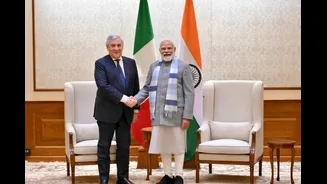

The personal rapport between Prime Minister Narendra Modi and Italian Prime Minister Giorgia Meloni has quietly become one of the strongest pillars of Delhi–Rome ties. Over the past few years, their frequent
meetings and clear alignment on global and strategic issues have given the India–Italy relationship a steady political anchor at a time of global churn.
Italian Deputy Prime Minister and Minister of Foreign Affairs and International Cooperation Antonio Tajani, who paid his second official visit to Delhi last week, sat down with CNN-News18 for an exclusive interview to explain how that political trust is being translated into action. From Italian investments in India and progress on the India–EU free trade agreement amid renewed tariff pressures from the US, to Meloni’s priorities ahead of her next visit, Tajani spoke about deepening cooperation across trade, defence, and technology.
He also detailed Italy’s plans to expand student intake and scholarships, increase Italian language teaching capacity in India, launch a joint initiative to counter terror financing, and Rome’s assessment of New Delhi’s growing diplomatic role, including its ability to engage Moscow while maintaining strong ties with Europe following President Vladimir Putin’s recent visit to India.
Here are edited excerpts from the interview:
Q: Italy has pitched itself as India’s economic gateway to Europe. Following your recent visit to New Delhi, which sectors are you now prioritising for Italian investment in India?
Antonio Tajani: Italy and India share strong economic complementarities. Historically, both have served as natural endpoints of an Indo-Mediterranean trade and investment corridor that has existed for centuries. Building on this legacy, the Italian government has chosen to invest decisively in the India-Middle East-Europe Economic Corridor, launched under India’s G20 Presidency in 2023. The objective is to better connect Italy and the wider European market, via Trieste, the Adriatic, the Balkans, West Asia, and North Africa, with the Gulf and India. In practical terms, it is about bringing more India to Italy and more Italy to India.
Our aim is to expand trade to €20 billion by 2029 and significantly increase two-way investments. India is the world’s fastest-growing major economy and is seeking reliable partners to strengthen its domestic industrial base. Italy, as Europe’s second-largest industrial power, is well placed to contribute to that growth.
We bring strong capabilities in technology and manufacturing across sectors ranging from advanced machinery and precision agriculture to automotive, defence, waste-to-energy, and even sports technologies. Our focus is on deeper co-production, joint ventures, and industrial partnerships, while also encouraging greater Indian investment in Italy.
Q: With President Trump reviving tariff-based trade measures, how concerned is Italy about potential spillover effects on India–EU trade, and could this add momentum to concluding the India–EU FTA?
Antonio Tajani: I would not frame the economic partnership between Europe and India through the prism of actions taken by third countries. Even before President Trump’s presidency, the European Union was India’s largest trading partner in goods. Today, our trade stands at around €120 billion, having grown by nearly 90 per cent over the past decade, and it accounts for almost one-fifth of India’s total trade.
Over 6,000 European companies operate in India, including around 700 Italian firms, while the EU’s stock of foreign direct investment in India has reached €140.1 billion. These figures reflect the reality that Europe and India are two foundational economic poles at the global level, bound by a shared commitment to technology, innovation, and resilient value chains.
In this context, an ambitious and mutually beneficial free trade agreement is a clear win-win. Italy fully supports its early conclusion. Negotiations between the EU and India have made significant progress in recent months, and we are now approaching the finishing line. I am confident of a positive outcome, as there is simply too much at stake for both sides to miss this opportunity.
Q: Prime Minister Meloni is expected to visit India next year. What will be her top priorities for advancing the bilateral agenda?
Antonio Tajani: The close relationship between Prime Ministers Giorgia Meloni and Narendra Modi, both at a working and personal level, has become a key asset in Italy–India ties. Over the past three years, the two leaders have met six times, reflecting a clear convergence of views and a shared, pragmatism-driven approach. We very much look forward to their next bilateral meeting. During my recent visit to New Delhi, Prime Minister Modi confirmed that he has accepted Prime Minister Meloni’s invitation to visit Italy in 2026.
Strong political dialogue is a precondition for fully implementing and building momentum around the Joint Strategic Action Plan 2025–29. This roadmap guides our cooperation across priority areas, including the economy and innovation, defence and science, connectivity and energy, as well as culture, sport, security, mobility and people-to-people exchanges.
Q: As the Russia-Ukraine conflict drags on and President Vladimir Putin’s recent visit to India underscored his close ties with Prime Minister Modi, how does Italy view India’s diplomatic role — particularly its ability to engage Moscow while maintaining strong relations with Europe?
Antonio Tajani: Italy and India share a common vision in support of peace and the resolution of conflicts through dialogue. India, now the world’s most populous country and on track to become the third-largest economy by the end of the decade, is playing an increasingly influential role on the global stage.
Its growing voice in international affairs was also evident in its participation in the G7 hosted by Italy in 2024, and we consider India an indispensable actor in addressing major global challenges. Italy firmly believes in the need for a just and lasting peace in Ukraine. We are convinced that New Delhi shares this objective and can make a meaningful contribution to efforts aimed at resolving the crisis.
Q: Italy has been pushing for more Indian students and tourists. With US universities tightening access for Indian students, how is Italy planning to expand student intake, scholarships, and fast-track visas?
Antonio Tajani: Around 12,000 Indian students are currently studying at Italian universities, drawn by high academic standards and strong offerings in areas such as STEM. But the Italy-India partnership is about far more than classrooms and degrees. It is also about the movement of talent, ideas, and ambition.
We want to see many more Indian students and researchers choose Italy, not only because they gain from our education system, but because their presence adds real value to Italian society and our innovation ecosystem. To support this, Italy plans to establish an innovation centre in India that will connect Indian talent with Italian universities, researchers, and industry, creating a two-way exchange of skills and expertise.
Language is another bridge we are keen to strengthen. Expanding the teaching of Italian in India, by increasing the number of trained language teachers, will allow a wider and more diverse group of Indian students to engage with Italy academically and culturally.
At the same time, our Embassy and Consulates are fully engaged in ensuring that Indian students can enter Italy in a timely and secure manner. We see student mobility not as a side issue, but as a long-term investment in the future of our bilateral relationship.
Q: India and Italy have announced a joint initiative to combat terror financing after PM Modi held talks with his Italian counterpart Giorgia Meloni in Johannesburg, in November. How will this cooperation move beyond intelligence sharing into enforcement, especially against cross-border funding networks?
Antonio Tajani: Terrorism remains a serious and shared threat to both India and Italy. Following the barbaric attack in Pahalgam, our government immediately expressed its full solidarity with India. Prime Minister Giorgia Meloni also conveyed her readiness to launch a joint initiative focused on cutting off the sources of terrorist financing.
Italy brings long-standing experience to this fight against terrorism. One of the guiding principles of our counter-terrorism approach comes from Giovanni Falcone, one of Italy’s most respected judges who played a decisive role in defeating organised criminal networks. His simple but powerful rule was to “follow the money.”
Applying this principle today requires a systemic domestic approach, with close coordination among law enforcement agencies, financial authorities, and intelligence services. At the same time, no country can address this challenge alone. Strong and sustained international cooperation is now more essential than ever.