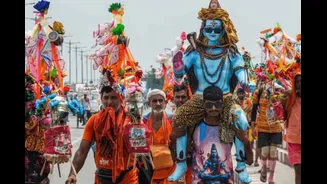








Ahead of the Kanwar Yatra beginning July 30, police across Uttar Pradesh, Uttarakhand and Delhi’s border districts have banned oversized DJ setups, weapons and non-vegetarian food along pilgrim routes,
even as a fresh diversion on Meerut’s NH-58 has triggered hours-long jams on the narrow Hastinapur-Chandpur stretch.
The pilgrimage, which runs from July 30 to Shravan Shivratri on August 11, sees lakhs of kanwariyas travel on foot and by vehicle to collect Ganga water from sites like Haridwar and Gangotri before returning to offer it at local Shiva temples.
To manage the crowds, police in Haridwar, Muzaffarnagar, Meerut, Hapur, Baghpat, Agra and Delhi’s neighbouring districts have rolled out route diversions, dedicated parking zones and heavy-vehicle restrictions, alongside food-safety checks at eateries along the way.
What Are The Do’s And Don’ts This Year?
| Do’s | Don’ts |
|---|---|
|
Carry ID proof through the yatra |
No hockey sticks, baseball bats, clubs, swords or weapons of any kind |
| Stick to designated kanwar routes only | No modified silencers or pressure horns on two-wheelers |
| In Baghpat: keep kanwar/DJ height under 10 ft, width under 12 ft, sound under 75 decibels | No non-vegetarian food, onion or garlic served at eateries on the route |
| In Agra: keep kanwar height under 12 ft, DJ sound within prescribed norms | Meat shops must stay shut near kanwar routes and temples |
| Camp organisers must install CCTV, fire safety gear and lighting | Check displayed rate cards before buying food/water at dhabas (don’t overpay) |
What Are The DJ And Kanwar-Height Rules, City By City?
Baghpat police have capped kanwar and DJ setups at 10 feet in height and 12 feet in width, with sound levels for DJs and other systems restricted to 75 decibels. No kanwar carrying weapons — hockey sticks, baseball bats, clubs or swords — will be allowed, and modified silencers or pressure horns on two-wheelers have been banned.
In Agra, a separate coordination meeting chaired by police commissioner Deepak Kumar set the kanwar height limit at 12 feet, with DJ volumes to be played within prescribed norms. Meat shops along kanwar routes and near temples will remain fully shut, and food department teams will inspect dhabas and hotels to ensure rate lists are displayed.
Where Is Traffic Already Piling Up?
The worst of it so far is on the Hastinapur-Chandpur stretch near Meerut. With heavy vehicles barred from NH-58 between July 28 and August 10, trucks have been rerouted through Hastinapur’s khadar (riverbed) area onto this narrower road, causing long queues and near-constant jams through the day. Locals say the stretch was already in poor condition, and residents have asked for additional traffic police to be deployed as school-goers, farmers and traders get stuck for hours.
What Route Diversions Are In Place Across Cities?
| City/Route | What’s changed |
|---|---|
|
Meerut (NH-58) |
Heavy vehicles barred July 28–Aug 10; rerouted via Hastinapur khadar-Chandpur, causing jams |
| Muzaffarnagar (NH-58) | Heavy vehicles barred July 29 midnight–Aug 12; one highway lane reserved for kanwariyas till Aug 4, both lanes after |
| Haridwar | Vehicles from Saharanpur, Delhi, Meerut and Yamunanagar rerouted to Bairagi Camp parking via Mandawar/Abdul Kalam Chowk |
| Dehradun-Rishikesh | Vehicles diverted via Nepali Tiraha and Dudhadhari flyover to Chamgadad Tapu/Lalji Wala parking; Delhi-Dehradun Expressway off-limits to kanwar vehicles |
| Delhi border districts | Joint coordination with Meerut, Hapur, Bulandshahr and Gautam Buddh Nagar police; WhatsApp group set up for real-time traffic alerts, extra emergency parking planned |
What About Food And Eatery Rules Along The Route?
The Food Safety Department has begun inspecting hotels and dhabas along yatra roads — around 130 in Hapur alone, officials there said.
In Muzaffarnagar, assistant commissioner (food) Archana Dheeran told PTI that non-vegetarian cooking, onion and garlic are banned at eateries on the route, a rule she said is enforced every year, with six teams checking for stale food.
Authorities have also fixed standard rates for 21 essential items to prevent overcharging, and eateries must display owner details, licence and food-safety QR codes; cooks are required to wear gloves.