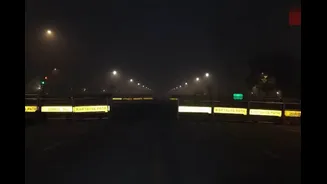









A thick layer of toxic smog continued to blanket parts of the national capital on Thursday, with visuals from the Najafgarh area showing severely reduced visibility and a persistent haze hanging over roads
and residential localities.
According to data from the Central Pollution Control Board (CPCB)’s Sameer app, Delhi’s AQI was recorded at 356 in the ‘very poor’ category, as of 6:00 am on Thursday.
#WATCH | Delhi: Visuals from the Najafgarh area as a layer of toxic smog continues to blanket the national capital.
AQI here is 284, categorised as ‘poor’ as per the Central Pollution Control Board (CPCB).
CAQM (Commission for Air Quality Management) has invoked all actions… pic.twitter.com/ve7xM01rN3
— ANI (@ANI) December 18, 2025
Anand Vihar recorded the highest AQI at 415 in the ‘severe’ category, followed closely by Vivek Vihar (410), Jahangirpuri (405), Rohini (400), ITO (399), Mundka (398) and Ashok Vihar (395). The Air Quality Index (AQI) in Najafgarh was recorded at 284, placing it in the ‘poor’ category.
#WATCH | Delhi | Visuals around Anand Vihar area as a thick layer of toxic smog engulfs the national capital.
AQI (Air Quality Index) around the area is 415, categorised as ‘severe’, as claimed by CPCB (Central Pollution Control Board).
CAQM (Commission for Air Quality… pic.twitter.com/0rQCBzHvRG
— ANI (@ANI) December 18, 2025
An AQI between 0 and 50 is considered ‘good’, 51 to 100 ‘satisfactory’, 101 to 200 ‘moderate’, 201 to 300 ‘poor’, 301 to 400 ‘very poor’, and 401 to 500 ‘severe’.
Train Delayed
Dense fog continued to disrupt rail services on Thursday morning, with at least 22 trains approaching New Delhi Railway Station running behind schedule over the next three hours.
As of 7 am, several long-distance trains were significantly delayed, including the Shramjeevi Express, which was running late by 2 hours and 48 minutes, the Jammu Rajdhani by 1 hour and 33 minutes, and the Tamil Nadu Superfast by over an hour. The Mahabodhi Express, Malwa Express, and Bihar Sampark Kranti were each delayed by more than four hours, reflecting the widespread impact of low visibility conditions on train operations.
Delhi Limits Office Attendance
With stricter pollution curbs in place across Delhi, the Labour Department on Tuesday announced work-from-home norms for government offices and compensation for construction workers impacted by the prolonged suspension of construction activities under the Graded Response Action Plan (GRAP).
As per the department’s decision, only 50 percent attendance will be allowed in offices and business establishments across the national capital starting December 18, while the remaining staff will work from home. Offices have also been asked to introduce flexible working hours.
The Delhi government has also suspended physical classes for students from nursery to Class 5. While parents earlier had the option to choose between online and offline learning, students in these grades will now continue classes from home.
Meanwhile, schools will operate in a hybrid mode for students of Classes 6 to 9 and Class 11, giving them the choice to attend classes either online or in person.
The Rekha Gupta-led Delhi government also announced tougher measures to curb rising pollution, including barring vehicles without a valid Pollution Under Control (PUC) certificate from purchasing petrol or diesel. Only BS VI–compliant vehicles will be allowed to operate within the city, while older vehicles will face restrictions.