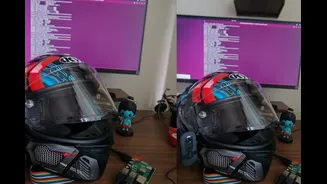

A Bengaluru techie whose AI-powered helmet for spotting traffic violations went viral online has now taken the conversation straight to the city’s top traffic officials. Pankaj Tanwar, the engineer behind
the experimental “AI traffic police” helmet, recently met the Joint Commissioner of Police to discuss whether the technology could work beyond social media demos.
Sharing details on X, Tanwar described the meeting as long, open and encouraging. “Met the joint commissioner, Bengaluru, today. Spent approximately two hours in a detailed discussion with officers. Pretty open, thoughtful and they genuinely loved the idea,” he wrote.
According to Tanwar, senior officers were keen to understand both the promise and the limits of the system before talking scale.
met the joint commissioner, blr today. spent ~2 hours in a detailed discussion with officers. pretty open, thoughtful and they genuinely loved the idea.
a few takeaways from the chat:
– direct integration with official astram apis
– snitching culture argument is baseless, goal… https://t.co/RmHpUA6YLg— Pankaj (@the2ndfloorguy) January 12, 2026
Integration, Criticism And The ‘Snitching’ Debate
One of the key topics was whether the helmet could plug into existing enforcement systems. Tanwar said officers discussed the possibility of direct integration with AstraM APIs, the backend infrastructure used by Bengaluru Police for traffic enforcement.
He also addressed online criticism that the helmet encourages a “snitching culture”. Tanwar said police officers were clear on that point. “Snitching culture argument is baseless, goal is deterrence and safety,” he quoted from the discussion. The focus, according to officers, was not punishment for its own sake but safer roads and visible enforcement.
Another point raised during the meeting was scale. “Violation detection at scale is still an evolving problem,” Tanwar noted, especially in a city as complex as Bengaluru. Officers also touched on behavioural science, arguing that the feeling of being watched often changes driving habits more effectively than fines alone. “Creating a sense of being observed has more long-term impact than issuing challans alone,” he wrote.
Low Compliance And What Comes Next
A striking statistic shared during the discussion stood out. Only about 20 per cent of traffic challans issued currently get paid. That gap, officers admitted, remains a serious challenge. Tanwar said he was also shown the city’s existing large-scale camera and AI surveillance setup. “Crazy to see scale and effort already being put,” he wrote, adding that officials were curious about how his helmet could complement what already exists.
For now, Tanwar plans to build a smaller early prototype and refine his AI models. He made it clear the idea isn’t driven by money. “No incentives, at least for now,” he wrote, saying the project would likely need grants or institutional backing.
i was tired of stupid people on road so i hacked my helmet into a traffic police device
Tanwar’s helmet first caught attention after he shared a video explaining how it works. Built around a Raspberry Pi, the setup runs an AI agent in near real time while he rides. Using computer vision, it flags violations like riding without a helmet, wrong-side driving and number plate issues, tagging them with red boxes and location data that could, in theory, be sent directly to authorities.