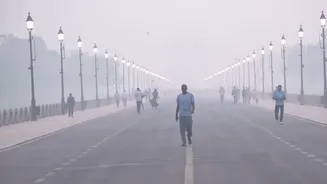





Delhi is set to introduce a series of restrictions from November 1 as the government steps up efforts to tackle the sharp deterioration in air quality during winter.
Chief Minister Rekha Gupta on Tuesday
announced the Delhi government’s 10-point Winter Action Plan for 2026-27, which will remain in effect until February 28. The plan includes stricter vehicle regulations, work-from-home arrangements, construction curbs and measures to control road dust and industrial emissions.
The plan will be implemented in coordination with the Centre, Commission for Air Quality Management (CAQM), Central Pollution Control Board (CPCB), Delhi Police, Delhi Metro Rail Corporation (DMRC), local bodies and other agencies.
No PUC, No Fuel
Delhi will intensify enforcement of its ‘No PUC, No Fuel’ policy from November 1, with checks at 500 petrol pumps equipped with Automatic Number Plate Recognition (ANPR) systems.
The rule, which came into effect on October 1, prohibits vehicles without a valid Pollution Under Control Certificate (PUCC) from refuelling. Vehicles that have exceeded their prescribed lifespan will also be denied fuel.
In another major restriction, petrol and diesel vehicles registered outside Delhi that do not comply with Bharat Stage VI (BS-VI) emission standards will be barred from entering the capital from November 1. However, CNG and electric vehicles will remain exempt.
The government will also provide financial incentives under the Parivartan Yojana and EV Policy 2026 to encourage the scrapping of ageing vehicles and the adoption of cleaner alternatives.
50% Work From Home, Staggered Office Timings
Government and private offices in Delhi will be required to implement work-from-home arrangements from November 1 to reduce traffic congestion and vehicular emissions.
Under the plan, 50% of employees will be required to work remotely, or offices will have to implement a two-day work-from-home arrangement each week.
Office timings will also be staggered to ease peak-hour congestion. Municipal corporation offices will operate from 8.30 am to 5 pm, while Delhi government offices will function from 10 am to 6.30 pm.
Construction Restrictions
The government has proposed a ban on dust-generating demolition activities and outdoor civil construction work between November 1 and January 31.
A broader restriction covering all types of construction and demolition activities will be imposed from December 10 to January 20 as part of efforts to control dust pollution.
Construction sites will also be required to maintain 100% CCTV coverage to strengthen monitoring of pollution-control measures. Registration on the government’s ‘Malba App’ will become mandatory for building-plan approvals.
Parking Fees To Double, Push For Public Transport
To discourage the use of private vehicles, parking charges at authorised facilities across Delhi will be doubled. However, parking facilities operated by the Delhi Metro will be exempt.
The government has also set a target of increasing daily Delhi Metro ridership to 72 lakh passengers and Delhi Transport Corporation (DTC) bus ridership to 42 lakh.
Delhi currently has a fleet of 6,840 buses, including 5,088 electric buses.
The winter action plan also includes efforts to improve last-mile connectivity through the Delhi Metro Sarathi App.
Road Dust Control And Pollution Hotspot Monitoring
The government has set a target of redeveloping 3,000 km of roads to tackle dust pollution, with work on 1,193 km already completed.
Concrete roadwork is scheduled for completion by October 31, while bitumen-related work is expected to be finished by November 15.
To control dust accumulation, 98 mechanical road-sweeping machines have been deployed in two shifts. Agencies have also been directed to accelerate water sprinkling, deep cleaning of roads, footpath improvements, paving and the removal of accumulated garbage.
Weekly inspections will be conducted at 37 identified air-quality and traffic hotspots by MPs, MLAs, councillors and designated nodal officers.
Separately, the government is working to make 15 major road stretches signal-free and congestion-free. Eight have already been completed, with the remaining work targeted for October.
Crackdown On Industrial Pollution And Open Burning
Industrial units violating pollution-control regulations will face stricter enforcement under the winter plan.
According to government figures, 2,283 polluting industrial units have been sealed or shut down following a survey of 11,271 establishments. Further action will target industries operating without adequate pollution-control measures, including those in non-conforming areas.
Authorities have also been directed to implement a ‘Zero Burning’ campaign to prevent the open burning of waste and biomass.
Heating booths will be established for security guards during winter to discourage the use of open fires for warmth.
AI Monitoring And Round-The-Clock Enforcement
The government also plans to deploy AI-enabled monitoring systems to strengthen surveillance and identify violations of pollution-control regulations.
A total of 334 enforcement teams are operating in two shifts around the clock. These include 256 teams from the Municipal Corporation of Delhi, New Delhi Municipal Council and Delhi Cantonment Board, along with 78 teams from the Delhi Pollution Control Committee.