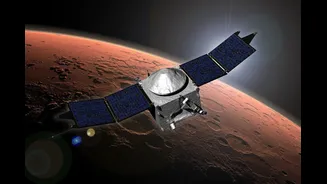









NASA’s MAVEN (Mars Atmosphere and Volatile EvolutioN) spacecraft, which has been orbiting Mars for more than a decade, experienced a loss of contact with ground stations on Earth on December 6.
Telemetry
data received before the spacecraft passed behind the Red Planet showed that all of MAVEN’s subsystems were functioning normally at the time.
However, when the spacecraft emerged from behind Mars and was expected to re-establish communication, NASA’s Deep Space Network did not detect any signal.
NASA’s spacecraft and operations teams are currently investigating the possible causes behind the unexpected loss of contact.
While engineers work to understand what may have gone wrong, the sudden silence has brought the long-running Mars orbiter back into the spotlight, sparking renewed interest in MAVEN’s work around the Red Planet. Here is a closer look at what MAVEN has been studying on Mars, what may have led to the loss of communication, and what steps NASA is taking next..
What MAVEN Was Doing Was At Mars
The MAVEN spacecraft was launched in November 2013 and entered Mars’ orbit in September 2014. The mission’s goal is to explore the planet’s upper atmosphere, ionosphere, and interactions with the Sun and solar wind to explore the loss of the Martian atmosphere to space.
Mars, scientists believe, was not always the dry, frozen world it is today. Ancient riverbeds, lake basins, and mineral deposits indicate a time when liquid water flowed across its surface. For that to happen, Mars must have once had a much thicker atmosphere capable of trapping heat and sustaining water in liquid form.
MAVEN was sent to find out what happened to that atmosphere. Rather than studying Mars from the ground, the spacecraft focused on the planet’s upper atmosphere, the region where gases gradually leak into space.
From this vantage point, MAVEN examined how the Sun’s energy and charged particles interact with Mars and slowly strip away its atmospheric layers. The mission’s goal was not just to observe the present, but to reconstruct billions of years of atmospheric loss and planetary change.
What MAVEN Has Discovered About Mars
Over years of observation, MAVEN delivered a clear answer to one of Mars’ biggest mysteries. Unlike Earth, Mars lacks a strong global magnetic field. That absence left the planet exposed to the full force of the solar wind, a stream of charged particles constantly flowing outward from the Sun.
The solar wind has been steadily eroding Mars’ atmosphere, knocking molecules into space over millions of years. The process was particularly intense in the planet’s early history, when the Sun was more active and violent. As the atmosphere thinned, surface temperatures dropped, pressure fell, and liquid water gradually disappeared.
These findings helped scientists connect Mars’ ancient, wetter past with its cold, barren present. They also offered a cautionary insight into how vulnerable planetary atmospheres can be when stripped of protective shields.
What Loss Of Contact Means & What NASA Is Doing Now
When a spacecraft stops communicating, it doesn’t necessarily signal the end of a mission. Spacecraft are equipped with protective systems that can trigger a shutdown or “safe mode” if an unexpected event occurs, such as a power fluctuation, orientation issue, or interference from space weather.
In MAVEN’s case, although no spacecraft telemetry has been received since December 4, the team recovered a brief fragment of tracking data from December 6.
According to NASA, initial analysis suggests that when MAVEN re-emerged from behind Mars, the spacecraft was rotating unexpectedly. Changes in the tracking signal also indicate that its orbital path may have shifted. Engineers are now closely studying the available data to piece together what may have caused the spacecraft to lose contact.
Engineers are attempting to diagnose the problem from millions of kilometres away by sending commands and waiting for a response. This process can take time, sometimes days or even weeks, depending on the nature of the issue and the spacecraft’s condition.
Why Losing MAVEN Would Still Be A Big Deal
MAVEN has already far outlived its original mission timeline, but its continued presence around Mars remains scientifically valuable.
The spacecraft provides ongoing observations of how Mars’ atmosphere responds to changing seasons and solar activity, offering a long-term perspective that few missions can match.
Its data also supports other Mars missions by helping scientists understand space weather conditions around the planet, information that will become increasingly important as space agencies plan future human exploration.
MAVEN’s role goes beyond studying Mars from orbit. It also helps relay communications between Earth and NASA’s rovers on the Martian surface.
With the spacecraft currently out of contact, NASA is taking steps to limit any impact on ongoing surface missions. MAVEN is one of four orbiters that support these communications.
The remaining orbiters, NASA’s Mars Reconnaissance Orbiter and Mars Odyssey, along with the European Space Agency’s ExoMars Trace Gas Orbiter, are operating normally.
To keep science work on track over the next two weeks, NASA is scheduling additional communication passes through these spacecraft, while the Perseverance and Curiosity teams have adjusted their daily planning.
Whether MAVEN communicates again or not, its contribution to planetary science is already secure.
For now, MAVEN continues its silent journey around Mars. And while engineers on Earth wait for a signal, the spacecraft’s most important work has already been done.