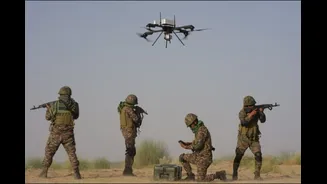










The Ministry of Defence (MoD) has initiated the process to procure 20 Tactical Remotely Piloted Aircraft Systems (RPAs) for the Indian Army, aimed at strengthening surveillance and reconnaissance capabilities
across challenging terrains.
The acquisition, being pursued under the ‘Make in India’ and ‘Atmanirbhar Bharat’ initiatives, will include the RPAs along with associated ground support equipment.
The MoD has issued a Request for Information (RFI) to identify suitable platforms and capable Indian vendors, while also finalising the Services Qualitative Requirements (SQRs) and the appropriate procurement category.
According to the RFI, the RPAs will be deployed across diverse operational environments, with an equal number earmarked for operations in the plains and in high-altitude or mountainous regions.
The systems are expected to support round-the-clock missions and remain fully operational in adverse weather conditions, including strong winds, rain and complex terrain.
The tactical RPAs must be capable of operating in winds of up to 60 knots in high-altitude areas and 30 knots in the plains, withstand rainfall of up to 20 mm per hour, and handle gusts of up to 10 knots during take-off and landing.
They should also be able to function within non-thunderous cloud cover, ensuring uninterrupted surveillance in varied climatic conditions.
Designed with a modular and scalable architecture, the platforms will allow future upgrades with minimal modifications.
The RPAs must be capable of simultaneously integrating at least two different payloads, enhancing operational flexibility. Planned payloads include electro-optical and infrared (EO/IR) sensors, communications and electronic intelligence suites (COMINT and ELINT), synthetic aperture radar (SAR) and foliage-penetrating (FOPEN) radar systems.
The RPA systems are required to offer a minimum endurance of eight hours, operate at altitudes exceeding 24,000 feet for high-altitude missions, and provide a line-of-sight range of at least 120 km, extendable up to 400 km through satellite communications.
They are also expected to function reliably in hostile electronic warfare and GNSS-denied environments, supported by secure dual-band data links with SATCOM as a backup.
In addition to surveillance roles, the platforms are envisaged to have weaponisation potential, with the ability to carry a minimum payload of 200 kg.
This would enable the integration of air-to-ground precision-guided munitions, glide bombs and loitering munitions, significantly expanding the Army’s tactical strike options.