





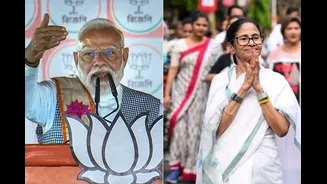
Intense political drama unfolded in Bhabanipur on Thursday as Chief Minister Mamata Banerjee arrived at the EVM strongroom following allegations of voter machine tampering. What actually happens to the electronic
voting machines (EVM) after polling and before counting? Can EVMs be tampered with? News18 explains.
BENGAL’s MIDNIGHT STRONGROOM STANDOFF
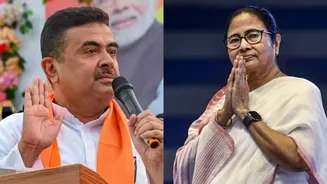
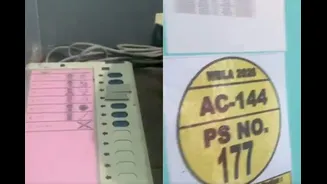
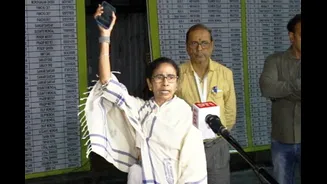
Mamata Banerjee reached the Sakhawat Memorial School strongroom on Thursday night and remained inside for nearly four hours, leaving shortly after midnight. She alleged “manipulation” was occurring and claimed she decided to visit personally after seeing concerning CCTV footage on television.
The Chief Minister claimed Central Forces initially denied her entry, but she asserted her right as a candidate to monitor the sealed rooms. Warning of a “life-and-death fight” against any attempts to steal the counting process, she accused the Election Commission of one-sidedness and bias.
The Election Commission rejected the claims, clarifying that the activity in the footage was the authorised segregation of postal ballots, which all parties had been informed about in advance.
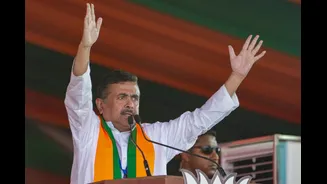
BJP leader Suvendu Adhikari shared footage of his own agent keeping watch over the CM while she was inside the premises to ensure no “dishonest means” were used. Earlier on April 30, Mamata Banerjee rejected exit poll projections showing a BJP lead, calling them a “demoralisation tactic” orchestrated at the instruction of the BJP.
ECI Introduces QR-Based ID System to Strengthen Security at Counting Centres
Read more : https://t.co/PBjfJOexYC pic.twitter.com/ZZwpDJ2dlF
— Election Commission of India (@ECISVEEP) April 30, 2026
EVMS: AFTER POLLING AND BEFORE COUNTING, THE PROCESS
Sealing: Once voting ends, the Ballot Unit, Control Unit, and VVPAT are switched off and sealed with multiple physical seals in front of polling agents. These seals are signed by officials and representatives of candidates, which means any later tampering would be visibly detectable. The idea is to create a verifiable “lock” at the point where voting stops.
Secure transportation to storage centres: After sealing, the machines are transported to designated storage locations under tight security. They usually move in escorted convoys, often with GPS tracking, and candidates or their agents are allowed to follow. This step ensures the machines are not out of sight or control during transit.
Storage inside strong rooms: The machines are kept in heavily guarded “strong rooms” under the supervision of the Election Commission of India. These rooms have layered protection—double locks, armed security personnel, and continuous CCTV monitoring—to prevent unauthorized access.
Continuous political oversight: Candidates can place their representatives outside the strong rooms кругл the clock, and in many cases they can also monitor CCTV feeds. This creates a system where not just officials but competing political parties are watching the machines, adding a layer of mutual scrutiny.
Strict logging and restricted access: Every movement or handling of EVMs is recorded in logs, and access to strong rooms is tightly controlled. If the room ever needs to be opened—for example, due to an emergency—it must be done in the presence of authorized officials and observers, with full documentation.
Verification on counting day: When counting begins, seals are checked in front of candidates and their agents before anything is opened. Only if the seals are intact does the counting proceed, and the Control Unit is used to retrieve the stored votes.
Cross-check using VVPAT slips: A sample of polling stations is selected where VVPAT paper slips are counted and matched with the electronic results. This acts as an audit mechanism to confirm that the EVM count aligns with a physical paper trail.
Legal and procedural backing: These steps are part of a system repeatedly examined by courts, including the Supreme Court of India, which has upheld EVM use while pushing for added verification measures like expanded VVPAT checks.
IS TAMPERING WITH EVMS POSSIBLE? WHAT ECI, CRITICS SAY
The ECI maintains that EVMs are “secure, standalone, and tamper-proof by design.”
It argues that tampering is extremely difficult because the machines are not connected to any network or internet, which eliminates remote hacking possibilities. The system is also built so that votes are stored in a non-rewritable memory chip, meaning recorded votes cannot be altered or deleted once cast.
ECI says even if someone tries physical interference, multiple safeguards (see the process above) prevent successful tampering. Any break in seals or unauthorized access would be immediately visible.
Before deployment, EVMs undergo technical evaluation by government-approved bodies, are tested for functionality and integrity, and are randomly checked during elections through mock polls.
The ECI also points out that EVMs used in India are custom-built and not general-purpose computing devices, which reduces attack surfaces.
The Supreme Court of India has repeatedly upheld the use of EVMs, while directing improvements like expanded VVPAT verification. Courts have generally accepted that theoretical vulnerabilities exist in any system, but no proven large-scale tampering has been established in practice
Critics argue that physical access during transit/storage is the weakest point. They say full verification is limited because only a sample of VVPAT slips is counted. They argue that trust relies heavily on procedure, not full end-to-end cryptographic transparency.
ECI BROUGHT IN NEW SYSTEM TOO: WHAT IS QR-BASED MODULE?
The Election Commission of India (ECI) has launched a QR-based Photo Identity Card module on its ECINET platform to secure counting centres for the 2026 Assembly elections. This system goes live on May 4, 2026, for the counting of votes in West Bengal, Assam, Kerala, Tamil Nadu, and Puducherry.
To prevent unauthorised entry, the ECI has mandated a strict triple-check verification process at all counting locations:
Levels 1 & 2: Manual verification of Photo ID cards issued by the Returning Officer (RO) at the outer perimeters.
Level 3 (Innermost): Entry to the counting hall is strictly restricted and permitted only after a successful QR code scan.
Implementation Details
The mandatory QR-based cards apply to all personnel authorised to enter the counting halls — Returning Officers (ROs) and Assistant Returning Officers (AROs), Counting staff and technical personnel, Candidates, election agents, and counting agents.
Dedicated Media Centres will be set up near halls for authorised press, who will still use traditional authority letters for entry. This system is part of over 30 recent reforms and will become the standard for all future Lok Sabha and State Assembly elections. District Election Officers have been directed to deploy specially trained personnel at checkpoints to manage the scanning process seamlessly.
KEY FAQs
What happens to EVMs immediately after voting ends?
After polling closes, EVMs are switched off and sealed at the booth itself. The Ballot Unit, Control Unit, and VVPAT are locked with paper seals signed by polling officials and party agents to ensure any later tampering would be visibly detectable.
Where are EVMs kept before counting?
They are transported under armed security to designated “strong rooms” and stored under CCTV surveillance. The Election Commission of India ensures round-the-clock guarding, and political party representatives are allowed to monitor the storage area continuously.
Can anyone access EVMs before counting day?
No. Access is strictly controlled and only permitted under authorised conditions. Strong rooms remain sealed until counting day, when seals are checked in front of candidates or their agents before opening. The Supreme Court of India has upheld this security system while supporting periodic VVPAT verification.
With agency inputs