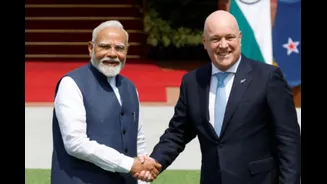








Prime Minister Narendra Modi on Monday welcomed the signing of the India–New Zealand Free Trade Agreement, calling it a landmark moment in bilateral ties and a major step towards deeper economic cooperation.
In a post on X, PM Modi said, “Today marks a landmark moment in the India–New Zealand partnership!”
“I am delighted that the India–New Zealand FTA signed today will add unprecedented momentum to our developmental partnership. It reflects the deep trust, shared values and ambition that bind our two nations.
Today marks a landmark moment in the India-New Zealand partnership!
I am delighted that the India-New Zealand FTA signed today will add unprecedented momentum to our developmental partnership. It reflects the deep trust, shared values and ambition that bind our two nations.… https://t.co/WBHn4gb1yB
— Narendra Modi (@narendramodi) April 27, 2026
The Prime Minister further highlighted that the agreement will greatly benefit our farmers, youth, women, MSMEs, artisans, startups, students and innovators.
“It will open new avenues for growth, create opportunities and deepen our synergy across sectors. The investment commitment of $20 billion by New Zealand will further strengthen our cooperation in agriculture, manufacturing, innovation and technology, paving the way for a more prosperous and dynamic future for both countries,” he said.
New Zealand Prime Minister Christopher Luxon also described the agreement as a significant milestone in relations between the two countries. In his post on X, Luxon said, “Today, we mark a historic milestone in the relationship between India and New Zealand: the signing of our Free Trade Agreement.
He further said the agreement carries strategic importance, signalling a shared commitment to stable and rules-based trade at a time of global uncertainty. Luxon also highlighted the role of the Indian diaspora in strengthening ties, calling it central to the relationship between the two countries.
Both leaders described the agreement as an important step forward, while expressing optimism about deeper cooperation in the years ahead.
What Does This Agreement Mean?
Big export boost for India: All 8,284 Indian product categories will get zero-duty access to the New Zealand market from the start, removing earlier tariffs that ranged up to 10%. This makes Indian goods more competitive and affordable abroad.
Key industries set to benefit: Sectors like textiles, leather, pharma, engineering, chemicals, electronics, and farm exports such as spices, coffee, and cereals are likely to see higher demand and growth.
India opens its market selectively: India will reduce or remove tariffs on about 70% of its product lines, covering most imports from New Zealand—especially items like wool, wine, timber, coal, avocados, and blueberries.
Protection for sensitive sectors: Nearly 30% of tariff lines remain shielded, meaning critical domestic industries such as dairy, pulses, edible oils, sugar, onions, and defence-related goods are safeguarded from foreign competition.
Support for farmers and allied sectors: The deal includes collaboration in agriculture, fisheries, forestry, and livestock, with technology sharing aimed at improving productivity and sustainability in India.
Easier opportunities for Indian professionals:A new visa pathway will allow up to 1,667 skilled Indian workers annually (with a cap of 5,000 at a time), creating better global job prospects.
Boost in foreign investment: New Zealand has pledged to facilitate around $20 billion in investments into India over the next 15 years, particularly in infrastructure, renewable energy, agriculture, and technology.