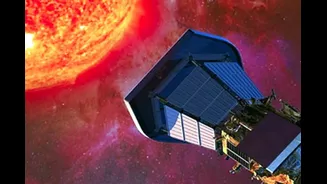

India’s maiden solar observatory, Aditya-L1, has played a pivotal role in a global scientific effort to decode the unusually powerful behaviour of the strongest solar storm to strike Earth in over two
decades, an event now known as “Gannon Storm”. According to ISRO, the precise magnetic field measurements provided by Aditya-L1 were crucial in helping an international team of researchers, including Indian scientists, explain why the May 2024 geomagnetic storm exceeded the intensity predicted by standard models.
The solar storm involved a series of giant explosions on the Sun known as Coronal Mass Ejections (CMEs)—massive bubbles of hot gas and magnetic energy hurled into space. When these bubbles impact Earth, they can severely disrupt the planet’s magnetic shield, posing serious threats to satellites, GPS, communication systems, and power grids.
The breakthrough study, published in the Astrophysical Journal Letters, revealed the unusual mechanism behind the storm’s exceptional strength. Researchers found that two CMEs collided in interplanetary space en route to Earth. This collision squeezed them so forcefully that the magnetic field lines inside one of the CMEs snapped and rejoined in new configurations, a phenomenon known as magnetic reconnection. This sudden, large-scale magnetic reorganisation effectively reversed the field’s direction, significantly amplifying the storm’s interaction with Earth’s magnetosphere.
Aditya-L1’s unique vantage point at the Lagrange Point 1 (L1) was central to the discovery. The observatory joined forces with six US satellites, including NASA’s Wind, ACE, and DSCOVR missions, allowing scientists to study the extreme solar storm simultaneously from multiple vantage points in space. Aditya-L1’s detailed magnetic field measurements specifically helped map the colossal reconnection zone, which was found to stretch approximately 1.3 million kilometres across—nearly 100 times the diameter of Earth. This marked the first time such a vast magnetic breakup and rejoining had ever been observed inside a CME.
ISRO noted that this discovery significantly enhances the global understanding of how solar storms evolve as they travel from the Sun to Earth, improving the ability to predict and prepare for powerful solar weather events that threaten modern technological infrastructure.