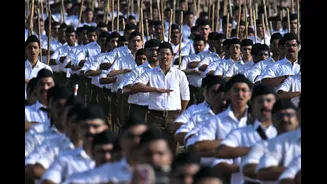

As we celebrate ‘Vijay Diwas’, marking the victory of the Indian armed forces over Pakistan on 16 December 1971 that led to the birth of Bangladesh, it would be pertinent to go back into history and see
how, keeping ideological differences aside, the Rashtriya Swayamsevak Sangh (RSS) supported the Congress governments in their war efforts. Political parties in opposition and all those who have indulged in petty politics over national security–related operations ranging from the surgical strike to Operation Sindoor can learn from the RSS about how to give top priority to the national interest.
1971 War and the Birth of Bangladesh
In 1971, when refugees from East Pakistan were pouring into India in large numbers to escape the brutal persecution of the Pakistan military, one of the highest decision-making bodies of the RSS—the Akhil Bharatiya Karyakari Mandal (ABKM)—passed a resolution which urged “the Government of Bharat to take strong and immediate measures in keeping with its basic stand and the assurances given to the people from time to time, and in consonance with national sentiments and self-respect.” The resolution said, “The people will wholeheartedly support any such action. It is true that when the Government resorts to such action, the people also will have to make supreme sacrifices. The Karyakari Mandal exhorts the people to rise to the occasion when such a call comes.”
After the formation of Bangladesh, the Akhil Bharatiya Pratinidhi Sabha (ABPS), another highest decision-making body of the RSS, passed a resolution praising Prime Minister Indira Gandhi, who was known for her anti-RSS views and policies. She had banned the RSS in 1975 during the Emergency, accompanied by a brutal crackdown on the organisation for 19 months. The RSS-inspired political outfit Bharatiya Jana Sangh was also a part of the opposition in 1971–72. However, giving top priority to the national interest, the RSS resolution said, “The ABPS is happy that the Bangla Desh problem has been satisfactorily solved through the exemplary unity of the Bharatiya people, the unparalleled skill and heroism of our armed forces and the firm leadership of the Prime Minister, as urged by the ABKM at its last meeting.”
The resolution further said, “The Pratinidhi Sabha pays its heartfelt tribute to the armed forces, their commanders, the Bharatiya people who stood solidly behind them, and the Government which formulated the right policies. The Pratinidhi Sabha pays its tearful homage to all the valiant officers and jawans who have immortalised themselves by offering their supreme sacrifice on the battlefield.”
India-China War of 1962
In 1962, the ABKM of the RSS passed a resolution supporting the Nehru government in its war efforts. This was despite the well-known fact that Pandit Jawaharlal Nehru had imposed a ban on the RSS in 1948 and was vehemently opposed to it.
The RSS resolution in 1962 said, “The people should also increase their savings to meet the demands of war and for future eventualities… The common public has generously contributed to the National Defence Fund. More and more voluntary contributions should come forward as evidence of the people’s sense of patriotism and sacrifice.”
It further added, “Partisan politics has no place in times of National Emergency. The people have, keeping aside all their differences, responded like one man in this hour of crisis. Their example needs to be emulated by the political parties.”
This stands in stark contrast with the attitude of the current political parties in the Opposition on issues of national security, and ironically they have the audacity to raise questions about the credentials of the RSS.
1965 War and the Question of Kashmir
On August 5, 1965, Pakistan launched Operation Gibraltar, which marked the beginning of the 1965 India-Pakistan War in August and September. Pakistan’s strategy was to change the status quo at the Jammu & Kashmir border. Following India’s victory in this war, India and Pakistan signed the Tashkent Declaration (January 1966), under which both countries agreed to withdraw forces to positions held prior to 5 August 1965.
In a 1966 resolution, the RSS again categorically backed the government, urging it to go ahead and deal with Pakistan. The resolution said, “The ABPS has grave apprehensions that Pakistan, having gained its point of advantage of return of forces to the pre-August 5 line, may well start hatching her aggressive designs to grab Kashmir and a situation more dangerous than the one in August–September last may develop at any time. If such a situation develops in future, let the Government display the nerve and grit to liquidate the very source of this evil. There is no doubt that the entire patriotic population will stand solidly behind the Government in such a bold step once it is resolutely decided and executed.”
Conclusion
When it comes to the issue of national security, the RSS has set an example in public life by not only extending unequivocal support to the government of the day but also urging the people to make sacrifices, maintain unity, and rise above partisan interests. This approach stands as a reminder that national security cannot be reduced to an arena of political point-scoring or selective patriotism.
The way the RSS has responded to issues of national security holds a larger lesson for all those in public life: differences in ideology are legitimate in a democracy, but when a nation’s security is at stake, unity of purpose and clarity of resolve must prevail.
The writer is an author and columnist. His X handle is @ArunAnandLive. Views expressed are personal and solely those of the author. They do not necessarily reflect News18’s views.