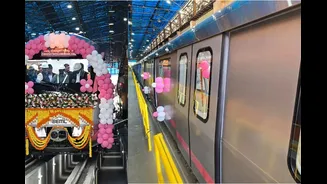







On Sunday morning, as the city was still shaking off its weekend sleep, a metro coach quietly rolled along a stretch of track most Bengaluru commuters have only seen from behind barricades. No crowds.
No rush. Just engineers, officials, and a train moving carefully through the new Pink Line corridor — testing, checking, and preparing for a future ride that thousands are already waiting for.
For many in south Bengaluru, that slow, silent run felt like the first real sign that the long wait for the Pink Line is finally turning into motion.
What started running
Trial operations have now begun on the 7.5 km elevated stretch of Namma Metro’s Pink Line between Kalena Agrahara on Bannerghatta Road and Tavarekere. It is the first operational movement on this corridor, and for Bangalore Metro Rail Corporation Limited, it marks a crucial step toward bringing the line into public use.
Over the next few months, trains will continue to run on this stretch under trial conditions. These are not ceremonial runs. Every movement is part of a long checklist of testing traction systems, braking response, signalling, power supply, communication networks, and how smoothly the trains behave on curves and gradients.
Only after these trials are completed will expert teams from RDSO and CMRS step in for inspections. Their reports will decide when the line is safe enough for everyday commuters. The final green signal will come in the form of a safety certificate from the Central Railway Board.
The bigger line behind this small stretch
This 7.5 km section is just the beginning of a much larger project. The full Pink Line will run for 21.56 km from Kalena Agrahara to Nagawara, cutting across the city with 17 stations along the way.
While this elevated portion is now ready for trials, the rest of the line tells a different story. From Tavarekere to Nagawara, the metro will run underground for nearly 13 km, passing through some of the city’s busiest zones. Twelve stations are being built along this tunnel stretch, and trial runs there will only begin once construction is fully completed.
For now, the focus remains on the elevated corridor, where five stations — Kalena Agrahara, Hulimavu, IIMB, J.P. Nagar 4th Phase, and Tavarekere — are closest to seeing trains move not just for tests, but for people.
What this means for commuters
For residents around Bannerghatta Road and J.P. Nagar, the Pink Line has long been a promise on hoardings and project maps. Traffic bottlenecks, long bus rides, and unpredictable travel times have made daily commutes exhausting. The sight of a train finally running on the tracks changes that feeling, even if the doors are not open yet.
BMRCL officials say commercial services on this stretch could begin soon after safety clearances are in place, possibly by the end of the year. It is not a date commuters can circle yet, but it is closer than it has ever been.
As the trial train completed its run and rolled back into the yard, there were no cheers, no selfies, no ribbon cutting. Just a line of officials ticking off observations and technicians checking systems.
But somewhere beyond the fences, people heading to work and students waiting for buses looked up at the tracks a little differently. The Pink Line, which for years felt like a distant plan, finally felt real.
For now, the train runs without passengers. Soon enough, it will carry stories, deadlines, tired faces, and everyday hopes across the city. And when that first commuter finally boards at Kalena Agrahara, they may never know about this quiet Sunday morning, the day Bengaluru’s next metro journey truly began.