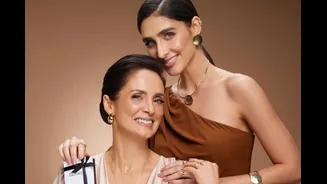





There is something deeply emotional about opening your mother’s jewellery box. Not because of the gold, the diamonds, or the craftsmanship, though those matter too, but because every piece feels alive
with memory. A bangle worn at family weddings. A chain she reached for every morning without thinking. Earrings that appeared in old photographs long before you understood fashion, adulthood, or inheritance.
Long before jewellery becomes luxury, it becomes familiarity.
For many women, some of the earliest memories of motherhood are attached to these quiet rituals: watching a mother get ready before a celebration, hearing the soft clink of bangles while she worked, or standing beside a dressing table where velvet boxes carried stories no one formally narrated, yet everyone somehow understood.
And perhaps that is why jewellery remains one of the most intimate heirlooms we pass down.
Jewellery That Carries More Than Beauty
Toranj Mehta, Country Head, Category Marketing, De Beers India, believes jewellery has always functioned as an emotional inheritance across generations. According to her, the pieces that survive most meaningfully through time are rarely trend-driven. Instead, they are defined by timelessness.
She points to the enduring power of a natural diamond solitaire, a piece that can evolve across decades while retaining its emotional core. A pendant can later become a ring. A solitaire can be reset into a bracelet. The jewellery changes form, but the memory attached to it remains intact. And that adaptability feels especially relevant today.
Modern heirlooms are no longer locked away for preservation alone. They are being reinterpreted by daughters who style inherited pieces in entirely personal ways. A mother’s necklace may now sit against a crisp white shirt instead of a silk sari. An old ring may be redesigned while still carrying its original emotional weight.
That balance between permanence and reinvention is what makes heirloom jewellery feel alive rather than archival.
The Emotional Architecture of Heirlooms
Ankita Sonawala, Brand Head, Zen Diamond India, beautifully describes heirloom jewellery as something “lived in, remembered, and reinterpreted.” And honestly, that may be the most accurate way to describe why inherited jewellery feels different from anything newly purchased.
Unlike trend-led fashion, heirloom jewellery gathers emotional residue over time.
It absorbs milestones. Celebrations. Grief. Rituals. Generational habits. Sometimes even silence.
A mother’s jewellery box often becomes an accidental archive of her life, pieces collected slowly across birthdays, anniversaries, weddings, achievements, and ordinary moments no one realised would later become precious.
And when these pieces pass to daughters, they carry far more than material value. They carry continuity.
The Warmth of What Has Been Worn Before
Yash Kataria, Director, Kataria Group of Companies, KATARIA JEWELLERS, speaks about this idea with remarkable tenderness. He recalls growing up around jewellery that was carefully wrapped in mulmul cloth and brought out during family occasions, not as display, but as part of family identity itself.
His observation feels strikingly true: the most valuable jewellery is often not the newest piece purchased, but the one that has already lived a life before reaching you.
There is something powerful about wearing a bracelet your grandmother once wore, or fastening a necklace that belonged to your mother long before you existed. These pieces carry physical memory. They have touched skin, travelled through generations, witnessed lives unfolding quietly across decades.
And unlike most objects we inherit, jewellery remains deeply intimate because it stays close to the body. Kataria also notes that heirloom jewellery evolves with every generation. A daughter may style inherited jewellery differently, modernise its setting, or wear it outside traditional occasions entirely, yet its emotional significance remains untouched. That is what gives heirlooms their soul.
The Jewellery That Outlasts Time
Mehul Jain, founder, EKARAA Jewellery, describes a scene that feels universally familiar: standing beside your mother’s dressing table, watching her untangle a chain or open a velvet jewellery box that carried years of quiet ritual. “It is not really about jewellery,” he says. “It is about memory.”
And perhaps that is exactly the point. Jewellery is one of the few things we inherit that still carries warmth. It has been worn. It has moved through someone’s life before entering ours. Unlike objects preserved untouched behind glass, heirloom jewellery continues living through the women who inherit it.
Jain explains that EKARAA’s Heirloom collection was built around this philosophy, creating pieces worthy not just of purchase, but of future memory. Jewellery that does not merely mark a moment, but outlasts it. Because ultimately, heirloom jewellery is not about ownership. It is about continuation.
What Mothers Really Pass Down
This Mother’s Day, perhaps the most meaningful inheritance is not the jewellery itself, but what it quietly represents.
Taste. Memory. Ritual. Femininity. Love. Identity. Resilience.
The passing down of jewellery in many Indian homes has always been more than tradition.
It is an unspoken language between generations of women, one that says: this belonged to me once, and now it carries you too. And maybe that is why heirlooms endure while trends disappear. Because some things are not meant to stay in closets forever. Some things are meant to keep living.