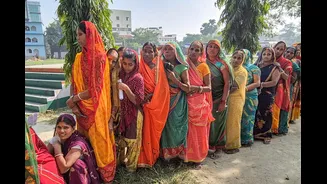








The election playbook is increasingly being rewritten around one decisive voter bloc: women. The latest to appeal to this voter bloc is the Dravida Munnetra Kazhagam (DMK) in Tamil Nadu. The MK Stalin-led
party has promised Rs 2,000 monthly assistance for women and an additional Rs 8,000 for household support, pivoting the state’s politics once again towards gender-targeted welfare.
Similar announcements have come from parties across the four states going to elections – West Bengal, Assam, Tamil Nadu and Kerala. While direct cash transfers continue to be the primary political instrument across states, some parties have moved beyond, pitching women welfare schemes.
What Have Tamil Nadu Parties Promised For Women?
The ruling DMK has sharpened its women-focused pitch by proposing to double its flagship cash assistance to Rs 2,000 per month, while also introducing an annual Rs 8,000 ‘Illatharasi’ coupon aimed at easing household expenses. This builds on its existing welfare architecture that already targets women as primary beneficiaries. The emphasis is clear: steady, predictable income support that directly reaches women and helps manage rising day-to-day costs within families.
The opposition All India Anna Dravida Munnetra Kazhagam (AIADMK) is attempting to outmatch this approach by floating a broader Rs 10,000 family support promise, alongside continuing subsidies like free transport and other household benefits.
Adding a new layer to this contest is Tamilaga Vettri Kazhagam (TVK), led by Vijay, which has gone even further with a Rs 2,500 monthly assistance promise for women. Its proposals combine direct cash with lifestyle and social support measures like free bus travel, LPG cylinders, and symbolic benefits like gold for marriages and newborn girls.
What Have West Bengal Parties Promised For Women?
In West Bengal too, the election narrative is increasingly centred on direct financial support for women, with both major players competing through cash transfer promises. The Bharatiya Janata Party (BJP) has proposed a Rs 3,000 monthly payout under its ‘Annapurna Yojana’, positioning it as a substantial income support measure aimed at women managing household expenses.
The ruling All India Trinamool Congress (TMC) is banking on its already popular Lakshmir Bhandar programme, which has been expanded to offer around Rs 1,500 per month to women beneficiaries. Rather than reinventing the model, the party is doubling down on delivery and continuity.
What Have Assam Parties Proposed For Women?
The Congress in Assam has promised Rs 50,000 in financial assistance for women entrepreneurs, positioning women not just as beneficiaries but as income generators. The pitch is centred on enabling small businesses, improving financial independence, and strengthening women’s participation in the local economy.
The ruling BJP, led by Chief Minister Himanta Biswa Sarma, is banking heavily on its existing track record of women-focused schemes. These include the Orunodoi scheme, which provides around Rs 1,250 per month directly to women from low-income households, and has reached tens of lakhs of beneficiaries. The government has also expanded support through one-time transfers, such as Rs 9,000 payouts to nearly 40 lakh women ahead of elections, and entrepreneurship-driven initiatives like the Mukhya Mantri Mahila Udyamita Abhiyan, which offers seed funding starting at Rs 10,000 and scaling up for women-led businesses. Alongside this, schemes like Swanirbhar Naari and Atmanirbhar Asom focus on self-help groups, microcredit, and interest-free loans, reinforcing a model where women are positioned as key drivers of household and local economic growth.
What Are The Women-Centric Policies In Kerala?
The Left-led government under the Communist Party of India (Marxist) has focused on strengthening public healthcare, social security pensions, and community-based livelihood networks that directly benefit women. Initiatives built around the Kudumbashree mission have been central to this model, enabling millions of women to access microcredit, run small enterprises, and participate in local governance. At the same time, expanded welfare spending and targeted support schemes, ranging from maternal healthcare to pensions for widows and elderly women, aim to provide stability across life stages.
How Many Women Voters Are There Across These 4 Poll-Bound States?
Putting together the latest electoral roll estimates across the four states, the total number of women voters is well over 10 crore.
Tamil Nadu has over 3.1 crore women voters, which is 51 per cent of the total electorate. West Bengal has over 3.7 crore women voters, which is 49–50 per cent of all voters. Kerala has about 1.4 crore women voters at 51.5 per cent of total electorate, making it the state with one of the highest percentages of women voters. In Assam, the 1.2 crore women voters account for 49–50 per cent of the total electorate.
Taken together, this is an electorate larger than the population of many countries. With women making up around half, or more, in each state, they form a decisive voting bloc that can shape outcomes across regions. This sheer scale explains why every major party is aggressively tailoring welfare promises specifically for women voters.