






Mount Everest is the tallest mountain on Earth that is situated on the border of Nepal and China. With the height of 8,849 meters above sea level, the peak is admired for its natural beauty and that is why
climbing Everest has become a dream for many adventurers.
Every year, hundreds try to reach the summit but continuous flow of climbers comes with a cost: waste left behind that affects the fragile ecosystem.
Garbage On Mount Everest
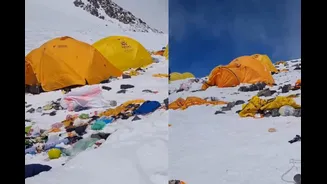
A video shared by Everest Today, a platform that reports news about Mount Everest, shows the mountain covered with garbage. The footage captures polybags, clothes, food packets, empty oxygen cylinders and even old tents scattered on the snow.
Though the video was recorded in 2024 the situation continues. High camps where climbers depend on oxygen are being left with large amounts of trash. The visuals show how even the world’s highest peak is not untouched by human negligence.
Along with the video, Everest Today wrote on X: “Disheartening to see the accumulation of garbage at Camp IV on Mt Everest (8848.86 m), where human life mostly depends on supplementary oxygen, the mountain itself is being left to suffocate beneath our waste. The garbage accumulating at the highest camps reflects a deeper failure of responsibility. In our race for higher summits, we are neglecting our duty to the very mountain that carries our ambitions. This cannot continue.”
“Protecting Sagarmatha is not optional—it is an obligation. To nature. To future generations. To the values we claim to uphold. It’s time to demand stricter regulations, enforce clean climbing practices, and commit to real waste management on Everest. Because the world’s highest mountain deserves more than our silence,” it added.
Disheartening to see the accumulation of garbage at Camp IV on Mt #Everest (8848.86 m), where human life mostly depends on supplementary oxygen, the mountain itself is being left to suffocate beneath our waste.
The garbage accumulating at the highest camps reflects a deeper… pic.twitter.com/NXNe08TlXc
— Everest Today (@EverestToday) December 19, 2025
What Are People Saying Online
The video and message sparked strong reactions from viewers with one user commenting, “Having been to Everest and stayed in base camp this breaks my heart. I really wish there was a way it could be collected and future expeditions would be responsible for leaving no trace.”
Another suggested, “Good post. Cleanup must be built into the cost of the climb. Climbers should be required to bring down a certain amount of garbage or fund locals to do the work. Something has to move in that direction.”
“Very sad. Perhaps we humans have caused more harm to the planet than any other species throughout the Geological age of Earth,” someone else remarked.
A person sharply wrote, “Completely disgusting no excuses, pristine nature turned into a total shitshow by multitudes of dopey pricks.”
“If they can’t pack out the garbage, they shouldn’t make the climb,” an individual said.
A viewer questioned, “Disgusting reflection of the human species. Why do the authorities allow this to happen? Surely, there are measures that can be put in place?”
“Give the Everest a break. Stop climbing,” “Absolutely disgusting” and “This is inexcusable” were some other remarks.
Someone added, “Time for stricter regulations.”
Nepal Government Takes Action
To tackle the growing waste problem, the Nepalese government has introduced a five-year strategy. The plan focuses on keeping mountains clean, protecting their natural beauty and maintaining ecological balance.
The strategy also talks about limiting the number of climbers. In recent years, Everest has faced heavy crowds near the summit often described as “traffic jams.” Even in 2025, these congestions were reported. While discussions about limiting climbers are ongoing, no final decision has been made yet.
Climbers have reported that garbage is most noticeable at Camps 2, 3 and 4 on Mount Everest. Over the past few years, melting snow has also revealed more dead bodies along the climbing routes. Government records show that between 1923 and 2019, 304 climbers lost their lives on the mountain and over 200 bodies still remain there.