






India is preparing to sign the Comprehensive Economic Partnership Agreement (CEPA) with Oman. The move is expected to significantly strengthen New Delhi’s economic engagement with the Gulf region and reinforce
its broader trade diversification strategy.
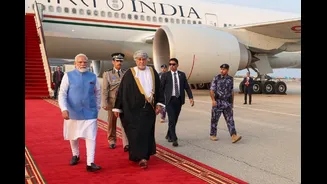
The India-Oman FTA will be signed today during Prime Minister Narendra Modi’s visit to the Gulf country.
At the India-Oman Business Summit, PM Narendra Modi said, “The Summit today India-Oman partnership will give a new direction, new speed, and help it reach new heights. In this, all of you play a big role.”
#WATCH | Muscat, Oman: At the India-Oman Business Summit, PM Narendra Modi says, “The Summit today India-Oman partnership will give a new direction, new speed, and help it reach new heights. In this, all of you play a big role.”
(Video: ANI/DD News) pic.twitter.com/5J8ah0ZLBr
— ANI (@ANI) December 18, 2025
It will be Oman’s second free-trade agreement with an individual country and its first such pact in nearly two decades. For India, the CEPA with Oman would expand the country’s presence in the strategically important Gulf market, which plays a critical role in energy security, remittances, logistics and regional trade flows.
The agreement is aimed at improving market access for goods and services, promoting two-way investments and enhancing cooperation across key sectors. It will support trade diversification and supply chain resilience at a time of global economic realignment.
In the last few years, India has signed many FTAs which are reaping rewards for our farmers, traders and exporters.
India’s Free-Trade Agreements
In 2025, India concluded the Comprehensive Economic and Trade Agreement (CETA) with the United Kingdom, which reduces tariffs on over 90 per cent of traded goods and is expected to significantly expand bilateral trade. A year earlier, India signed a trade and economic partnership agreement with the European Free Trade Association (EFTA) bloc, comprising Switzerland, Norway, Iceland and Liechtenstein, backed by strong investment commitments into the Indian economy.
India’s Economic Cooperation and Trade Agreement (ECTA) with Australia, signed in 2022, cut or eliminated tariffs on most traded goods and opened new export opportunities for Indian products. The same year, India entered into a CEPA with the United Arab Emirates, reducing tariffs on more than 90 per cent of Indian exports and giving a major boost to sectors such as gems and jewellery, textiles, leather and engineering goods.
Earlier, in 2021, India signed its first Africa-focused trade pact with Mauritius, improving market access and positioning the island nation as a gateway for Indian businesses into African markets.
The proposed CEPA with Oman fits into this broader framework, underscoring India’s push to build a diversified and resilient trade architecture through mutually beneficial partnerships. With the Gulf emerging as a key node in global supply chains and investment flows, the agreement is expected to further anchor India’s economic and strategic ties with the region.
India and Oman share strong and growing economic ties. Bilateral trade during FY 2023-2024 stood at $8.947 billion, while in FY 2024-25, it increased to $10.613 billion. Investment relations between the two countries have also remained robust, supported by a large number of joint ventures.
There are over 6,000 India-Oman joint ventures operating in Oman. The cumulative outward direct investment from India to Oman stands at $675 million. Meanwhile, the cumulative FDI equity inflow from Oman to India between April 2000 and March 2025 amounts to $610.08 million.