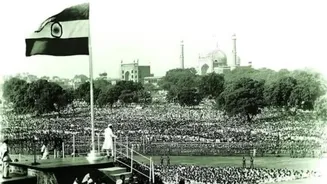







India had waited decades for freedom. But when Lord Mountbatten fixed August 15, 1947, as the date for the transfer of power, not everyone greeted the announcement with relief.
Some astrologers were alarmed.
In Calcutta, now Kolkata, Swami Madananand reportedly rushed to his charts after hearing Mountbatten’s announcement on All India Radio. According to Dominique Lapierre and Larry Collins’ Freedom At Midnight, his reaction was immediate. “What have they done! What have they done!” he cried.
The concern was not political. It was astrological.
August 15, 1947, fell on a Friday and, according to the astrological calculations cited in accounts of the period, the day was considered unfavourable for the birth of a new nation.
But by then, the date had effectively been locked in.
Mountbatten had announced it publicly, preparations for the transfer of power were under way, and there was little appetite for pushing Independence back over an astrological objection.
So another question emerged: if the date could not be changed, could the timing be? That search eventually led to the midnight of August 14-15 — and to one of the most famous speeches in Indian history.
Why August 15 Was Chosen In The First Place
Britain had originally planned to transfer power to India by June 1948. But as political tensions deepened and Partition became increasingly unavoidable, Lord Mountbatten decided to bring the timetable forward.
On June 3, 1947, Mountbatten, Jawaharlal Nehru, Muhammad Ali Jinnah and Baldev Singh addressed the country over All India Radio as the plan to partition British India into India and Pakistan was announced.
A day later, Mountbatten revealed that the transfer of power would take place much sooner than originally planned — on August 15, 1947.
The date was his own choice. “The date I chose came out of the blue,” Mountbatten later recalled, according to Freedom At Midnight. He said he knew the transfer had to happen quickly and was “determined to show I was master of the whole event”.
But August 15 was not entirely random. “Why? Because it was the second anniversary of Japan’s surrender,” Mountbatten explained.
Japan had announced its surrender on August 15, 1945, bringing the Second World War in Asia towards its end. Mountbatten, who had served as Supreme Allied Commander in South East Asia, attached significance to the date.
Astrologers Object To The Date
Once August 15 was announced, astrologers in different parts of India reportedly began studying the date.
Lapierre and Collins wrote that Mountbatten had made the decision without consulting the jyotishis, or astrologers, who were traditionally approached by many Indians before important beginnings.
“He [Mountbatten] had committed the unpardonable fault of announcing his choice without first having consulted representatives of the most powerful occult body in India, the jyotishis, the astrologers,” the authors wrote.
According to Freedom At Midnight, astrologers in Benares, now Varanasi, and parts of southern India viewed the proposed date with particular concern.
“As soon as the radio announced Mountbatten’s date, astrologers all over India began to consult their charts. In Benares and parts of southern India, their reaction was severe. The date was considered so unfavourable that India, they believed, would be better advised to tolerate the British one day longer rather than risk eternal damnation,” the book says.
Madananand, too, believed the calculations pointed towards trouble. “As he did so, he sat up aghast. His calculations foretold disaster,” Lapierre and Collins wrote.
He then appealed directly to Mountbatten. “For the love of God do not give India her independence on 15 August,” Madananand wrote, according to Freedom At Midnight.
His warning went further. “If floods, drought, famine and massacres follow, it will be because free India was born on a day cursed by the stars,” he wrote.
But an appeal to change the date was unlikely to succeed. The political process was moving too quickly, and Mountbatten had already committed publicly to August 15.
That is when the focus shifted from the day itself to the exact moment at which India would become free.
The Search For An Auspicious Hour
Astrologer KN Rao later wrote about the controversy in The Nehru Dynasty: Astro-Political Portraits of Nehru, Indira, Sanjay and Rajiv. The issue, in the accounts he cited, was not necessarily to reject August 15 altogether but to identify a more favourable muhurta, or auspicious time, around the transition.
That gave Indian leaders room to manoeuvre. If August 15 had to remain the official date, the transfer of power could still be timed for a moment that satisfied both the political timetable and the astrological concerns.
According to Rao, citing journalist Durga Das’ India from Curzon to Nehru and After, Nehru found exactly that compromise.
“Nehru then hit upon an interesting compromise. He called the Constituent Assembly in the afternoon of 14th August and continued its sitting till midnight when, according to Western practice, 15th August took birth and zero hour was within the auspicious period envisaged by the Hindu calendar,” Rao wrote, citing Durga Das.
Why India Became Free At Midnight
Lapierre and Collins also recorded the compromise.
“A congeries of astrologers finally advised India’s politicians that, though 15 August was a wholly inauspicious day on which to begin their nation’s modern history, 14 August represented a considerably more favourable conjuncture of the stars,” they wrote.
According to Freedom At Midnight, Mountbatten accepted the arrangement proposed by Indian leaders.
The Constituent Assembly therefore met on the night of August 14 and remained in session as the country approached the moment of Independence.
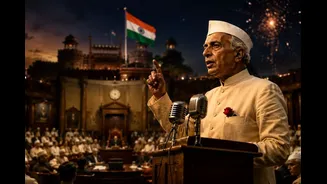
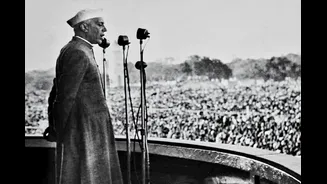
Then, just before midnight, Nehru rose to speak. “Long years ago we made a tryst with destiny, and now the time comes when we shall redeem our pledge,” he told the Assembly.
And as the clock struck 12, came the line that would define the moment: “At the stroke of the midnight hour, when the world sleeps, India will awake to life and freedom.”
The phrase has since become synonymous with India’s Independence.