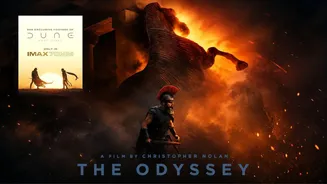











Christopher Nolan’s The Odyssey is the first feature film ever shot entirely with IMAX 70mm cameras, and yet, despite India’s love for the big screen and over 30 IMAX theatres in the country, not one of
them can show it the way Nolan actually shot it. Here’s why.
Christopher Nolan Has Taken IMAX Further Than Ever Before
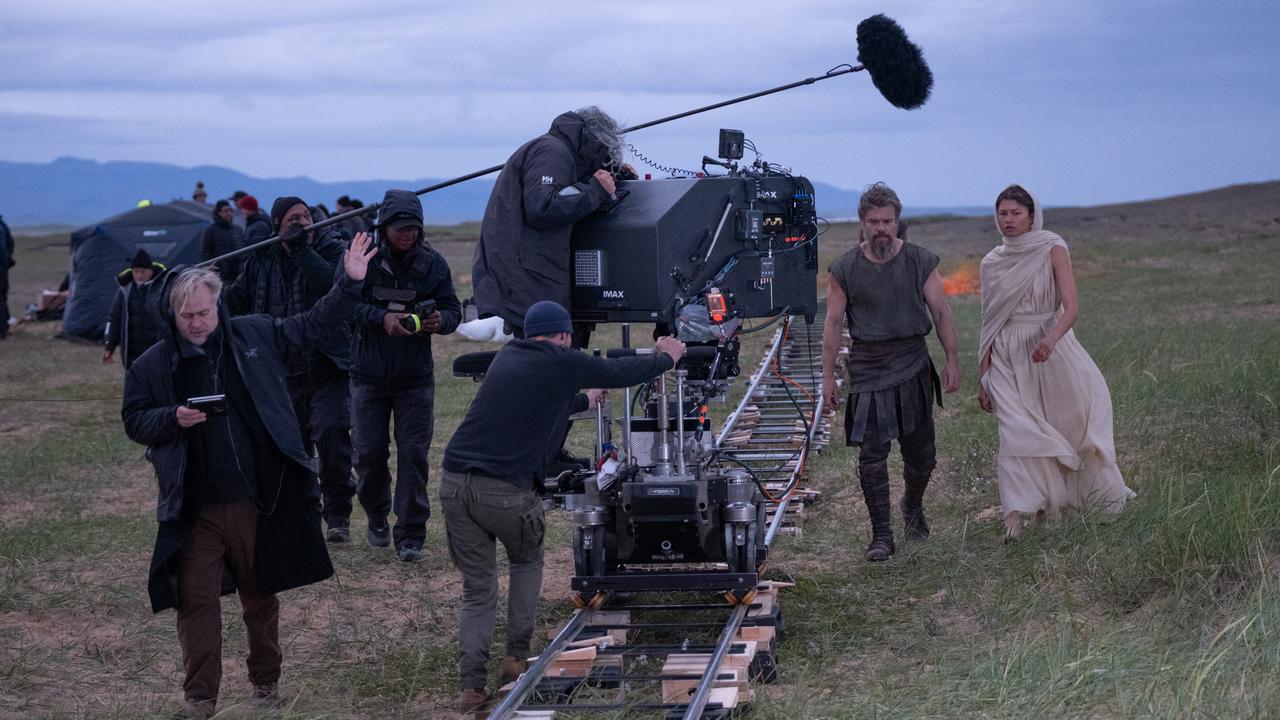
Nolan has used IMAX cameras for parts of his films since The Dark Knight. Interstellar, Dunkirk and Oppenheimer all had sequences shot this way. The Odyssey goes a step further. It’s the first film in history shot entirely on IMAX film, made possible by a new, generation of cameras built specifically for this production. Older IMAX cameras were too noisy to record dialogue, so directors had to switch formats whenever actors spoke. Nolan and IMAX fixed that problem for good this time.
What Does IMAX 70mm Actually Mean?
The term “15/70” is really just describing the film itself. The “70” means the film strip is 70mm wide, double the width of standard 35mm film. The “15” refers to each frame stretching across 15 perforations, the little sprocket holes that move the film along.
Here’s the interesting part: unlike regular film, which runs vertically through a projector, IMAX 70mm film runs horizontally. That gives each frame around nine times more image area than standard film, capturing detail so fine it’s often compared to 16K or 18K digital resolution.
Read More: The Odyssey Review: Matt Damon Anchors Christopher Nolan’s Most Visually Stunning, Emotionally Rich Epic Yet
Why Is Everyone Talking About 18K?
Digital cameras shoot at fixed resolutions, 4K, 8K and so on. Film doesn’t work that way. It captures detail chemically, not in pixels. Because IMAX 70mm negatives are so large, experts estimate they hold detail roughly equivalent to 16K-18K when scanned under ideal conditions. That’s what lets a screen the size of a building show an image this sharp.
The Film Print Is Bigger Than Most People Imagine
Showing The Odyssey the way Nolan intended isn’t as simple as sending cinemas a digital file. Each IMAX 70mm print is a genuinely massive physical reel, weighing hundreds of pounds and running for miles. IMAX CEO Rich Gelfond has said every print needs two platter systems and specially trained projectionists just to run safely, and each one costs tens of thousands of dollars to produce. Only a limited number exist anywhere in the world.
Why Can’t Most IMAX Theatres Play It?
Here’s the big misconception people have: that every IMAX theatre offers the same experience. They don’t. Most IMAX screens today use digital laser projectors. They’re still bigger, brighter and louder than a regular multiplex, but they aren’t physically projecting IMAX film.
To show The Odyssey exactly as Nolan shot it, a cinema needs a specialised IMAX 15/70 film projector. These are rare, costly to maintain, and need trained operators to run. Most were retired years ago as theatres moved to digital. Some cinemas showing The Odyssey actually had to dust off and restore old projection systems just for this release.
How Many True IMAX 70mm Screens Exist?
Very few. IMAX has confirmed only a small number of cinemas worldwide will screen The Odyssey in true 70mm film, mostly in the United States, with a handful more in the UK, Australia, Belgium and the Czech Republic.
Why Doesn’t India Have One?
India has plenty of IMAX theatres, but none of them can currently project film in the 15/70 format. Some were originally built with that capability, but were converted to digital over time. Mumbai’s IMAX Wadala briefly brought its 15/70 projector back to life for Dunkirk in 2017, when Nolan visited India, but no commercial theatre in the country has a working IMAX film projector today. So Indian audiences watching The Odyssey in IMAX will still get an impressive show, just not the original film experience Nolan built it for.
Will Indian Audiences Miss Part Of Nolan’s Vision?
Not entirely, but there is a difference. Digital IMAX still gives you the giant screen, immersive sound and sharper picture than a standard multiplex. What it doesn’t give you is a film actually projected from a physical IMAX print. On true 70mm screens, viewers also see Nolan’s full image frame, something digital versions don’t always show in full, depending on the theatre’s aspect ratio.
Is It Still Worth Watching In IMAX?
Absolutely. Even without the 70mm print, Nolan built The Odyssey for large-format cinemas and IMAX digital is still the closest you will get to that in India, better image, better sound, better scale than any regular screen. If you are chasing the full 70mm experience though, you’ll need to travel, London’s BFI IMAX and Science Museum are among the handful of cinemas worldwide still equipped to show it exactly as Nolan intended.