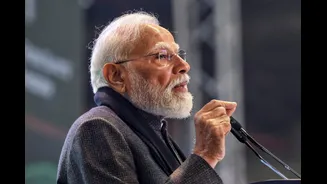


Looking back, cutting through the noise and clutter, 2025 was a decent year for Prime Minister Narendra Modi on the home front. Politically, the Bharatiya Janata Party managed to wrest Delhi from the Aam
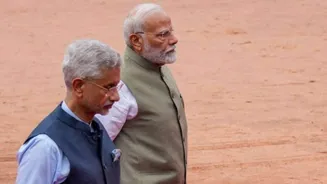
Aadmi Party, and its victory in Bihar was nothing short of spectacular. The government managed to pass many important, sometimes contentious, Bills in Parliament, such as the Waqf (Amendment) Act and liberalisation in Foreign Direct Investment (FDI) in insurance, and private participation in the nuclear power sector. On the economic front, India clocked a Gross Domestic Product (GDP) growth of 6.6 per cent in the calendar year, which is expected to exceed the 7 per cent threshold in the fiscal year, as per various estimates. The reforms on Goods and Services Tax – or GST 2.0, as it is being called – were a bold move. Inflation was at one of its lowest levels since 2019, and unemployment statistics are showing a drop. All in all, a satisfactory run. India and PM Modi’s main challenges came from international quarters. The Pahalgam terror attack in April was a turning point. Though Operation Sindoor was a resounding success militarily, it did not yield a commensurate foreign policy dividend. The considerations or circumstances that led to the sudden declaration of a ceasefire may never be known. But even more curious was the ensuing hugfest between Pakistan’s military leadership and the President of the United States (US). What was most unexpected, however, was the sudden hardening of the US position on the trade deal with India, leading to the raising of tariffs on India to a whopping fifty per cent in August 2025. The relationship between the two countries has remained on the edge since then, notwithstanding President Donald Trump’s frequent shower of praise on Prime Minister Modi. Although India has cut down on its oil imports from Russia, this has not led to a visible thaw in the stand-off. Meanwhile, India’s neighbourhood continues to simmer. Pakistan — an economic basket case for long — survives on US oxygen amidst its own internal conflicts. Nepal went through a swift regime change in the garb of a mysterious “Gen Z revolt”. Bangladesh is on the boil as it braces for elections and a referendum on constitutional change. The main protagonist of the drama is the charlatan Nobel Laureate, supplanted by international puppeteers, who nurtures a distinct soft spot for radical Islamist forces and has not hesitated to woo estranged cousins on the west of the subcontinent, namely Pakistan, from whom the country had broken off in 1971. The plot has thickened with the return from exile of the heir of a political dynasty, seeking to reclaim their mother’s political legacy. India cannot openly or overtly participate in this unfolding drama. At the same time, it cannot be denied that India remains an interested party. The former Prime Minister of Bangladesh, and the leader of Bangladesh’s largest political party, having taken informal asylum in India, further complicates the situation. In the midst of all this, it is no mean achievement of PM Modi to keep India an island of calm internally, despite attempts by the usual suspects to muddy the waters by creating unrest and disenchantment. To simultaneously navigate international waters in the present highly complex and volatile world environment speaks volumes about PM Modi’s evolution as a towering international leader and a voice of the Global South. It takes a great deal of resilience and stamina to remain stoical in the face of provocations from a mercurial and maverick master of the Western Empire. Much has been commented upon PM Modi avoiding face-to-face interaction with Trump, who has a penchant for embarrassing his guests. But not enough has been said about PM Modi’s calibrated outreach towards other world leaders, including some of his adversaries like Xi Jinping of China. Notably, his forays have not been limited to any particular bloc like the QUAD or BRICS, but have cut across Western countries, the Gulf and Middle East, Latin America, the Caribbean, Eastern Europe, South-East Asia and Africa. Relations with Canada have improved visibly since the change of guard at what Trump had famously referred to as the “51st state of the USA”. There have been a number of Heads of Government visiting New Delhi, with, of course, Russian President Vladimir Putin’s visit – steeped in strategic signalling – being the icing on the diplomatic cake. It would be a mistake to underplay the significance of these exchanges and interactions as mere symbolism or innocuous messaging. Many of these leaders are themselves trying to figure out their own place in these turbulent times and shifting axes of international relations. In that churn, this is a clear declaration of India’s arrival on the world stage. We may still have some way to go before becoming a superpower, but by no means are we a pushover — nor can we be isolated from the rest of the world. Our size and scale — not just in terms of population and economy, but our achievements in every field (human resources, intellectual capital, manufacturing, science and technology, space, nuclear and defence capabilities) — make us a formidable entity in our own right. These assertions may appear as motherhood statements to us, since we are a self-critical race, but they require reiteration periodically to outsiders. The Modi government has been doing this with quiet confidence, ignoring the taunts and jibes of its domestic detractors. That does not mean the going will get easier in the coming months. It is going to be a war of attrition. Others would expect us to blink first, but we have to hold our horses and stay the course. This might mean traversing a lonely path until a new equilibrium is established. However, we must utilise this lean period to get our act together, as many countries — like Japan, Korea and China — have done through periods of crisis. What aided them was a nationalistic spirit and discipline. The biggest challenge will be to keep our own house in order and manage a nation of argumentative people. However, that is what one expects of an epochal leader like Narendra Modi.
Sandip Ghose is a writer and public commentator. His X handle is @SandipGhose. Views expressed in the above piece are personal and solely those of the author. They do not necessarily reflect News18’s views.