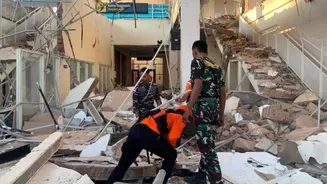








A magnitude 5.9 earthquake struck Indonesia’s earthquake-hit Flores region on Monday. This came just days after a powerful 7.7-magnitude tremor killed at least 53 people, injured more than 130 and caused
widespread destruction.
The latest earthquake was recorded by Germany’s GFZ Research Centre for Geosciences at a depth of about 10 km. There were no immediate reports of additional casualties or damage.
The tremor struck days after the 7.7-magnitude earthquake hit East Nusa Tenggara province on Saturday morning. The US Geological Survey placed its epicentre about 68 km northwest of Ende.
The powerful quake triggered a tsunami warning, prompting residents in coastal areas to move to higher ground. Authorities later lifted the warning after detecting no significant changes in sea levels.
Death Toll Rises, Rescue Ops Continue
Indonesia’s National Disaster Management Agency had earlier said rescuers recovered 47 bodies on Saturday, mainly in Sikka, Manggarai and East Manggarai. Six more bodies were recovered on Sunday, taking the death toll to 53.
More than 130 people were injured, while thousands of residents spent the night outdoors amid fears of further aftershocks.
Authorities initially reported more than 230 aftershocks following Saturday’s earthquake. The disaster agency later said at least 995 aftershocks had been recorded, although only 46 were felt by residents. The strongest measured 6.2 on richter scale.
The earthquake destroyed more than 900 homes and damaged another 450 across East Nusa Tenggara, forcing about 5,000 people into temporary shelters. At least 241 homes were damaged in the Flores region.
More than 100 public facilities, including schools, medical centres and churches, were also damaged or destroyed.
East Nusa Tenggara police chief Rudi Darmoko said the earthquake caused severe structural damage and collapsed buildings, while power outages disrupted communications.
“We are continuing to collect reports of damage and casualties, but there are communication disruptions,” Darmoko was quoted saying by Times Now.
Landslides triggered by the earthquake also blocked sections of the Trans-Flores highway in Ende regency. The roughly 435-mile road runs across Flores from Labuan Bajo to Larantuka.
Remote Villages Remain Cut Off
Rescue officials have warned that the death toll could rise as landslides have buried or isolated remote villages across six regencies on the island.
Indonesia’s National Disaster Management Agency has deployed a helicopter to transport supplies and support emergency operations, including possible evacuations. The region’s geography, with East Nusa Tenggara spread across numerous islands, has made access difficult for rescue teams.
Residents described the earthquake as unusually powerful. Yulian Juita Ekalia, a 37-year-old university lecturer living in Ruteng, more than 60 miles from the epicentre, was quoted by AFP saying that she had never experienced an earthquake of such intensity.
“As I rushed to get outside, everything in the house fell down: the television, my son’s trophies, the dish racks, suitcases on top of the wardrobes,” she said.
Footage from local television showed patients being moved outside several hospitals as a precaution. Medical staff shifted beds, oxygen cylinders and other equipment outdoors and set up temporary treatment areas.
Indonesia is prone to earthquakes and volcanic eruptions because it lies along the Pacific Ring of Fire, an area with intense seismic and volcanic activity.
Flores suffered another major disaster in 1992, when an earthquake-triggered tsunami killed about 2,500 people. In 2018, a magnitude 7.5 earthquake caused a large localised tsunami that devastated coastal areas and killed more than 4,400 people.
The 2004 Indian Ocean earthquake, which struck off Sumatra with a magnitude of 9.1, generated a tsunami that killed about 230,000 people across a dozen countries. The deaths occurred in India as well, but its severest impact was seen in Indonesia’s Aceh.