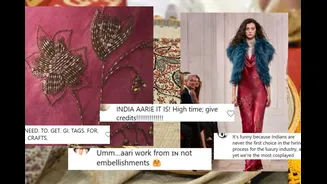








Ralph Lauren’s most recent posts, including a video of a gorgeous deep pink gown under runway lights, showcased ensembles with dense metallic thread, beads and precise beaded handwork. On 12 September
Ralph Lauren posted close-ups on Instagram. The caption carefully named the fabric—“shimmering silk-viscose” interwoven with fine metallised yarns—and called the piece a cinematic statement. The embroidery itself received one word: “hand-applied embellishments.”
But social media was, once again, quick to call out the brand for not mentioning India, and the regional handicrafts that it allegedly (and boldly) displayed on a runway.
Designer Prakhar Rao Singh Chandel posted the images with a direct question: “Look at that embroidery. Now tell me who made it. You cannot. Neither can I.” He noted that the cloth received a proper description while the handwork was reduced to a single vague term. Then he quoted Ralph Lauren’s own line from the same post—that each piece should feel as though it carries its own history and character—and asked: “Whose history? Whose character?”
Chandel went further. “‘Bead and metal-thread embroidery’ like this has a name where I live. Zardozi has been registered to Lucknow and six districts around it since 2013, and one lakh seventy-five thousand artisans work in that cluster. It is a place before it is a decoration.” He reminded readers of the pattern: Prada showed Kolhapuri-style sandals in Milan in June 2025 and called them leather sandals. India was named only after the Maharashtra Chamber of Commerce wrote to the board. “That is the tactic,” he wrote. “Say nothing, take the applause, produce the credit only once somebody forces you to. Name it when you use it. Not when you get caught.”
On his own label’s homecoming pieces, he added, the zardozi is done by Bablu bhai in Wazirbagh, Lucknow. “He has a name and I am going to keep using it, because saying it costs nothing and not saying it costs him everything.”
Is It Zardozi Or Aari?
The comments under Ralph Lauren’s post also called out the brand. Users wrote “Start acknowledging Indian art,” “Indian embroidery inspired by Indian crafts,” and “Indian art and it’s done by Indian artisan.” Others were blunter: “Lol literally embellishments from India. Stop stealing craft.” One called the situation “a level of audacity that needs to be studied.” Another observed that cultural appropriation this year had been particularly noticeable.
A separate Instagram post by the user Ashiifinds pointed out that many commenters were typing “AARI” repeatedly. Instead of Zardozi, as Prakhar had mentioned, users were quick to mention that the “embellishment” showcased by Ralph Lauren was in fact Aari. It is the centuries-old Indian hook embroidery technique from Gujarat, which eventually flourished during Mughal rule. France borrowed it in the 1700s, renamed it “tambour,” added beads in 1865, and the technique is now used across couture houses, usually without reference to India. Ashiifinds noted this was not a one-off for Ralph Lauren. In March the brand showed earrings that looked like jhumkas and called them “vintage earrings.” In April a bandhani skirt was labelled “tie-dye.” This season a cummerbund arrived with no background at all. “That’s three,” the post said. By contrast, Fendi had named the Chanakya School on a bag. “So no, credit isn’t hard. It’s a choice.”
Not The First Time
The current backlash sits against earlier questions about Ralph Lauren. In March 2026 models wore bell-shaped earrings that viewers compared with traditional Indian jhumkas; the brand described them as “authentic vintage accessories.” In August 2026 a pre-draped saree-style garment appeared on the European website as a “Botanical Embellished Draped Overlay Maxi Dress” priced at €198.
The Prada case remains the clearest recent parallel. In 2025 the Italian house showed flat T-strap sandals that closely resembled Maharashtra’s Kolhapuri chappals. Only after formal pressure did the brand publicly acknowledge the footwear’s roots in western India. Credit arrived after the fact.
The issue is not that a global house cannot look at older techniques. Fashion has always borrowed. The issue is the consistent choice to describe the surface while omitting the source. When a craft is geographically registered and carries a clear cultural identity, reducing it to “embellishments” is not neutral language. It removes the makers from the story while the brand claims the atmosphere of history and character.
As social media users emphasised, visibility is not decorative. For the artisans in UP and Gujarat, this recognition is what stops them from disappearance into anonymous inspiration. Saying the name costs nothing. Not saying it costs the people who still hold the skill.