








India is set to enter a new era of weather-linked financial products. The National Commodity & Derivatives Exchange Ltd (NCDEX) will launch RAINMUMBAI, the country’s first exchange-traded weather derivatives
contract, on June 1, 2026.
The product will allow businesses and stakeholders to hedge against monsoon uncertainty through a regulated financial instrument linked to rainfall data. Here are 10 key things to know about RAINMUMBAI:
1. India’s First Exchange-Traded Weather Derivative
RAINMUMBAI will become the first weather derivative contract traded on an Indian exchange. Until now, India has largely relied on crop insurance and government support mechanisms to deal with weather-related risks.
2. The Product Is Linked To Rainfall
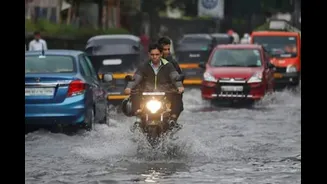
The contract is based on rainfall levels recorded in Mumbai during the monsoon season. It tracks the Cumulative Deviation Rainfall (CDR), which measures how actual rainfall deviates from the Long Period Average (LPA).
3. It Uses Data From Santacruz And Colaba Stations
The derivatives contract will rely on rainfall readings from IMD observatories located at Santacruz and Colaba in Mumbai. The use of standardised IMD data is aimed at ensuring transparency and credibility.
The LPA is benchmarked against a 30-year dataset spanning 1991 to 2020, with daily readings sourced from IMD weather stations at Santacruz and Colaba in Mumbai.
4. Developed With IIT Bombay And IMD
NCDEX developed the product in collaboration with the Indian Institute of Technology Bombay using official rainfall data from the India Meteorological Department. The benchmark uses a 30-year historical rainfall dataset from 1991 to 2020.
5. Sebi Has Approved The Product
The launch has received approval from the Securities and Exchange Board of India (Sebi), bringing the weather-linked product under a regulated trading framework.
6. Farmers Are Not The Only Target Users
While agriculture remains one of the key sectors affected by rainfall variability, the product is also aimed at power utilities, construction firms, infrastructure companies, logistics operators, and banks with agricultural loan exposure. Any business whose revenues depend heavily on monsoon patterns can potentially use the contract.
7. Unlike Insurance, There Is No Physical Loss Assessment
Traditional insurance products often require field surveys and damage assessments before payouts are processed. RAINMUMBAI is different because it is a cash-settled derivative linked directly to rainfall data.
This means settlement depends purely on observed weather readings, allowing faster payouts and reduced disputes.
8. Contract Specifications Have Been Defined
NCDEX said the contract will have:
- Tick size: 1 mm rainfall
- Lot multiplier: Rs 50 per mm
- Maximum order size: 50 lots
- Daily price limit: 9%
Trading will take place from Monday to Friday starting at 10 am.
9. The Product Turns Weather Risk Into A Tradable Risk
The idea behind weather derivatives is to convert unpredictable climate variability into a measurable financial risk that can be hedged in markets. For example, a business expecting heavy rainfall losses can take positions in the contract to offset potential financial damage caused by weak or excess monsoon conditions.
10. NCDEX Calls It ‘Science Meeting Finance’
NCDEX Managing Director and Chief Executive Arun Raste said in a statement, “India has lived with monsoon uncertainty for centuries. RAINMUMBAI provides every stakeholder with a regulated, scientific tool to manage this uncertainty.”
Meanwhile, IMD official Bikram Singh described the initiative as “science meeting finance in a regulated marketplace”. The launch comes at a time when climate volatility is becoming a bigger economic risk for sectors ranging from agriculture to infrastructure and energy.