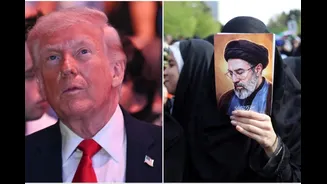









Negotiations between the United States and Iran in Islamabad ended without an agreement after Tehran refused to accept Washington’s core demand, a firm commitment not to pursue nuclear weapons or capabilities
enabling rapid nuclear development.
US Vice President JD Vance said the lack of such a commitment prevented progress despite more than 21 hours of discussions.
“We need to see an affirmative commitment that they will not seek a nuclear weapon, and they will not seek the tools that would enable them to quickly achieve a nuclear weapon,” Vance said.
“That is the core goal of the President of the United States, and that’s what we’ve tried to achieve through these negotiations.”
Vance said Iran declined to accept US terms, resulting in the American delegation leaving Pakistan without a deal.
“The bad news is that we have not reached an agreement, and I think that’s bad news for Iran much more than it’s bad news for the United States of America,” Vance said.
“We’ve made very clear what our red lines are.”
The Vice President remained in constant contact with US President Donald Trump during the negotiations, speaking with him multiple times as talks continued into the early hours.
FIRST DIRECT TALKS IN OVER A DECADE
The Islamabad negotiations marked the first direct engagement between senior US and Iranian officials in more than a decade and the highest-level contact since the Iranian Revolution.
The US delegation included special envoy Steve Witkoff and Jared Kushner, while Parliament Speaker Mohammad Baqer Qalibaf and Foreign Minister Abbas Araqchi represented Iran.
According to Pakistani sources cited in the reports, discussions saw fluctuating tensions, with the “temperature going up and down” during the first round of talks.
Iran’s government later said technical experts from both sides would continue exchanging documents, indicating negotiations have not completely collapsed despite major differences.
STRAIT OF HORMUZ AND WAR DEMANDS COMPLICATE NEGOTIATIONS
Beyond the nuclear issue, significant disagreements persist over the Strait of Hormuz, a key global shipping route through which about 20 per cent of the world’s oil and natural gas supplies pass.
Iran is demanding control over transit arrangements in the strait, war reparations, sanctions relief, and a ceasefire across multiple regional theatres, including Lebanon.
The United States, meanwhile, is seeking guarantees for free navigation through the waterway and limits on Iran’s nuclear enrichment programme.
The US military said it was “setting the conditions” to clear mines in the strategic passage, while Iranian state media denied claims that American naval vessels had transited the strait.
The outcome of negotiations is closely tied to the future of a fragile two-week ceasefire and the potential reopening of the critical energy route, disruption of which has contributed to rising global oil prices.
CEASEFIRE STRAINS AND REGIONAL CONFLICT PRESSURE TALKS
The discussions come amid continued Israeli military operations against Iran-backed Hezbollah in Lebanon, a key sticking point in broader ceasefire negotiations.
While Washington and Israel maintain that the truce with Tehran does not extend to Hezbollah, Iran has pushed for a region-wide halt to hostilities.
According to AP, the war has entered its seventh week and has killed thousands of people, while tensions continue to affect global markets.
Iran also raised issues, including frozen assets held abroad, while a US official denied that Washington had agreed to release such funds.
Tehran has further sought compensation for wartime damages and guarantees against future attacks, complicating diplomatic progress.
TALKS TO CONTINUE DESPITE DEADLOCK
Despite the failure to secure a breakthrough, both sides indicated that discussions would continue at technical levels.
Pakistani officials said meetings between experts from both delegations were ongoing even after the main round of talks concluded.
The negotiations represent a significant diplomatic effort amid high regional tensions and deep mistrust between Washington and Tehran.