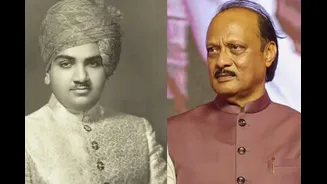

In the wake of the death of Maharashtra Deputy Chief Minister Ajit Pawar in a plane crash on Wednesday morning, memories have resurfaced of another tragic incident in modern history, the 1952 air crash that
claimed the life of Jodhpur’s last ruling Maharaja, Hanwant Singh.
The accident, regarded as the first major civilian plane crash in Rajasthan, occurred near Sumerpur in Jodhpur district. Hanwant Singh was travelling in a private plane along with his wife, actor Zubeida Begum, when the plane went down, killing both on the spot. The incident remains deeply etched in public memory, not only for its tragic nature but also for its far-reaching political and cultural implications.
Born on June 16, 1923, Hanwant Singh ascended the throne of Jodhpur in 1947, the same year India gained Independence. As princely states were being integrated into the Indian Union, the young Maharaja chose an unconventional path, embracing democracy instead of retreating into ceremonial royalty. He floated his own political party and contested both the 1952 Lok Sabha and Rajasthan Assembly elections.
The results, announced after his death, underscored his mass appeal. Of the 35 candidates fielded by his party, 31 emerged victorious. Hanwant Singh himself won both parliamentary and Assembly seats. His popularity was such that senior Congress leader Jai Narayan Vyas lost his deposit while contesting against him. The Maharaja, however, never lived to see this political triumph.
Beyond politics, Hanwant Singh’s personal life often made headlines. He was first married in 1943 to Princess Krishna Kumari of Dhrangadhra, with whom he had three children, including Gaj Singh, who later became the Maharaja of Jodhpur. An avid aviation enthusiast, Hanwant Singh frequently travelled to Europe, where he fell in love with British nurse Sandra McBride. The two tied the knot, but the marriage was never accepted by the royal family, and Sandra eventually returned to the UK.
Later, Hanwant Singh married noted Mumbai actor Zubeida Begum on December 17, 1950. Zubeida, it is said, converted to Hinduism and was renamed Vidya Rani, though she too failed to gain acceptance within the royal household. The couple had a son, Hukum Singh Rathore. Zubeida also had a son from her earlier marriage, Khalid Mohammed, who went on to become a prominent film critic, journalist and filmmaker.
On the night of January 25, 1952, exhausted after days of relentless election campaigning and little sleep, Hanwant Singh decided to fly to Udaipur in a Beechcraft Bonanza aircraft, piloting the plane himself. The following morning, January 26, as the nation celebrated its first Republic Day, the aircraft crashed near Sumerpur. Subsequent accounts suggested fatigue may have played a role in the tragedy.
After the couple’s death, the royal family raised Hukum Singh Rathore, who was later murdered under mysterious circumstances within the palace premises, adding another layer of intrigue to the already tragic saga.
Years later, Khalid Mohammed chronicled the love story of Hanwant Singh and Zubeida in a book, which inspired Shyam Benegal’s acclaimed film Zubeida.
Observers now note a symbolic parallel often drawn between Hanwant Singh and Ajit Pawar, both leaders seen as charting independent political paths. While Hanwant Singh was the first ruler in independent India to form his own political party and swiftly consolidate power, Ajit Pawar too has been viewed as a politician attempting to carve out his own identity beyond the shadow of his uncle, Sharad Pawar.