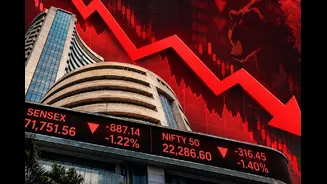









The Indian stock market witnessed a sharp intraday reversal on Monday, November 23, as benchmark indices Sensex and Nifty gave up their early gains and slipped into negative territory within the first
hour of trading. Heavy selling in banking, metal and financial stocks, coupled with weak global cues and concerns over the technology-led sell-off on Wall Street, weighed on investor sentiment.
The sell-off came after a strong rally in the previous week, when both benchmark indices advanced for the fourth consecutive week and settled at nine-month highs. The Nifty 50 had gained around 2.6% during the week, while the BSE Sensex advanced nearly 2.9%.
The BSE Sensex, which had opened at 84,421.97 and climbed to an intraday high of 84,662.96, reversed sharply. At 9:34 am, it was trading at 83,388.08, down 531.63 points, or 0.63%, from its previous close. This represented a fall of nearly 1,275 points from the day’s high.
Similarly, the NSE Nifty 50 dropped from its early high of 25,992.60 to 25,637.65, declining 162.95 points, or 0.63%, against its previous close. The index lost nearly 355 points from its intraday peak.
The banking sector witnessed particularly heavy selling. The Nifty Bank index, which had crossed the historic 65,000 mark for the first time and touched a record high of 65,193.40, subsequently plunged to 63,545.65, down 1.69%.
Here are five key reasons why the Indian stock market is falling today.
1. Global Technology Sell-Off And AI Valuation Concerns
One of the biggest reasons behind Monday’s market weakness is the sharp sell-off in global technology stocks, particularly those linked to artificial intelligence (AI).
Wall Street witnessed a bruising session on Friday, November 20, as investors continued to reassess the valuations of technology companies and the sustainability of massive investments in artificial intelligence infrastructure.
The Nasdaq Composite plunged 1,261.47 points, or 5.28%, to close at 22,617.73. The S&P 500 declined 3.70% to 6,910.42, while the Dow Jones Industrial Average fell 949.73 points, or 1.93%, to 48,147.33.
The sell-off was particularly severe in semiconductor stocks. Nvidia shares plunged 14%, while the Philadelphia Semiconductor Index declined around 11%.
Investors have become increasingly concerned about whether the massive capital expenditure on AI infrastructure and data centres will generate sufficient returns. Questions over debt-funded investments, stretched valuations and the profitability of the AI boom have added to market uncertainty.
The weakness spread to Asian markets on Monday. South Korea’s KOSPI plunged around 5%, while Hong Kong’s Hang Seng declined about 1.5%.
The global risk-off sentiment put pressure on Indian equities despite their relatively strong performance in recent sessions.
2. Heavy Profit Booking In Banking And Financial Stocks
Banking stocks were among the biggest contributors to Monday’s market decline. The Nifty Bank index initially crossed 65,000 for the first time, touching a record high of 65,193.40. However, the index subsequently witnessed heavy selling and fell to 63,545.65 by 9:34 am.
The Nifty PSU Bank index declined 1.94%, while the Nifty Private Bank index fell 1.59%. The Nifty Financial Services index was also down 1.07%.
Among individual stocks, Axis Bank declined 2.90%, ICICI Bank fell 1.46%, Kotak Mahindra Bank dropped 1.42% and State Bank of India lost 1.28%.
The sharp reversal suggests that investors booked profits in banking shares after the recent rally. Banking stocks had been among the major drivers of the market’s advance last week. The selling in heavyweight financial stocks also amplified the losses in the benchmark indices.
3. Metal Stocks Witness Broad-Based Selling
Metal stocks were another major drag on the domestic market. The Nifty Metal index declined 1.92% to 12,035.70 by 9:34 am, emerging as one of the worst-performing sectoral indices.
Tata Steel was among the biggest losers on the Sensex heatmap, falling 3.77%. The weakness in metal shares came amid concerns over global economic growth and the broader risk-off sentiment in international markets.
Metal stocks are particularly sensitive to expectations of global industrial activity, commodity demand and developments in major economies such as China. The weakness across metal counters added to the pressure on the broader market.
4. Rising Volatility Makes Investors Cautious
The India VIX, commonly known as the market’s fear gauge, climbed 5.48% to 18.27 by 9:34 am on Monday. The index measures the market’s expectations of volatility over the near term. A rise in India VIX generally indicates greater uncertainty and an increased demand for protection against potential market swings.
The sharp intraday reversal in benchmark indices, coupled with heightened volatility, suggests that investors were becoming more cautious after the recent rally.
The move also highlights how quickly sentiment can change when global uncertainty increases, particularly after a sustained period of gains.
5. Investors Assess Inflation, RBI Policy And Domestic Economic Outlook
Apart from global developments, investors are also assessing the domestic macroeconomic outlook ahead of important economic data releases and the Reserve Bank of India’s (RBI) monetary policy decision.
Retail inflation rose to 6.09% in October from 5.54% in September, moving above the RBI’s upper tolerance limit of 6%. Wholesale inflation also climbed to 12.29%.
The higher inflation readings have raised concerns over the interest-rate outlook and the possibility of further monetary tightening in India.
Market participants are also awaiting India’s second-quarter GDP data and the RBI’s December 4 monetary policy decision.
Higher inflation, borrowing-cost uncertainty and the possibility of tighter monetary conditions could influence investor positioning in the near term.