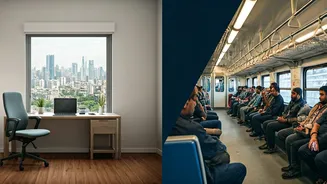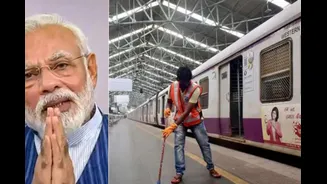



Every Mumbaikar sitting in a Virar-to-Churchgate local at 8:47 am has fantasised about it: what if half the city just… stayed home? PM Modi’s appeal for work-from-home amid the West Asia crisis has handed
that fantasy a policy hook. But between the fantasy and the reality sits a city of 22 million people, ₹168-per-sq-ft office rents, a Metro network still finding its feet — and an enormous number of people for whom WFH is simply not on the table.
Will It Actually Reduce Train Rush And Road Traffic?
In theory, yes. In practice, only partially. Mumbai’s suburban railway carries over 7.5 million commuters daily across 450 kilometres of track — the daily commuters alone constitute roughly 40% of Indian Railways’ total ridership.
During Covid, when WFH was mandatory rather than suggested, the suburban network saw a drop of 14.39 lakh commuters, from 76.34 lakh in FY20 to 61.95 lakh — a reduction of nearly 19%. That’s significant. But the moment restrictions lifted, numbers climbed back.
Central Railway alone carried 143.58 crore passengers in suburban trains in FY2025-26, a 1.12% increase over the previous year. Trains are getting busier, not emptier. A voluntary WFH appeal, without enforcement, is unlikely to move the needle the way a lockdown did.
What About The Roads — Specifically Ghodbunder?
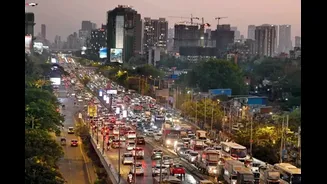
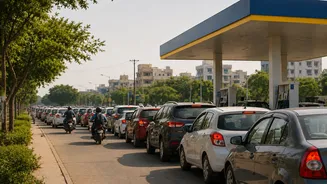
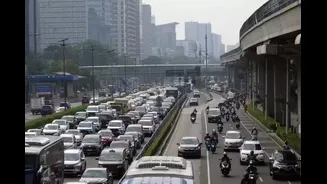
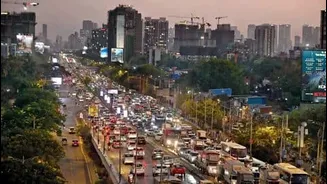
Ghodbunder Road, the lifeline connecting Thane’s western belt to the rest of Mumbai, has been a recurring nightmare for commuters in Thane, Kasarvadavali, Waghbil, and Hiranandani Estate. Throughout 2025, Ghodbunder Road repeatedly made headlines as commuters complained of hours-long jams, joining BKC, Western Express Highway, JVLR, and Dadar as some of MMR’s biggest traffic hotspots.
Even temporary road closures for repair work caused journeys of 10-20 minutes to stretch beyond an hour. Could WFH fix this? Partially.
Traffic modelling from the Covid period suggests that removing 20-25% of peak-hour vehicles from a saturated corridor can improve flow disproportionately — sometimes cutting travel times by 40% or more because congestion is non-linear.
The problem is that Ghodbunder’s bottleneck isn’t just volume; the stretch from Gaimukh to Fountain Hotel Junction is structurally a four-lane bottleneck connecting wide Thane city and national highway segments, with heavy vehicles further compounding the slowdown. WFH reduces cars. It doesn’t fix the road.
Then What About Mumbai Metro — Isn’t The Government Building It At Pace?
Yes, and this is where the timing creates an awkward tension. Mumbai’s metro network now spans over 101 km of operational lines as of April 2026, with the Aqua Line (Line 3) fully operational from Cuffe Parade to Aarey JVLR — the city’s first major north-south underground transit link.
Four more metro lines are expected to open in phases through 2026, including Line 4 and 4A connecting Mumbai and Thane, and Line 6 along the Jogeshwari-Vikhroli Link Road.
By end of 2026, Mumbai Metro expects to handle over 50 lakh daily passengers — significantly easing the load on the suburban railway. The government has spent lakhs of crore building this network.
Nudging people back to staying home, right when that infrastructure is ready to absorb commuters, is somewhat contradictory.
In 2026, ridership on some newly opened corridors, especially the Aqua Line, already remained below expectations, with last-mile connectivity gaps and fare differentials cited as factors. WFH will not help fill those trains.
Who Loses Money If WFH Becomes Serious?
Quite a few people. On the commercial side, Mumbai has become India’s most expensive office market. Office rentals in the Mumbai Metropolitan Region jumped 28% in three years — from ₹131 per sq ft in 2022 to ₹168 in 2025 — driven by aggressive return-to-office trends, tight Grade A supply, and premium demand from GCCs and BFSI firms.
Grade A office spaces in CBD areas like South Mumbai and BKC command ₹24,500-30,000 per desk per month, while secondary districts like Lower Parel and Andheri Kurla Road range from ₹15,000-18,000 per desk per month.
Landlords sitting on long-term commercial leases, co-working operators, and building owners in micro-markets like Powai, Goregaon, and Malad will all feel the squeeze if tenancy utilisation drops.
On the residential side, people who moved to Thane, Navi Mumbai, or Mira Road specifically to access proximity to offices — and are paying EMIs on that bet — face a different anxiety: if offices go hybrid, does their location premium erode?
Experts say not immediately. Real estate analysts note that Modi’s WFH appeal is principally about fuel savings and foreign exchange for the duration of the current crisis, and does not fundamentally alter office demand, which always takes a long-term view.
Is Hybrid The Middle Ground?
It’s the most realistic one. The Covid experience showed that a hard binary — office or home — doesn’t work for most organisations.
A three-day office, two-day home model already operates quietly across most of Mumbai’s IT, fintech, and media companies.
Genuinely enforcing even a two-day WFH for the city’s white-collar workforce would meaningfully reduce peak-hour trains and road load while keeping offices financially viable.
Experts suggest a wider adoption of hybrid models is likely to further influence how people choose their homes and communities, with buyers increasingly seeking larger living spaces and developments that can comfortably support both living and working.
And Who Simply Cannot WFH, No Matter What PM Modi Says?
This is the piece that gets lost in every WFH conversation. A very large share of Mumbai’s workforce has no choice but to physically show up — every single day.
Construction workers, BEST bus and auto drivers, domestic help, hospital staff, retail and restaurant workers, factory labour in Thane and Bhiwandi, delivery personnel, bank tellers, police, sanitation staff, and the entire informal economy that keeps the city fed and moving.
These workers, many of whom are also the city’s heaviest local train users, are invisible in the WFH debate. For them, the choice between office and home does not exist.
Any serious WFH policy that doesn’t address their commute burden — by ensuring less crowded trains during peak hours, cheaper fares, or better last-mile options — risks making things better for laptop workers and no different, or even worse, for everyone else.
The fantasy of an empty 8:47 am Virar local is real. Getting there requires more than an appeal.