





Just days after the Central Board of Secondary Education (CBSE) faced immense heat over allegedly swapped and mismanaged Class 12 evaluation sheets, the controversy has exploded into a full-blown infrastructure
and transparency crisis.
What started as individual student complaints about low marks under the new On-Screen Marking (OSM) system has morphed into a massive tech scandal. A user on X (formerly Twitter) dropped a bombshell revelation: CBSE allegedly left their massive cloud storage database entirely unprotected, allowing absolutely anyone on the internet to view, list, and download the 2026 board exam answer sheets.
The digital whistleblowing began when user nisarga (@ni5arga) pointed out a catastrophic data security lapse on the board’s cloud network: “CBSE people didn’t configure their AWS bucket properly and now we can paginate & enumerate all their media which has 2026 answersheets & question papers. ListObjectsV2 works without any auth and the bucket root is listable too — anyone on the internet can download any scanned booklet — across institutions. Multiple institutions are using the same bucket, insanely insecure.”
CBSE people didn’t configure their AWS bucket properly and now we can paginate & enumerate all their media which has 2026 answersheets & question papers. ListObjectsV2 works without any auth and the bucket root is listable too — anyone on the internet can download any scanned… pic.twitter.com/Jy6MMyHzbP
— nisarga (@ni5arga) May 31, 2026
Internet Reacts To Shadows On Papers
With the database allegedly exposed, students and tech experts quickly began downloading and analysing the “scanned” photocopies provided by CBSE. What they found allegedly shatters the board’s official claims of using high-end, professional document scanners to digitise lakhs of answer booklets. Pointing out an embarrassing digital anomaly, class 12 student Sarthak Sidhant (@sidhant_sarthak) directly tagged the board’s official handle:
“@cbseindia29 good morning CBSE, you said you used scanners to scan these copies, now since the copies are out to the public view, do you mind explaining which copies when scanned through a scanner, have a drop shadow? and these 3 folds? did you really use scanners?”
The revelation that the national board might have simply taken casual phone pictures of critical exam papers instead of using standardised industrial scanners triggered a wave of mockery and fury on X.
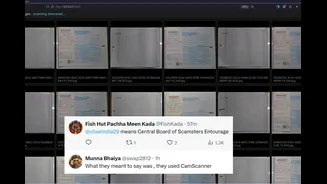
One user sharply re-christened the board’s acronym to reflect the growing distrust:“@cbseindia29 means Central Board of Scamsters Entourage”
Others quickly jumped in to joke about the bootleg methods allegedly deployed by officials to grade the futures of millions of teenagers: “What they meant to say was , they used CamScanner”
The realization of how deeply casual the process appeared left many in utter disbelief: “Omg, they took photos of every page of lakhs of answer books instead of scanning!”
Commenters pointed out that even everyday mobile tools put the board’s official infrastructure to shame: “Cheap phone apps do a much better job than this.”
@cbseindia29 good morning CBSE, you said you used scanners to scan these copies,
now since the copies are out to the public view, do you mind explaining
which copies when scanned through a scanner, have a drop shadow? and these 3 folds?
did you really use scanners? pic.twitter.com/GF2I9FiKLh
— Sarthak Sidhant (@sidhant_sarthak) May 31, 2026
A Compromised System?
As the tweets went viral, tech-conscious students pointed out that the presence of page curves, shadows, and creases proves that no professional scanning software was ever utilised.
“Welp looks like they didn’t even use those book stand scanners, because those have software present to clean up all these irregularities and create a flat document.”
Beyond the bad optics of a poor scanning job, families are stepping forward to allege that this cost-cutting, highly irregular process has actively ruined student scores. Many believe the entire bidding and evaluation process was compromised to maximise profit margins.
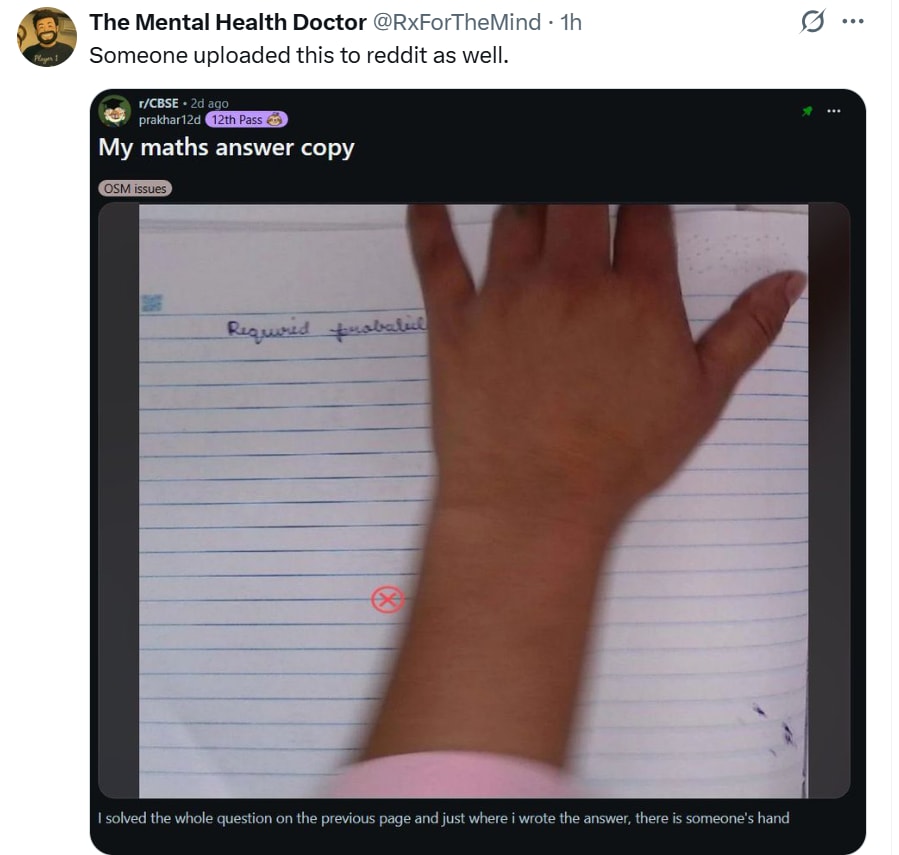
“I think they have used a mobile cam scanners or taken photo.or by any tab so that they can cut scanning cost and can make more profit….so they have signed tender at minm rate🤷🏼♀️☺️whole system was compromised🤔”
The digital footprint left behind by this chaotic scanning process has also revealed alarming discrepancies inside the booklets themselves. One user shared a deeply troubling anecdote about a family member who found foreign handwriting inside their official verified copy.
“You’re right, one of my cousins applied for a scanned photocopy. On the last page of the copy, a name was written in blue ink, which is abnormal. He even emailed CBSE, but no response till now. I tried to contact CBSE, the number was busy and no response”