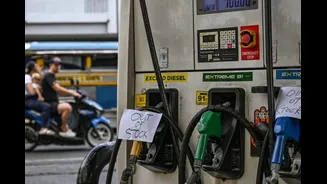









Brent crude surged to $120 per barrel, triggering a global energy crisis and sending governments scrambling amid the ongoing conflict in West Asia.
Experts said the global economy is facing its most significant
threat since the 1970s as energy markets face a massive supply shock due to the escalating war in the Gulf, where both Iran and US-Israel targeted major oil infrastructure over the past three days.
According to reports, benchmark Brent crude has surged past $118 per barrel with some intraday trading sessions seeing prices spike dangerously close to the $120 mark. This is primarily driven by the effective closure of the Strait of Hormuz, a vital maritime artery through which approximately 20 percent of the world’s total petroleum and LNG (liquefied natural gas) flows daily.
Follow US-Israel-Iran War News LIVE Updates Here
With the Islamic Revolutionary Guard Corps (IRGC) claiming control over the strait and threatening ships attempting to pass, there has been a near-total halt of tankers carrying oil from major producers like Saudi Arabia, Iraq, and Kuwait. This has threatened global economic stability, resulting in a surge in “imported inflation” as fuel costs cascade through industrial supply chains.
Experts said every 10 percent rise in oil prices typically adds 0.4 percent to global inflation, and sustained high prices could slash global GDP growth by up to 0.25 percent. As financial markets in Asia and Europe plunge, governments are desperately seeking ways to insulate themselves from the crippling energy costs.
Follow Dubai, Abu Dhabi, UAE, News LIVE Updates Here
WHAT IS GOING ON IN ASIA?
Asian countries, which are the most exposed to the crisis due to their extreme reliance on hydrocarbons from West Asia, have been the first to implement drastic emergency measures to shield their economies.
Japan, South Korea
Japan and South Korea, which import 95% and 70% of their oil from West Asia are the most impacted in Asia.
In South Korea, President Lee Jae Myung has announced the introduction of fuel price caps for the first time in nearly 30 years to alleviate the burden on the manufacturing-heavy economy.
“We should swiftly introduce and decisively implement a price ceiling system for petroleum products that have recently seen excessive price increases,” Lee said during a recent cabinet meeting.
Similarly, Japan has instructed its domestic oil reserve bases to prepare for possible releases to protect refiners from prolonged disruptions noting that it holds reserves equivalent to 254 days of consumption.
Vietnam, Philippines
Vietnam is moving to slash import tariffs to zero on various petroleum products, including unleaded gasoline and diesel, to stabilise its domestic market.
In the Philippines, the government has adopted a four-day working week for civil servants to reduce fuel consumption, while President Ferdinand Marcos has ordered a mandatory 10 to 20 percent reduction in electricity and fuel use across all state agencies.
China, Thailand
China, the world’s second-largest economy, has reportedly asked its major refiners to suspend exports of diesel and gasoline to prioritise domestic needs. Thailand has halted its own oil exports despite securing two months of supply.
Myanmar, Bangladesh
In more fragile economies like Myanmar and Bangladesh, the measures are even more severe.
Myanmar has begun rationing fuel based on vehicle licence plate numbers, while Bangladesh has taken the step of shutting universities to conserve electricity and fuel.