





Nvidia has delivered a record-breaking quarterly performance, with revenue more than doubling to $115.8 billion, even as the world’s most valuable chipmaker grapples with one of the biggest leadership
upheavals in its 33-year history. Its co-founder and longtime CEO Jensen Huang has resigned after his extra-marital affair became public, the board has ruled out bringing him back, and the company is now preparing to move ahead under interim chief executive Colette Kress.
Nvidia is at the centre of a global artificial intelligence boom, supplying the processors that power some of the world’s most advanced AI systems. But the man who built the company into a technology powerhouse is no longer at its helm. Can Nvidia’s business continue growing at the same pace without its most recognisable leader?
The company’s latest earnings offer an indication of the strength of its underlying business. Nvidia reported a revenue of $115.8 billion for the third quarter of fiscal 2027, which ended October 25, marking a 103 per cent increase from the same period last year. The figure exceeded Wall Street’s expectations of around $109.3 billion. Its adjusted earnings stood at $2.68 per share, against analysts’ estimates of $2.47.
More importantly, Nvidia expects fourth-quarter revenue of $130 billion, plus or minus 3 per cent, significantly above the average analyst estimate of $125.3 billion. The company also raised its projected revenue growth for fiscal 2028 to 75 per cent, from an earlier estimate of 70 per cent.
The numbers suggest that demand for AI computing infrastructure remains strong, even as questions grow around the company’s leadership and the sustainability of the broader AI investment boom.
The biggest contributor to Nvidia’s earnings is its data centre business, which generated $107.6 billion in the third quarter, more than doubling from a year earlier. The division accounted for nearly 93 per cent of the company’s total revenue.
Jensen Huang’s Exit
Huang was closely associated with almost every major strategic decision that transformed Nvidia. Founded in 1993 by Huang, Chris Malachowsky and Curtis Priem, the company initially focused on graphics processors for gaming and personal computers. Huang’s decision to push GPU technology into scientific computing and artificial intelligence helped open up an entirely new market.
He also became the public face of the AI industry, travelling extensively to meet customers, technology leaders, suppliers and governments. His hands-on approach extended to Nvidia’s business partnerships and investments in companies involved in building AI infrastructure.
Nvidia announced on November 12 that Huang had resigned as president, CEO and a member of its board, with immediate effect. The company appointed its longtime chief financial officer Colette Kress as interim CEO and said it would consider both internal and external candidates for the permanent position. The board also appointed Harvey C Jones as its first-ever chairman.
The circumstances surrounding Huang’s exit have added to the uncertainty. Reports of personal relationships, including one involving a woman allegedly suspected of having links to Chinese intelligence, triggered scrutiny. Nvidia said it was examining whether Huang had been the target of a foreign intelligence effort. The allegations remain subject to investigation.
In a public statement ahead of the earnings announcement, Huang acknowledged that he had made a serious personal mistake and said he would cooperate with the board’s investigation. He also indicated that he was willing to return if the board believed it was in the company’s best interests.
However, the board has made its position clear. Speaking during the November 17 earnings call, chairman Harvey Jones said, “The Nvidia board does not intend to reinstate Jensen as CEO.” He added that the board had unanimously accepted Huang’s resignation.
The decision effectively closes the door on an immediate comeback, despite public support for Huang from some influential technology figures and investors. US President Donald Trump had also indicated that bringing Huang back would not be a bad idea.
Investment firms Altimeter Capital Management and Atreides Management urged the board to take a “slow, measured, and deliberate” approach to choosing the next chief executive, citing the extraordinary success of Huang’s leadership and the uncertainty created by his departure.
The Task Ahead For Colette Kress
The responsibility of steering the company now rests with Kress, who has been Nvidia’s CFO since September 2013. She joined the company after holding senior finance positions at Texas Instruments, Microsoft and Cisco, bringing nearly 25 years of experience in the technology sector. During her time at Nvidia, the company’s annual revenue expanded from $4.13 billion in fiscal 2014 to $215.9 billion in fiscal 2026.
Kress is familiar with Nvidia’s financial operations, customers and investment strategy. She has also been involved in financing arrangements with companies that purchase Nvidia’s chips and use them to provide computing services to other businesses.
Such arrangements, sometimes described as circular financing, have attracted attention because of the financial risks they could create. For instance, Nvidia holds a nearly 13 per cent stake in CoreWeave, a cloud computing company that buys Nvidia processors and rents computing capacity to AI developers.
Her immediate priority is to reassure customers and investors that the leadership transition will not disrupt the company’s operations. “It’s business as usual,” Kress said during the earnings call. “We’ve engaged with our customers. We’ve engaged with our suppliers, our partners. They’re all 100% behind us.”
In its November 12 announcement, Nvidia had also emphasised that the board had “full confidence” in Kress and its existing leadership team, adding that operations, customer commitments and the product roadmap were expected to continue without interruption.
China, Chip Restrictions And The Next Big Challenge
The new leadership will also have to navigate an increasingly complicated geopolitical environment. Nvidia’s advanced AI chips have become a major point of contention between Washington and Beijing. The United States has imposed restrictions on the export of high-performance processors to China over concerns that the technology could strengthen China’s military and artificial intelligence capabilities.
During its latest earnings update, Nvidia indicated that its revenue forecast did not assume any data centre chip sales to China. The company also said it would no longer ship its licensed Hopper data centre products to the country, despite having been permitted to sell certain versions under US export rules.
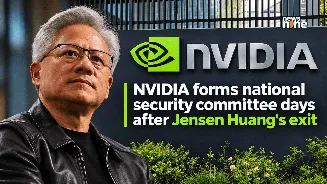
The board has responded by establishing a dedicated national security and export control oversight committee, a significant governance move following Huang’s departure.
Competition is another challenge. AMD is expanding its AI chip business, while Google, Amazon and other technology companies are developing their own processors to reduce dependence on Nvidia. The company will need to maintain its technological lead while ensuring that its next-generation products meet the rapidly growing requirements of AI developers.
There are also concerns about the scale of its financial commitments. According to a Bloomberg report, Nvidia’s spending commitments have risen to $518 billion, compared with $366 billion three months earlier. Its gross margin is expected to be around 71.5 per cent in the current quarter, down from nearly 75 per cent three months ago.
Nvidia Bigger Than Jensen Huang
For investors, the latest earnings have provided some reassurance that Nvidia’s growth story remains intact. Reuters quoted David Wagner, head of equity and portfolio manager at Aptus Capital Advisors, as saying that the quarterly performance reinforced the view that “the franchise is intact and demand hasn’t moved”.
But the leadership question remains unresolved. Reuters quoted James St Aubin, chief investment officer at Ocean Park Asset Management, raising an important question about Huang’s role: Was he “the critical cog in the machine or just a great conductor of an orchestra”?
That may ultimately determine how the transition is judged. Nvidia has a strong technology portfolio, an established customer base, a vast developer ecosystem and billions of dollars in revenue. These are advantages that do not disappear overnight with the departure of a CEO.
However, Huang’s influence went beyond managing the company’s operations. He helped shape the AI industry’s investment priorities, built relationships across the supply chain and persuaded businesses to commit enormous resources to AI infrastructure.
Nvidia’s next chief executive will have to preserve that momentum while building confidence in a company entering a new chapter. For now, the $115.8-billion quarter shows that the AI business is still booming. The bigger test is whether Nvidia can prove that its future is not dependent on the man who built its past.