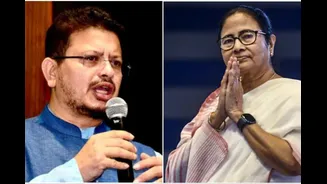








The dramatic rebellion within the Trinamool Congress (TMC) has triggered an unprecedented constitutional and political debate in West Bengal – can an MLA expelled from a party effectively take control
of its legislature wing?
The question gained urgency on Wednesday after 58 dissident TMC MLAs backed expelled leader Ritabrata Banerjee as the leader of the legislature party and secured recognition from Assembly Speaker Rathindra Bose, marking the first split in the party’s 28-year history.
While the Mamata Banerjee camp continues to control the organisational structure of the party, the rebels have claimed legitimacy through their numerical strength in the Assembly, setting the stage for a legal and political battle over who represents the “real” TMC.
WHAT HAPPENED?
According to news agency PTI, the dissident camp led by Ritabrata Banerjee and fellow expelled MLA Sandipan Saha submitted letters of support from 58 legislators to the Speaker, comfortably crossing the two-thirds threshold required under the anti-defection law.
With the TMC holding 80 seats in the Assembly, the required number stands at 54.
The rebels subsequently elected Ritabrata Banerjee as Leader of Opposition and appointed a new leadership structure for the legislature party.
The Speaker accepted their claim, effectively recognising the breakaway group within the Assembly.
Significantly, the dissidents have stopped short of challenging Mamata Banerjee’s position as party chairperson.
Instead, they have targeted the influence of the party’s national general secretary Abhishek Banerjee, saying they continue to accept Mamata Banerjee as their leader but not her nephew’s authority over legislative affairs.
DOES EXPULSION AUTOMATICALLY DISQUALIFY AN MLA?
No. Under India’s constitutional framework, expulsion from a political party does not automatically result in disqualification from the legislature.
The Supreme Court and election law experts have repeatedly held that an MLA’s membership of the House comes from being elected by voters, not from continued membership of a political party.
An expelled legislator remains an MLA unless disqualified under the Tenth Schedule of the Constitution, commonly known as the anti-defection law.
This distinction has become crucial in the current TMC crisis because Ritabrata Banerjee’s expulsion from the party does not automatically strip him of his legislative rights.
WHAT DOES THE ANTI-DEFECTION LAW SAY?
The anti-defection law underwent a major change through the 91st Constitutional Amendment in 2003.
Before the amendment, legislators could claim protection through a “split” if one-third of lawmakers broke away from a party. That provision was abolished.
Today, only a “merger” involving at least two-thirds of a legislative party receives protection from disqualification.
The TMC rebels argue they have crossed this threshold by securing support from 58 MLAs out of 80.
According to PTI, the dissident camp relied on this provision while seeking recognition from the Speaker.
However, legal experts note that crossing the two-thirds mark alone does not automatically grant ownership of the parent political party.
LEGISLATURE PARTY VS POLITICAL PARTY
This is perhaps the most important distinction in the ongoing crisis.
A legislative party consists of elected MLAs inside the Assembly.
A political party, on the other hand, includes its organisational structure, office-bearers, workers, constitution, finances and election symbol.
The rebels currently claim dominance over the legislature party because they command the support of a majority of TMC MLAs.
The Mamata Banerjee camp, meanwhile, continues to control the party organisation and has responded by dissolving all committees and frontal organisations across West Bengal before beginning a restructuring exercise.
WHAT DO PREVIOUS CASES TELL US?
Political observers have drawn comparisons with the Shiv Sena split led by Eknath Shinde in 2022 and the Nationalist Congress Party split led by Ajit Pawar in 2023.
In both cases, rebel factions initially established dominance within the legislature party by securing support from a majority of MLAs.
The dispute later moved beyond the legislature and reached the Election Commission of India (ECI), which had to determine which faction represented the “real” political party.
In the NCP case, the Election Commission ultimately recognised Ajit Pawar’s faction as the real NCP and allotted it the party’s name and symbol, citing support within both the organisational and legislative wings, according to publicly available ECI orders and court proceedings.
The Shiv Sena case similarly evolved into a prolonged battle involving the Speaker, Election Commission and the Supreme Court.
CAN THE REBELS NOW CLAIM THE TMC SYMBOL?
Not immediately. Recognition as a legislative party inside the Assembly is separate from recognition as the official political party before the Election Commission.
For the rebels to secure control over the TMC’s election symbol and party name, they would likely need to establish before the Election Commission that they represent the authentic party organisation under the party constitution and relevant provisions of the Election Symbols (Reservation and Allotment) Order.
At present, the Mamata Banerjee faction continues to control the organisational apparatus of the TMC.
WHAT HAPPENS NEXT?
The crisis threatens to create two parallel centres of authority within the TMC.
One faction, led by Mamata Banerjee, controls the party machinery, organisation and political brand.
The other, led by Ritabrata Banerjee, claims legitimacy through legislative numbers and Speaker recognition.
The coming weeks could see challenges before the Assembly Speaker, the Election Commission and possibly the courts, depending on whether either side seeks a formal determination over control of the party.
For now, the rebels appear to have established dominance within the legislature party.
But whether an expelled MLA can ultimately take over the TMC as a political party is a far more complex question, one that may ultimately be decided not by numbers alone, but by constitutional institutions and electoral law.