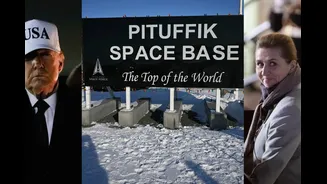









US President Donald Trump has repeatedly asserted that he wants the United States to gain control of Greenland. On Wednesday, Trump said, “We need Greenland for national security. If we don’t go in, Russia
is gonna go in and China is gonna go in, and there’s not a thing that Denmark can do about it — but we can do everything about it.”
US and Denmark are now in talks to reach a consensus over how the US can alley fears of a threat, even as Trump continues to insist he wants nothing short of “full control” of Greenland. With Greenland making headlines, is it really possible for the US to completely take over the island nation? What is this threat that the US is citing to justify its demands for a complete control of Greenland? Let’s delve deep into Greenland’s current administrative authority, its sovereign control and more importantly, its geography.
Who Holds What Authority Over Greenland?
Greenland is an autonomous territory within the Kingdom of Denmark. It is not an independent country, but it is also not a Danish colony.
Greenland has it’s own internal governance through its own parliament (Inatsisartut) and government (Naalakkersuisut). This governance controls: education, healthcare, policing and justice, natural resources (including mining and hydrocarbons), fisheries, environment, and local taxation, social welfare and local economic policy.
Denmark, on the other hand, controls foreign policy and diplomacy, defence and security, monetary policy and currency, citizenship, Supreme Court jurisdiction (in limited cases).
Denmark also provides an annual block grant (about €500 million), which still forms a significant part of Greenland’s budget.
Greenland is not a member of the European Union as it left the EEC in 1985 after gaining home rule. It can sign some international agreements in areas under its own jurisdiction, but Denmark represents it internationally on core sovereign matters.
The United States maintains a military presence (Thule/Pituffik Space Base) under agreements with Denmark, not directly with Greenland.
What Is Greenland’s Path To Independence?
Under the 2009 Self-Government Act, Greenland has the legal right to declare independence following a referendum. Full independence would require assuming responsibility for defence, foreign policy, and replacing Danish financial support. While Independence is legally possible, it is not yet exercised.
What Does Trump Want To Do?
Donald Trump has stressed that he wants the United States to gain control of Greenland. His publicly stated reasons include:
1. Strategic and national-security claims: Trump says Greenland is crucial for US national security, especially to counter what he frames as the rising influence of Russia and China in the Arctic. He argues the US must control it to prevent them from doing so.
2. ‘Ownership’, not just access: Trump frames this as owning Greenland outright — not just maintaining military access — arguing that owning a territory is better for defence than leases or agreements.
He has said the US will act “whether they like it or not” and suggested doing it the “easy way” (negotiated) or the “hard way” (implying force or stronger pressure).
3. Exploring options including purchase or pressure: There have been reports that Trump officials discussed economic incentives (e.g., potential payments to Greenlanders) to encourage independence from Denmark and eventual US alignment.
Trump has appointed a special US envoy to Greenland with a mission described by critics as working to make Greenland part of the US, which Denmark condemned.
Trump has reiterated that the US must have Greenland, hinting that diplomacy could give way to other measures if a deal can’t be reached with Denmark.
In some statements, he has refused to rule out military force as a means to secure Greenland — though specifics on such plans remain unverified.
Denmark and Greenland’s response
Greenland’s government and political parties have strongly rejected US takeover ideas and reaffirmed their desire to remain part of the Kingdom of Denmark and decide their future themselves.
Denmark — a NATO ally — has warned that any attempt by the US to force Greenland away from Danish sovereignty could severely damage NATO relations.
European partners (e.g., Germany, Norway, Sweden) have increased military cooperation in Greenland to reassure Denmark and deter unilateral moves.
Why Is Greenland Strategic For The US?
The US insistence on Greenland is driven less by economics and more by hard geography and military physics. In simple terms, Greenland sits at the choke-point of America’s northern defences.
Here’s why it matters so much to Washington:
1. Greenland sits on the shortest attack route to the US. On a globe, not a flat map, the shortest path between Russia and the United States runs over the Arctic — directly past Greenland. Russian intercontinental ballistic missiles (ICBMs) aimed at the US East Coast would travel over or near Greenland. The same is true for hypersonic glide vehicles, which fly lower and faster than traditional missiles. This makes Greenland a front-row observation post for detecting attacks early.
Whoever controls Greenland controls early warning time — measured in minutes that decide retaliation and survival.
2. Cornerstone of US missile-warning and space defence
The US already operates Pituffik Space Base (formerly Thule Air Base) in northwest Greenland.
From there, the US:
- Tracks ballistic missile launches
- Monitors space objects and satellites
- Feeds data into NORAD (North American Aerospace Defense Command)
If a hostile power gained influence over Greenland:
- US early-warning systems could be degraded, blinded, or surveilled
- Space-tracking assets could be compromised
For US planners, losing Greenland is equivalent to poking a hole in America’s missile shield.
3. Control of the GIUK gap (naval choke point)
Greenland forms part of the GIUK Gap — Greenland–Iceland–United Kingdom
This is a critical maritime corridor where Russian submarines must pass to enter the Atlantic. This is where NATO tracks and contains Russian naval movements.
During the Cold War, the GIUK gap was the main line preventing Soviet submarines from threatening the US East Coast.
That logic still holds today, especially with nuclear-armed submarines and hypersonic cruise missiles launched from sea.
Greenland is the northern anchor of Atlantic naval containment.
4. Arctic ice melt is turning Greenland into a gateway, not a barrier
Climate change is transforming the Arctic from a frozen shield into a new strategic highway.
As ice retreats, new shipping routes open between Asia, Europe, and North America. Simultaneously, Russia is militarising its Arctic coast and China calls itself a “near-Arctic state” and has been seeking access.
Greenland sits astride Arctic air routes, future sea lanes and undersea communication cables.
The US sees Greenland as the key terrain of the next great-power competition, not a remote island.
5. Preventing Chinese and Russian footholds
The US fear is not Denmark — it is strategic vacuum.
Washington worries that China could gain leverage via infrastructure, ports, mining, or telecom projects. It also fears Russia could expand intelligence and naval reach and even civilian projects can have dual-use military value
That is precisedly why Trump says, “If we don’t anchor Greenland firmly in the Western security system, someone else will.”
6. Geography that cannot be replaced
Unlike bases elsewhere, Greenland’s position cannot be replicated on the map. While Alaska covers the Pacific side, Greenland covers the North Atlantic and Arctic approach. It is a once-on-the-map location, not an optional outpost.
This is why US strategists see Greenland not as a foreign territory — but as part of America’s defensive perimeter.