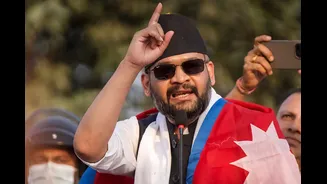








Last year, Gen-Z protests triggered political change in Nepal and led to the resignation of former Prime Minister KP Sharma Oli. A new wave of youth anger has emerged against the government of Prime Minister Balendra
“Balen” Shah.
Shah, who rose to power on the back of strong youth support after his Rastriya Swatantra Party (RSP) won a near two-thirds majority in the House of Representatives, is now facing criticism over his government’s policies, particularly after the death of a 25-year-old ride-hailing driver who allegedly died by self-immolation following a confrontation with municipal police.
Hundreds of young protesters took to the streets on Sunday outside the Singhdurbar Secretariat, a key government office in Kathmandu, demanding accountability and action from the government.
The Balendra Shah-led government, which came to power three months ago, has introduced strict traffic regulations and proposed higher fines for traffic violations. The measures have drawn sharp criticism on social media, with many questioning the government’s approach.
Death Of Ride-Hailing Driver Sparks Anger
The latest protests were triggered by the death of Ganesh Nepali, a 25-year-old man who worked as a driver for ride-hailing platform Pathao.
Nepali allegedly attempted self-immolation outside the Department of Passports office in Kathmandu on Thursday after police locked the wheel of his parked motorcycle over an alleged parking violation.
According to reports, Nepali had parked his motorcycle outside the Department of Passports in Tripureshwar while waiting for his next booking. Police and CCTV footage showed municipal police asking him to move the bike. Following an argument, authorities immobilised the motorcycle with a wheel lock.
Police said Nepali argued with officers for nearly two hours over the 1,000 Nepali rupee parking fine before he allegedly took petrol from his motorcycle, poured it on himself and set himself on fire.
Police personnel intervened and attempted to put out the flames, but Nepali suffered severe burn injuries. He was admitted to Bir Hospital, where he later died.
Protests Demand Justice, Probe Into Incident
Following Nepali’s death, his family, friends and supporters gathered outside Bir Hospital on Saturday, demanding justice.
The protesters accused the state machinery of being insensitive towards the struggles of poor and working-class citizens and demanded an impartial and independent investigation into the incident.
The anger over Nepali’s death led to the Kathmandu Metropolitan City and Nepali’s family reaching a nine-point agreement on Sunday. Under the agreement, an independent probe committee will be formed, while personnel involved in the incident will be suspended during the investigation.
The Nepal government has also constituted a five-member probe committee headed by Deputy Inspector General of Police Govinda Thapaliya to investigate the circumstances surrounding the rider’s self-immolation.
Political Opposition Targets Government
The incident has also drawn criticism from political leaders, with opposition lawmakers accusing the government of adopting a harsh approach towards citizens.
Speaking in the National Assembly, Nepali Communist Party lawmaker Bishnu Bahadur Bishwakarma blamed the government’s approach for the tragedy.
“This cruel government, which compelled a citizen to commit suicide, has no right to remain in power,” he said.
In the House of Representatives, Nepali Congress chief whip Basana Thapa said, “The government has failed to protect the lives of its citizens.”
The protests mark a major challenge for the Balen Shah government, which had earlier gained popularity among young voters following the Gen-Z-led political movement that reshaped Nepal’s political landscape.