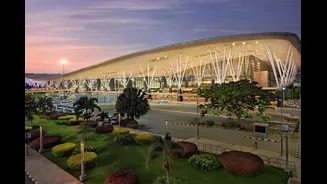

Anyone who has rushed through Kempegowda International Airport with a boarding pass in one hand and luggage in the other knows the feeling. You clear security, check your gate, and then realise your flight
is from the other terminal. The next few minutes are spent hunting for the shuttle bus, checking your watch, and hoping traffic inside the airport roads behaves.
That small but stressful part of the journey may soon become history.
Passengers at Bengaluru’s airport are set to get a major upgrade in how they move between terminals, with plans underway to introduce an automated people mover system. It promises quicker transfers, smoother rides and one less reason to panic when connections are tight.
What exactly is coming to KIA
Bangalore International Airport Limited has taken the first official step toward this change by inviting bids for design consultancy services for the automated people mover, often called an APM. This marks the beginning of a project that could transform everyday airport movement for millions of travellers.
An APM is a fully driverless, rail-based transit system designed for short-distance, high-frequency travel. Unlike buses, these systems run on dedicated tracks, move at fixed intervals and do not depend on road traffic or human drivers. Around the world, they are a familiar sight at major airports, quietly ferrying passengers between terminals with clockwork efficiency.
Why this matters for Bengaluru flyers
Right now, passengers at Kempegowda International Airport rely on electric shuttle buses to move between Terminal 1 and Terminal 2. While they do the job, they often come with waiting times, congestion during peak hours and the occasional confusion about stops.
With international traffic growing and Terminal 2 adding to the airport’s footprint, inter-terminal movement has become a bigger part of the travel experience. A missed shuttle or a delayed transfer can easily mean a missed flight.
The automated people mover aims to remove that uncertainty. Once operational, it will offer predictable travel times, smoother rides and a far more seamless connection between terminals.
A first for Indian airports
Plans for this system were first revealed in December 2023. When implemented, it will make Bengaluru the first airport in India to introduce an automated, rail-based inter-terminal transit system.
Globally, such systems are already standard at airports in the United States, China, Malaysia and Singapore. For frequent international travellers, they are part of what makes large airports feel organised rather than overwhelming. Bengaluru now looks ready to join that league.
For a city that sees itself as forward-looking, this move is more than just infrastructure. It is about setting a new benchmark for airport experience in India.
Where the project stands right now
At present, the APM project is still in its tendering phase. BIAL has invited consultants to help with design and planning, but the final timeline for construction and rollout is yet to be announced.
Airport officials have said that detailed schedules will only be clear once the consultancy process is complete and feasibility assessments are finalised. In other words, the idea is firmly on track, but passengers will need to wait a little longer before seeing construction on the ground.
A luxury hotel also on the cards
Alongside the transit upgrade, another big plan is quietly taking shape within the airport campus.
BIAL’s subsidiary, Bangalore Airport Hotel Limited, has issued a request for proposals to hire consultants for a feasibility study on building an ultra-luxury hotel at the airport. The idea is to cater to premium travellers, airline crew and long-haul transit passengers who prefer staying close to the terminal rather than travelling into the city.
Like the APM, this project is still at the study stage. BIAL has declined to share timelines, stating that both initiatives are currently under evaluation. But together, they point to a clear direction, turning the airport into more than just a place to catch flights.
What travellers can expect in the future
For passengers, these developments signal a shift in how Kempegowda International Airport is evolving. The focus is no longer only on adding terminals and runways, but on improving the spaces in between.
Faster terminal transfers, better connectivity within the airport, and premium stay options all point toward a more passenger-centric future.
When the automated people mover finally begins operations, it will likely become one of those features travellers quickly take for granted. A short ride instead of a long wait. A smooth connection instead of a stressful dash.
And for anyone who has ever checked their boarding time while standing at a shuttle stop, that change cannot come soon enough.